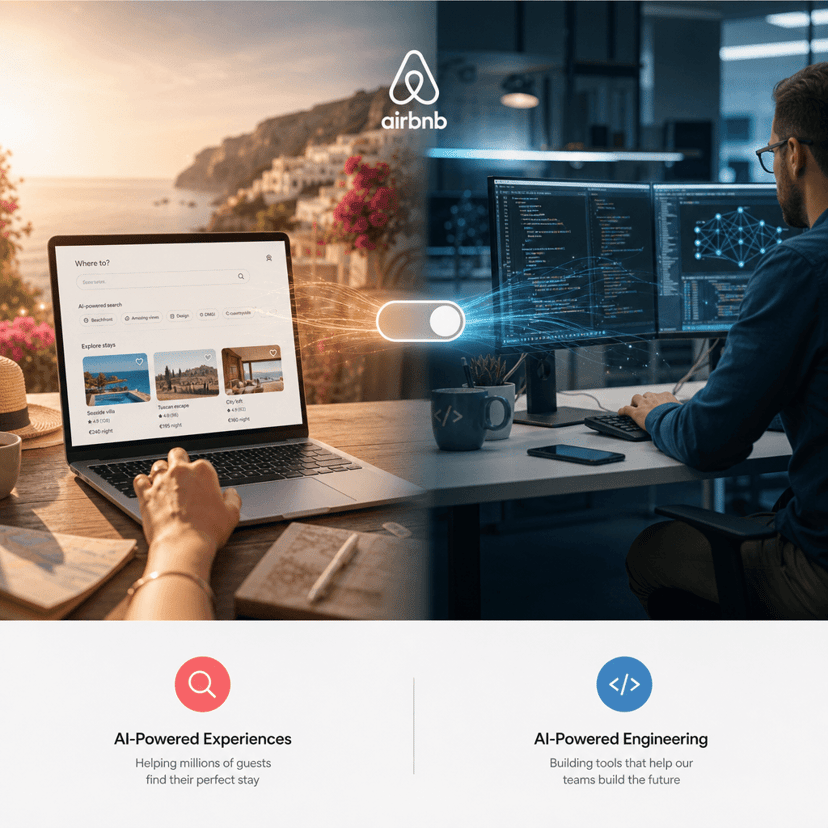
Airbnb is betting big on AI in two directions at once. The company just announced it's testing a new AI-powered search experience with a simple toggle switch, while simultaneously using AI coding tools internally to accelerate feature development. CEO Brian Chesky's dual strategy reveals how the rental giant plans to stay competitive as AI reshapes both software development and consumer expectations in travel booking.
Airbnb just gave the clearest signal yet that it's treating AI as both a product feature and an engineering accelerant. The vacation rental platform is rolling out an AI-powered search experience that users can toggle on or off, while simultaneously deploying AI coding assistants behind the scenes to help engineers ship features faster.
The timing couldn't be more critical. Travel search has become the latest battleground for AI applications, with Google integrating generative AI into travel planning and Expedia launching its own conversational booking assistant earlier this year. Airbnb CEO Brian Chesky has been vocal about AI's potential to transform how people discover stays, moving beyond simple filters toward more intuitive, conversational interactions.
What sets Airbnb's approach apart is the toggle. Rather than forcing users into an AI-first experience, the company is letting travelers choose between traditional search and the new AI-powered alternative. It's a measured bet that acknowledges not everyone wants their vacation planning mediated by large language models, while still pushing the technology forward for early adopters.
But the consumer-facing feature is only half the story. According to TechCrunch, Airbnb is also using AI to accelerate its internal engineering processes. The company has embraced AI coding tools that help developers write, debug, and ship code more efficiently - part of a broader industry trend that's seeing engineering teams boost productivity with tools like GitHub Copilot and Anthropic's Claude.
This dual strategy makes business sense. By using AI to speed up development cycles, Airbnb can iterate faster on the consumer-facing AI features that might eventually differentiate its platform. It's a compounding effect - AI tools helping engineers build better AI products.
The company's engineering culture has historically favored careful, measured rollouts over flashy launches. Chesky famously scrapped Airbnb's original AI-powered trip planning feature last year to go back to the drawing board, telling investors the team needed more time to get it right. This new search toggle suggests the company has found an approach it's comfortable testing publicly.
For Airbnb, the stakes extend beyond just keeping pace with competitors. The company's business model depends on helping travelers discover properties they might not have found through traditional search. If AI can surface better matches - understanding nuanced preferences like "quiet neighborhood but walkable to restaurants" or "family-friendly with a workspace" - it could drive both booking conversion and host satisfaction.
The toggle approach also gives Airbnb valuable data. By running traditional and AI-powered search in parallel, the company can measure exactly how much value the AI adds - which queries it handles better, where it falls short, and whether users actually prefer it. That feedback loop will be critical as Airbnb decides whether to make AI search the default experience.
Investors are watching closely. Airbnb has maintained strong margins compared to other travel platforms, partly by keeping its engineering team lean and focused. If AI coding tools genuinely boost developer productivity without sacrificing quality, it could help the company maintain that efficiency advantage even as it builds more sophisticated features.
The broader context matters too. Every major tech platform is racing to integrate AI in ways that feel useful rather than gimmicky. Meta is embedding AI assistants across Facebook and Instagram. Microsoft has baked Copilot into nearly every product. Google is reimagining search itself with AI overviews. Airbnb's challenge is making AI feel native to travel planning, not just bolted on because everyone else is doing it.
Airbnb's dual AI play - using it to both accelerate engineering and enhance search - represents a blueprint for how consumer platforms are adapting to the AI era. The toggle gives users control while letting the company learn what actually works. Meanwhile, the internal productivity gains could help Airbnb iterate faster than competitors still relying on traditional development workflows. The real test will be whether users actually prefer AI-powered search enough to keep that toggle switched on, and whether the engineering velocity gains translate to meaningful product advantages. For now, Airbnb is hedging its bets smartly, treating AI as both a tool and a product without betting the farm on either.