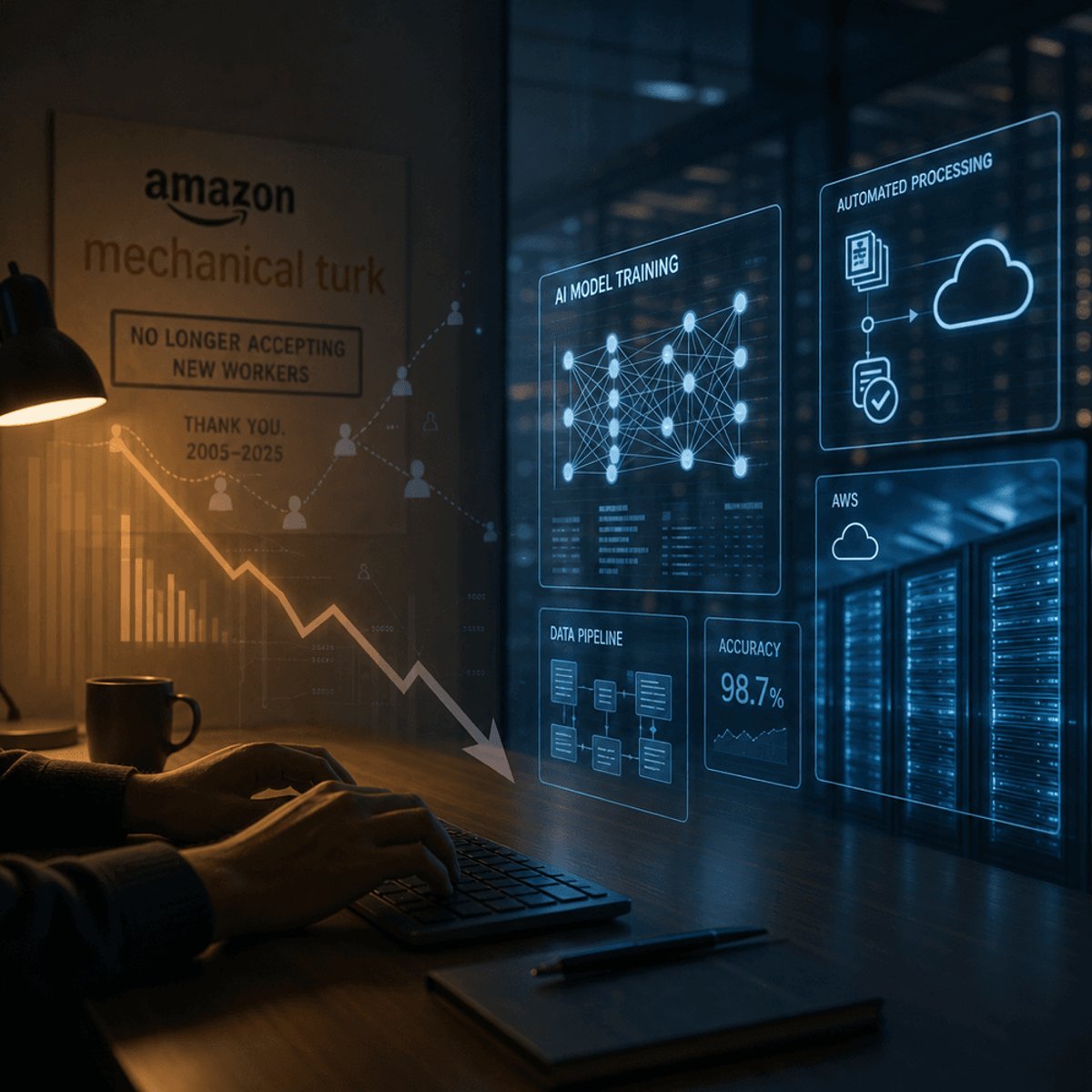
Amazon is shutting the door on its nearly two-decade-old Mechanical Turk platform, signaling the end of an era for human-powered AI training. The company announced it will no longer accept new customers for the crowdsourcing service that once helped build the foundation of modern machine learning. For the thousands of workers and businesses still using the platform, it's a stark reminder of how quickly AI automation has eclipsed the very humans who trained it.
Amazon just pulled the plug on new sign-ups for Mechanical Turk, the platform that pioneered the gig economy's role in training artificial intelligence. According to TechCrunch, the company quietly updated its website to reflect that it's no longer onboarding new customers, marking what could be the beginning of the end for a service that once seemed essential to AI development.
Launched in 2005, Mechanical Turk—named after an 18th-century chess-playing automaton that secretly housed a human operator—became the go-to platform for businesses needing human intelligence to label images, transcribe audio, and perform other micro-tasks that machines couldn't handle. At its peak, the platform employed hundreds of thousands of workers worldwide, each earning pennies per task to help train the algorithms that would eventually replace them.
But the AI landscape has shifted dramatically. OpenAI's GPT-4 and similar large language models now handle many tasks that once required human intervention, from basic data classification to complex content moderation. Synthetic data generation has exploded, with companies like Meta and Google creating vast training datasets without ever touching real human input.
Amazon Web Services, which operates Mechanical Turk, hasn't disclosed how many active customers remain on the platform or provided a timeline for complete shutdown. Existing customers can continue using the service, but the writing's on the wall. Industry insiders suggest Amazon's own AI services, including SageMaker Ground Truth, have cannibalized Mechanical Turk's core business by offering more sophisticated automated labeling with minimal human oversight.
The platform's decline mirrors broader changes in how AI companies approach training data. Where early machine learning models required millions of carefully labeled examples, modern approaches like self-supervised learning and reinforcement learning from human feedback need far fewer human annotators. Tesla's Autopilot team, once a major customer of crowdsourced labeling services, now relies primarily on automated systems and a small in-house team.
For the workers—called "Turkers" in platform parlance—the news is bittersweet. Many have spent years building reputations and workflows on the platform, earning supplemental income through repetitive but reliable micro-tasks. Online forums show mixed reactions, with some expressing relief at potentially moving away from tasks that paid as little as a few cents for several minutes of work, while others worry about losing a flexible income source.
The closure to new customers also reveals Amazon's strategic priorities. The company has poured billions into generative AI initiatives and partnered with Anthropic in a $4 billion investment. Those bets represent the future Amazon sees—AI that improves itself with minimal human intervention, not platforms dependent on global workforces clicking through image labels.
Industry analysts see this as part of a broader platform consolidation. Microsoft shut down its similar UHRS public marketplace last year, and smaller competitors like Figure Eight (formerly CrowdFlower) were acquired and absorbed into enterprise AI stacks. The human-in-the-loop model isn't dead, but it's increasingly moving in-house or being handled by specialized vendors working under strict NDA with frontier AI labs.
What remains unclear is whether Amazon will maintain Mechanical Turk indefinitely for existing customers or if this is the first step toward a full sunset. The company hasn't responded to requests for comment about long-term plans. But the pattern is familiar—Amazon has a history of quietly winding down services that no longer align with its strategic vision, from Amazon Restaurants to its physical bookstores.
Mechanical Turk's slow fade represents more than just another platform sunset—it's a milestone in AI's evolution from labor-intensive training to self-improving systems. The irony isn't lost on anyone: the humans who spent years teaching machines to see, read, and understand are now watching those same machines make their work obsolete. For Amazon, it's a practical business decision. For the broader tech industry, it's a preview of how quickly today's essential infrastructure becomes tomorrow's legacy system. The real question isn't whether Mechanical Turk will shut down completely, but what happens to the next wave of workers when the AI they're training today learns to train itself tomorrow.