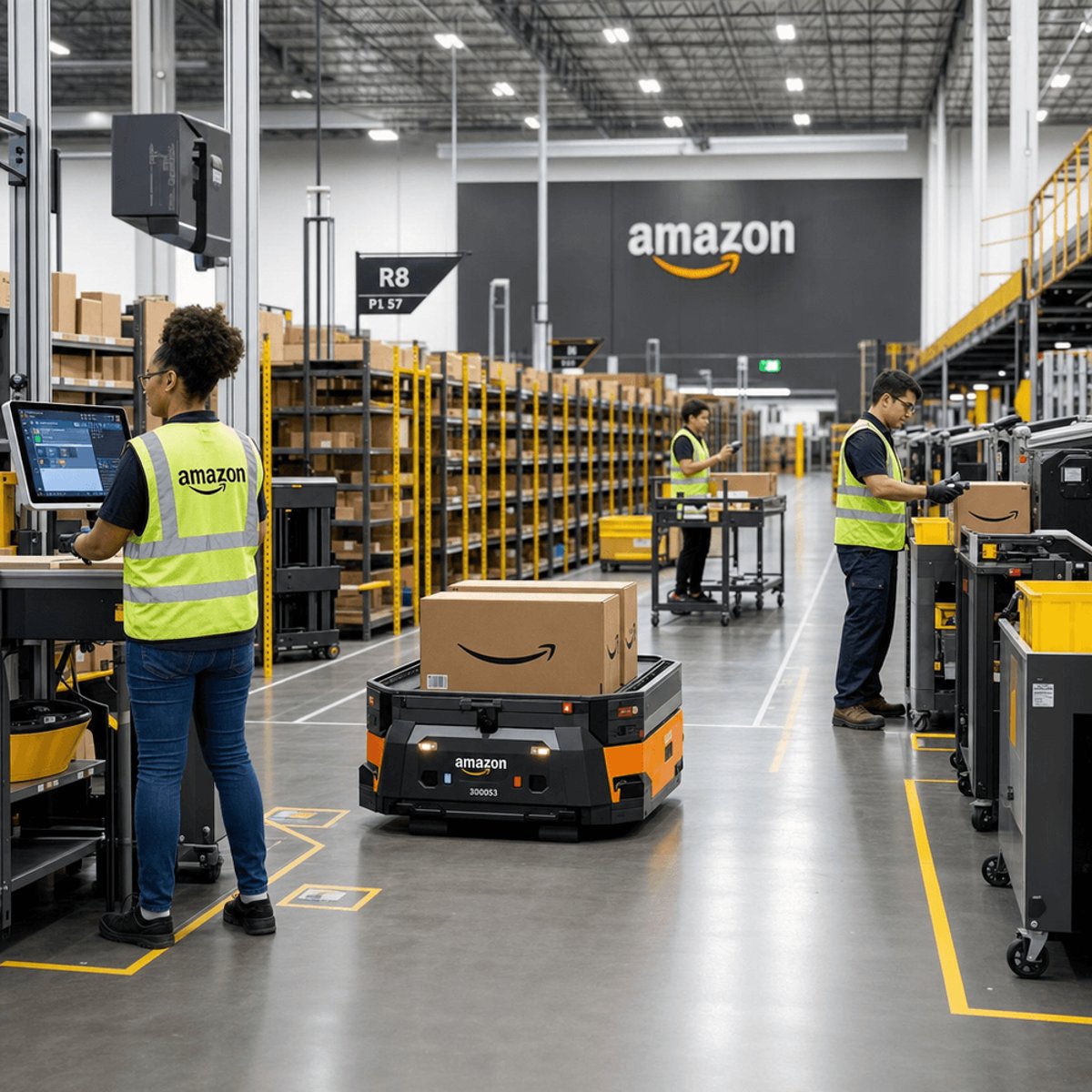
Amazon is pushing forward with its warehouse robotics expansion even as the broader tech industry continues AI-driven workforce reductions. The e-commerce giant unveiled its latest autonomous warehouse robot while defending automation's impact on jobs, with executive John Boumphrey telling CNBC that the company's experience shows robots have "actually driven up employment rather than the reverse." The announcement comes as tech giants from Google to Microsoft trim workforces amid AI transformation pressures.
Amazon is making a bold statement about the future of warehouse work. The company's latest robotics unveiling comes at a moment when the tech industry is grappling with how AI and automation will reshape employment, and Amazon's message is clear - more robots means more jobs, not fewer.
"Our experience of robots is that it's actually driven up employment rather than the reverse," Amazon executive John Boumphrey told CNBC during the announcement. It's a counterintuitive claim that flies in the face of widespread fears about automation displacing workers, but Amazon has been making this argument for years as it transforms its fulfillment network into one of the most automated logistics operations on the planet.
The timing is striking. While Amazon doubles down on robotics investment, competitors across the tech landscape are announcing workforce reductions justified by AI transformation initiatives. Microsoft has trimmed teams to focus on AI integration, Google has restructured around machine learning priorities, and even Meta continues optimizing headcount as it pivots toward artificial intelligence. Amazon's approach suggests a fundamentally different philosophy - that automation should augment human workers rather than replace them wholesale.
Amazon's robotics journey began in earnest with its 2012 acquisition of Kiva Systems for $775 million. Since then, the company has deployed over 750,000 robots across its fulfillment network, according to company disclosures. Yet warehouse employment has grown in parallel, expanding from around 125,000 workers in 2012 to over 1.5 million today. The company argues that robots handle the repetitive, physically demanding tasks while creating new roles in robot maintenance, oversight, and more complex picking operations.
But the reality on warehouse floors is more nuanced than executive talking points suggest. While total headcount has grown alongside Amazon's explosive e-commerce expansion, the productivity expectations for human workers have intensified. Robots don't eliminate jobs directly - they change the nature of work, often making it more technical but also more demanding. Workers now coordinate with machines, meet algorithm-driven performance metrics, and adapt to constantly evolving automated workflows.
The employment argument also depends heavily on continued business growth. Amazon can claim robots boost employment because the company keeps opening new facilities to meet surging demand. If growth slows, the equation changes. A highly automated warehouse requires fewer humans per package than a traditional one, which means future facilities might not generate the same job numbers that legacy operations did.
What makes Amazon's robotics push particularly significant is the company's influence across the broader logistics industry. When Amazon automates, competitors feel pressure to match that efficiency or risk losing ground. That ripple effect could reshape employment across warehousing, trucking, and last-mile delivery in ways that extend far beyond Amazon's own workforce decisions.
The contrast with AI layoffs elsewhere in tech highlights different automation strategies at play. Software companies are using AI to consolidate roles, eliminate layers, and do more with smaller teams. Amazon is using robots to increase throughput and handle volume that would be impossible manually. One approach shrinks workforces, the other transforms them. Neither is inherently better or worse - but they lead to very different outcomes for workers.
For now, Amazon continues expanding its robotics capabilities while maintaining that human workers remain central to operations. The company recently began testing humanoid robots in warehouses and continues refining autonomous mobile robots for package transport. Each advancement sparks renewed debate about where automation ends and job displacement begins.
Amazon's latest robotics announcement isn't just about new machines - it's a philosophical statement about automation's role in the future economy. While much of the tech industry treats AI as a path to workforce reduction, Amazon is betting that the right kind of automation can support employment growth, at least while business keeps expanding. The real test will come when growth inevitably slows. Whether robots truly create jobs or simply reshape them in ways that benefit companies more than workers remains the defining question as automation accelerates across industries. For the 1.5 million people working in Amazon warehouses today, the answer matters more than any executive talking point.