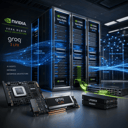
Nvidia just revealed it owns 9.3% of Nebius, the AI cloud infrastructure upstart, sending the stock surging in early trading. The disclosure comes four months after the chip giant announced a $2 billion investment in the company formerly known as Yandex's tech assets. The move signals Nvidia's aggressive push beyond silicon into the full stack of AI infrastructure, from chips to the clouds that run them.
Nvidia isn't just selling picks and shovels in the AI gold rush anymore - it's staking claims on the mines themselves. The company disclosed Tuesday it holds a 9.3% ownership position in Nebius, the AI-focused cloud infrastructure company that emerged from Yandex's restructuring, confirming what many suspected when it announced a $2 billion investment back in March.
Nebius stock rallied on the news, though the company declined to specify exact trading figures. What's clear is that investors see this as validation - when the world's most valuable chipmaker puts serious money into your infrastructure play, it's a signal the business model works.
The investment thesis makes sense when you map out Nvidia's evolving strategy. The company dominates AI chip sales, capturing an estimated 80% of the data center GPU market. But as cloud providers build their own silicon and customers hunt for alternatives to expensive H100 clusters, Nvidia's hedging its bets by moving up the stack. Owning a piece of Nebius gives it a direct window into how enterprises actually deploy AI infrastructure - and a revenue stream that doesn't depend solely on hardware margins.
Nebius isn't your typical cloud provider. The company specializes in GPU-optimized infrastructure for training large language models and running inference workloads - exactly the compute-intensive tasks that require Nvidia's high-end chips. It's essentially a symbiotic relationship: Nebius buys Nvidia hardware, Nvidia invests in Nebius's growth, and both benefit as AI spending accelerates.
But the deal creates some awkward dynamics. Amazon Web Services, Microsoft Azure, and Google Cloud are simultaneously Nvidia's biggest customers and Nebius's main competitors. Those hyperscalers already eye Nvidia warily, concerned about depending on a single supplier for critical AI infrastructure. Now that supplier is bankrolling a competitor, even if Nebius operates at a fraction of their scale.
The $2 billion commitment announced in March valued Nebius at roughly $21 billion post-investment, according to sources familiar with the terms. At 9.3% ownership, that math tracks - suggesting Nvidia's stake is worth approximately $1.95 billion at that valuation, though market fluctuations since then make the current value fluid.
Nebius CEO Arkady Volozh, who founded Yandex before spinning out its international tech assets, has been pitching the company as a neutral alternative to U.S. hyperscalers for European and emerging market customers. The Nvidia backing adds credibility to that pitch, but also ties Nebius more closely to American tech power at a time when digital sovereignty concerns are rising.
The regulatory filing doesn't detail whether Nvidia received board seats or special governance rights, though investments of this scale typically come with strategic oversight. What's certain is that Nvidia now has insider access to Nebius's customer conversations, deployment patterns, and infrastructure roadmap - intelligence that feeds directly into its chip design and go-to-market strategy.
This isn't Nvidia's first venture beyond pure hardware. The company's been building out software tools, reference architectures, and even its own cloud services through DGX Cloud partnerships. But a $2 billion equity stake represents a different level of commitment - one that blurs the line between vendor and competitor in cloud markets.
For Nebius, the Nvidia relationship provides more than capital. It ensures priority access to scarce GPU supply, a critical advantage when H100 and upcoming B200 chips remain backordered for months. It also serves as a trust signal to enterprises evaluating cloud providers - if Nvidia's betting billions on Nebius's infrastructure, it's probably production-ready.
The disclosure comes as AI infrastructure spending shows no signs of slowing. Hyperscalers are projecting another year of massive capital expenditures focused on GPU clusters and the networking to connect them. Smaller players like Nebius, CoreWeave, and Lambda Labs are racing to capture enterprises who can't access capacity from the big three or want specialized AI-native infrastructure.
What happens next depends partly on how Amazon, Microsoft, and Google react. If they accelerate their own chip development to reduce Nvidia dependence, it validates Nvidia's strategy of diversifying into cloud infrastructure. If they deepen their Nvidia partnerships to maintain performance advantages, Nebius becomes a testing ground for next-generation deployments.
Either way, the stake disclosure marks a clear strategic shift. Nvidia's no longer content being the arms dealer to cloud providers - it wants ownership of how AI infrastructure evolves. That's a bigger bet than any single chip generation.
Nvidia's disclosed 9.3% stake in Nebius represents more than a financial investment - it's a strategic repositioning for the AI era. As the chip giant watches hyperscalers develop their own silicon and customers hunt for infrastructure alternatives, owning a piece of a specialized AI cloud provider provides both a hedge and a laboratory for next-generation deployments. The move puts Nvidia in the uncomfortable position of competing with its biggest customers, but in a market growing this fast, controlling multiple layers of the stack might be worth the friction. For enterprises watching this unfold, the message is clear: the AI infrastructure wars are escalating, and the lines between chipmaker, cloud provider, and platform are dissolving faster than anyone expected.