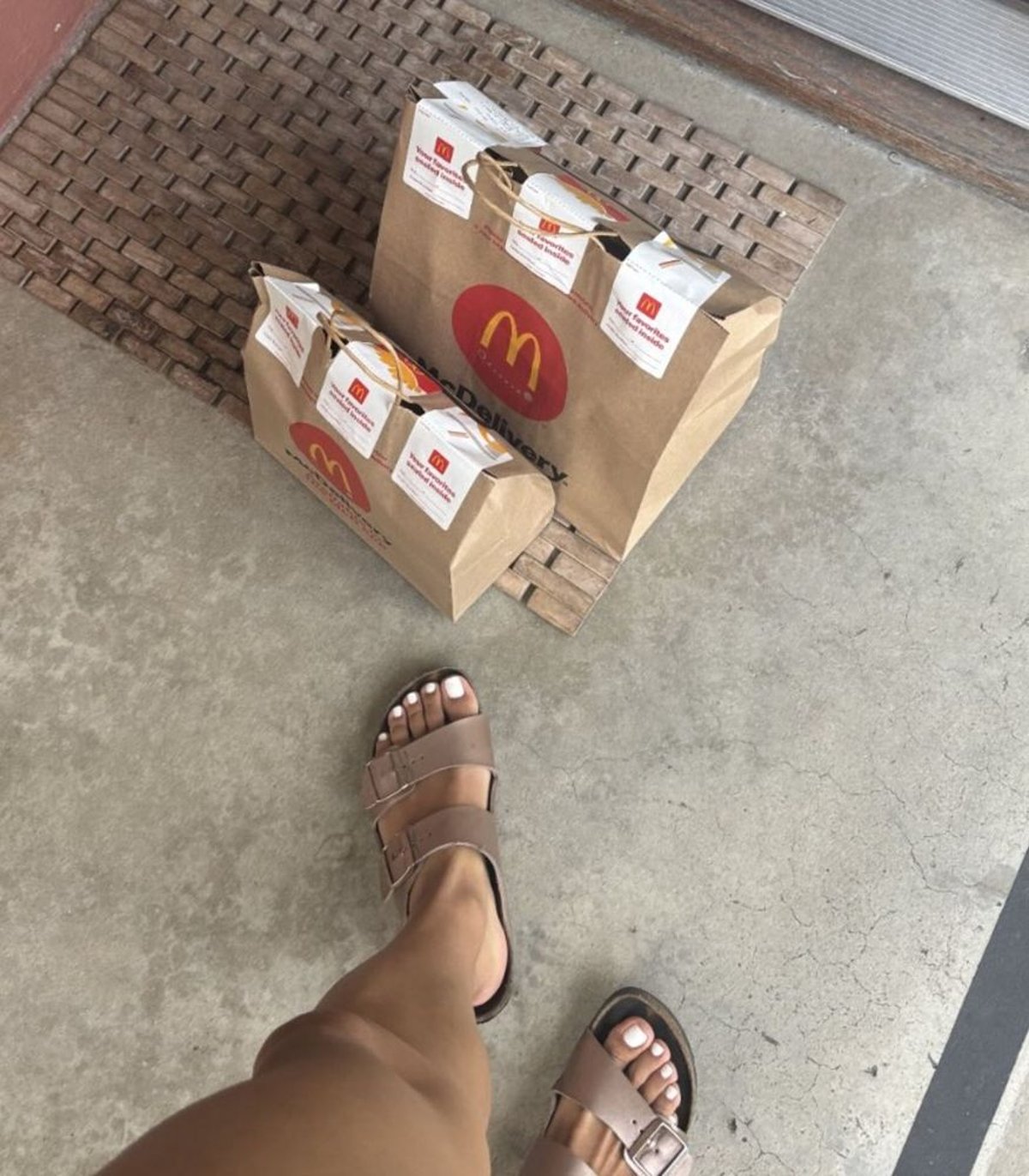
The story about a Los Angeles delivery driver boosting tips by including her feet in drop-off photos reads at first like disposable internet trivia. Yet it reveals something more structural about how tipping culture, gendered expectations, and algorithmic gig work intersect. What looks like a clever trick is better understood as a small behavioral experiment unfolding inside a labor system that quietly rewards workers for presenting themselves in ways customers find attractive.
The Jade Phoenix Experiment
The driver at the center of the viral moment, Jade Phoenix, explained on the social platform Threads that she began subtly angling the delivery confirmation photos she uploads in the Uber Eats app so that her feet and legs appeared in the frame along with the food bag. Delivery apps require a photo as proof that the order has been left at the door. By shifting the camera angle slightly, Phoenix discovered that tips increased, often arriving after the drop-off when customers reviewed the photo. Other drivers quickly tried the same approach and shared screenshots showing unusually large tips for otherwise routine deliveries.
Seen narrowly, this is a simple optimization. In a system where base pay is low and demand fluctuates, gig workers run constant micro-experiments to see what nudges customers toward adding a few extra dollars. But the experiment also exposes how the mechanics of tipping interact with human psychology. Customers respond not only to the quality of service but to cues about the worker themselves. Restaurants have long documented this dynamic: servers who are perceived as more attractive tend to receive slightly higher tips even when service quality remains unchanged. Appearance becomes an informal variable in the economics of hospitality.
Delivery apps attempt to remove that variable. Their interfaces reduce workers to minimal identifiers: a first name, perhaps a profile photo, and a small map icon moving toward the destination. The design frames the job as pure logistics. By inserting her feet into the delivery image, Phoenix reintroduced something the interface was built to suppress: a visible human body. For a subset of customers, that visual cue carried a sexual or aesthetic charge, which translated into higher gratuities.
From the standpoint of incentives, the strategy makes sense. A few extra dollars per order can compound into meaningful income over a week of deliveries. When earnings depend partly on tips and algorithmic dispatch systems remain opaque, workers have strong reasons to test small adjustments in presentation and behavior. Some add handwritten notes. Others update their profile photos. Phoenix’s tweak simply used a different lever: visual attention.
The “Beauty Premium”: Blessing or Curse?
What matters is not the novelty of the tactic but the environment that makes it rational. Gig platforms have built a labor structure defined by fluctuating demand, limited transparency in pay calculations, and heavy reliance on tips to supplement earnings. Research on tipping consistently finds that customers rely on subtle cues when deciding how much to leave. Appearance, friendliness, and perceived effort all influence the final amount. In restaurant settings this has produced what labor scholars describe as a “beauty premium,” where workers who fit certain aesthetic preferences earn marginally more than their peers.
That pattern has consequences beyond income. Scholars studying tipped restaurant work have repeatedly found that dependence on customer gratuities increases vulnerability to harassment. Workers are encouraged to be friendly and accommodating while customers know they hold financial power over them. In surveys of restaurant employees, a majority report experiencing some form of sexual harassment from patrons. The tipping system creates an implicit pressure to tolerate behavior that might otherwise be rejected, because the interaction directly affects earnings.
Delivery platforms shift the setting but not the logic. Instead of flirtation across a table, the interaction happens through a smartphone interface and a delivery photograph. The mechanism is still the same: a customer evaluates a worker and decides whether to reward them. If certain forms of presentation trigger higher tips, those behaviors begin to spread informally among workers looking for any edge in a precarious system.
The burden of this optimization falls unevenly. Women dominate many service roles where tips form a large portion of income, and studies show that appearance-linked tipping effects are strongest in those positions. A strategy like Phoenix’s works precisely because some customers interpret the image through a sexual lens. Male drivers experimenting with the same tactic would likely see weaker results. The economic incentive therefore nudges women, more than men, toward forms of self-presentation that draw on sexualized attention.
Platforms benefit from this arrangement without actively promoting it. Higher tips improve the perceived value of the service without increasing the company’s own labor costs. Customers feel generous and satisfied, workers see occasional income spikes, and the platform can maintain the position that tipping is purely a matter of individual choice. Yet the incentives embedded in the system quietly steer behavior in predictable directions.
Algorithmic Management
There are also safety implications. Delivery customers already see fragments of information about workers: a name, sometimes a photo, a map showing their approach to the address, and a time window indicating when they are active. When visual cues begin to carry sexual connotations, the possibility of unwanted attention increases. What begins as a strategy for earning a few extra dollars can evolve into a recognizable personal “brand” attached to a driver’s identity and location patterns.
Labor advocates studying gig platforms argue that these dynamics are tied to a broader phenomenon known as algorithmic management. Companies like Uber rely on automated systems to dispatch orders, monitor performance, and manage workers without direct human supervision. The rules governing those systems are largely invisible. Workers respond by constantly adjusting their behavior in hopes of improving ratings, tip levels, or order frequency. Small changes become experiments in navigating an opaque economic machine.
Phoenix’s viral anecdote therefore functions less as a curiosity than as a case study in how workers adapt to that machine. When income depends on customer perception and the platform provides few other levers to increase pay, people look for signals that influence tipping behavior. Sometimes those signals involve friendliness or speed. Sometimes they involve visual cues tied to attraction.
Takeaways
The broader question raised by the episode concerns the structure of the work itself. If workers feel compelled to explore strategies that sexualize their presentation to make a living, that signals deeper pressures in the system.
Raising base pay, reducing dependence on tips, and providing clearer safeguards against harassment would change the incentive landscape. Without those changes, similar experiments are likely to keep appearing, each revealing another small way workers attempt to survive inside a platform economy that rewards whatever customers happen to like.
A pair of feet in a delivery photo may seem trivial. Yet it captures a larger dynamic: when precarious labor meets algorithmic management and tipping culture, workers end up performing quiet economic calculations about how much of themselves to reveal in exchange for a few extra dollars. The system never instructs them to do it. It simply makes the outcome predictable.