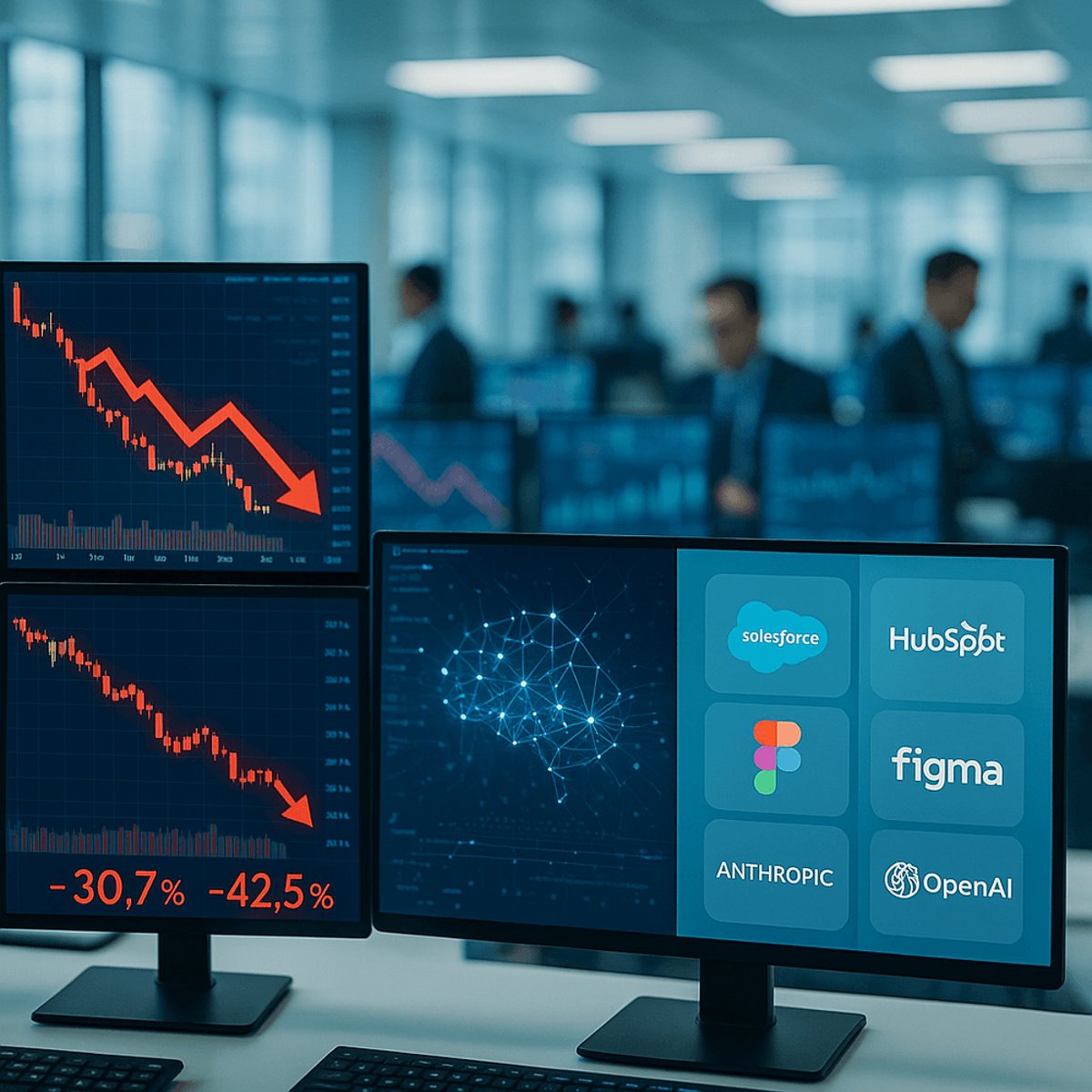
The software industry is bleeding value at an unprecedented rate. Anthropic's Friday launch of enterprise AI plugins for its Claude Cowork platform has accelerated a brutal selloff that's wiped out nearly 30% of the sector's value in just three months. HubSpot has cratered 39% year-to-date, Figma plunged 40%, and even giants like Salesforce are down 25% as Wall Street decides AI will devour traditional software companies whole.
Anthropic just dropped a bomb on the software industry, and the shrapnel is still flying. The AI startup's Friday announcement of new legal, finance and product marketing capabilities for Claude Cowork - released as open-source plugins - has sent software stocks into freefall. The WisdomTree Cloud Computing Fund plummeted 6.5% this week alone, capping a brutal 20% decline in 2026.
The carnage is hitting companies across the board. HubSpot shares have collapsed 39% this year after sliding 42% in 2025. Figma is down 40%, Atlassian dropped 35%, and Shopify fell 29%. Even Box, whose CEO Aaron Levie calls this "the most exciting moment we've ever had" in the company's 20-year history, is nursing a 17% loss in 2026.
Wall Street's thesis is simple and brutal - foundation model companies like Anthropic and OpenAI will eat the software industry's lunch. Why pay for specialized software when Claude or ChatGPT can handle legal documents, financial analysis and marketing copy with a few text prompts? Celso Pinto, senior director of product at The Access Group, captured the shift in a Monday X post: "I am in awe of this technology," he wrote, describing how he's used Cowork and Claude Code to review marketing materials, fix bugs and produce legal documents.
But software executives are fighting back against the doomsday narrative. Levie told CNBC's "The Exchange" Wednesday that investors fundamentally misunderstand how businesses actually operate. "It somewhat misunderstands this idea of where companies tend to spend their resources and their time and their energy," he said. His argument - companies would rather pay specialized vendors for back office software and CRM systems than build and maintain everything themselves with all the liability that entails.
Salesforce CEO Marc Benioff made a similar case to CNBC's Jim Cramer in December, pointing to the company's data advantage. "We've got all the customers' data," Benioff said, calling Agentforce - which automates sales and customer service workflows - "the fastest growing product I have ever seen in the history of Salesforce." The stock is still down 25% this year.
ServiceNow CEO Bill McDermott pushed back even harder after his company reported strong quarterly results last week. The market's concerns are "misplaced," he argued, positioning ServiceNow's products "as the semantic layer that makes AI ubiquitous in the enterprise." Dan Springer, former DocuSign CEO now running legal software startup Ironclad, agrees ServiceNow can't be easily replaced. "I haven't seen something that's been built that would attack that franchise," he said. ServiceNow is still down about 25% year-to-date.
The disconnect between executive optimism and market panic is creating what some see as a massive buying opportunity. Byron Deeter, a longtime cloud software investor at Bessemer Venture Partners and early Box backer, posted on X Wednesday: "Chaos creates opportunity! A lot of money is about to be made for those who have the conviction to place the right private and public software bets right now."
Analysts are starting to echo that view. Stifel wrote in a report last month that despite broader AI disruption fears, "no partner cited near-term headcount reductions or seat disruption related to AI" at HubSpot. They recommend buying the stock. Cantor analysts called Monday.com - down 29% this year - a "profitable grower benefiting from digital and AI collaboration secular growth trends" with an "attractive setup" at current prices.
Meanwhile, the market has decided who the AI winners are, and it's not the software companies. Anthropic signed a term sheet this month for a $10 billion funding round at a staggering $350 billion valuation. OpenAI is reportedly eyeing over $800 billion. Google parent Alphabet has seen its stock rocket 60% in the past year, pushing its market cap to $4 trillion as its Gemini AI goes head-to-head with Claude and GPT models.
Claude is carving out its own niche by focusing on large enterprise subscriptions rather than consumer adoption. The new plugins for legal, finance and product marketing work represent a direct assault on specialized software vendors in those categories. By releasing them open-source, Anthropic is betting businesses will customize Claude for their specific needs rather than pay for multiple point solutions.
Levie acknowledges the pressure is real, even if he thinks the market is overreacting. "AI is causing every software company to have to stay on its toes," he told CNBC. "It is certainly forcing every incumbent to make sure that they're doing more for their customers. I think that's an incredible thing for the market and for IT buyers."
The question is whether software companies can innovate fast enough to justify their valuations in an AI-first world. The next few quarters will show whether executives like Benioff and McDermott are right that AI enhances their products, or whether Wall Street's bet on wholesale disruption plays out.
The software sector is caught in a violent clash between present reality and future fears. While companies like Salesforce, ServiceNow and Box report strong results and accelerating AI product adoption, Wall Street is pricing in a world where Anthropic, OpenAI and Google's foundation models make specialized software obsolete. Analysts and veteran investors see a buying opportunity in the wreckage, betting that businesses will continue paying for domain expertise, data integration and liability protection. But with Anthropic now valued at $350 billion and releasing enterprise tools as open source, software companies have little margin for error. The next earnings season will either validate the optimism or confirm the market's darkest predictions about AI-driven disruption.