TL;DR:
• Anthropic launches conversation memory for Claude's Max, Team, and Enterprise tiers
• Feature differs from ChatGPT by requiring manual activation rather than persistent profiling
• Timing follows OpenAI's GPT-5 launch and Anthropic's $170 billion funding round
• Memory features become key battleground for user retention in competitive AI market
Anthropic just fired its latest salvo in the AI arms race, rolling out a conversation memory feature for Claude that lets users pick up where they left off across projects. The feature launches today for premium subscribers as the $170 billion-valued company directly challenges OpenAI's ChatGPT dominance in enterprise productivity tools.
Anthropic isn't just playing catch-up anymore. The company's Monday release of conversation memory for Claude represents a calculated strike in the escalating AI productivity wars, arriving just days after OpenAI launched its much-anticipated GPT-5 model.
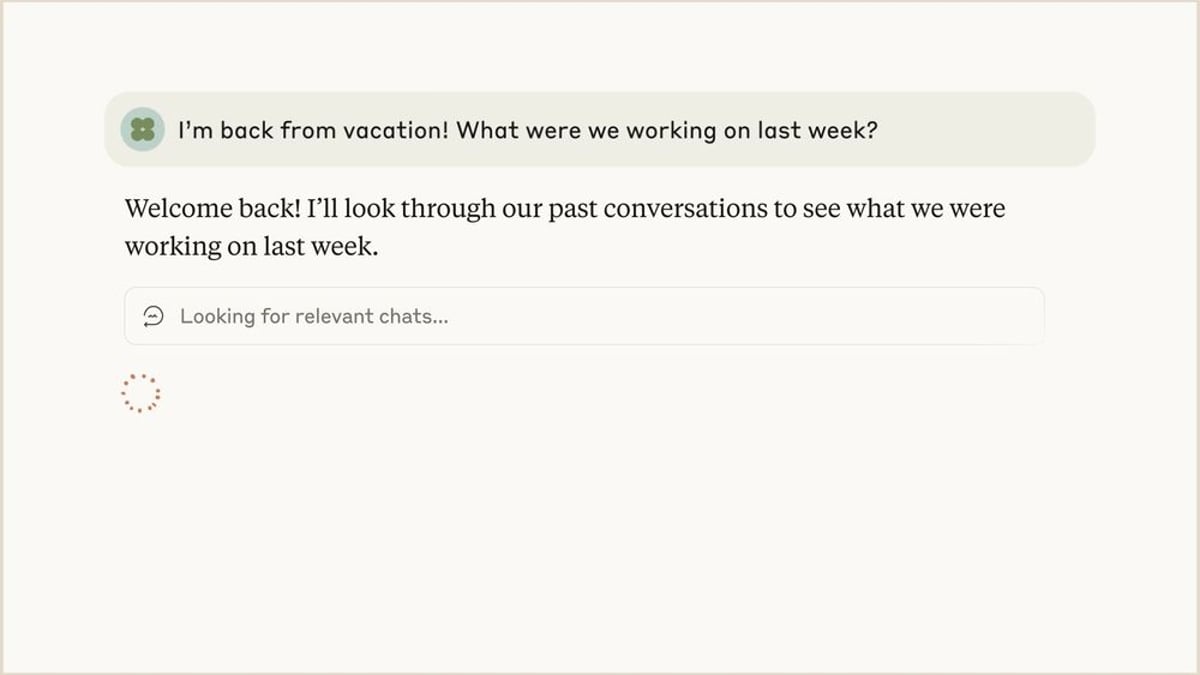
The timing signals how fiercely these AI giants are competing for enterprise mindshare. "Never lose track of your work again," Anthropic promises in its demonstration video, showing Claude seamlessly retrieving and summarizing past conversations to help users resume complex projects after interruptions.
But Anthropic is taking a distinctly different approach than its Silicon Valley rival. While ChatGPT automatically builds persistent user profiles from conversations, Claude's memory function only activates when explicitly requested. According to Anthropic spokesperson Ryan Donegan, the system won't autonomously construct user profiles or retain information across sessions without permission.
This privacy-first stance could prove strategically brilliant as enterprise customers increasingly scrutinize AI tools for data governance compliance. The feature works across web, desktop, and mobile platforms, maintaining separate project workspaces while requiring users to manually enable "Search and reference chats" in their profile settings.
The competitive dynamics couldn't be more intense. OpenAI shocked the industry last week with GPT-5's surprise launch, while Anthropic is simultaneously closing a funding round that could value the company at $170 billion according to Bloomberg sources.
Memory functions have become the new front in the AI stickiness battle. Both companies recognize that users who invest time building conversational history with an AI system become exponentially harder to poach. It's the digital equivalent of switching costs – once your work patterns are embedded in Claude or ChatGPT, migration becomes psychologically and practically daunting.
Yet this arms race carries unexpected psychological risks. Recent reports describe users experiencing "ChatGPT psychosis" after forming unhealthy attachments to AI conversations, while others controversially use these tools as therapy substitutes. Anthropic's manual activation approach may prove prescient if regulatory scrutiny intensifies around AI emotional dependency.
For enterprise customers evaluating these platforms, the feature differences matter enormously. ChatGPT offers seamless continuity but raises data retention concerns. Claude provides user control but requires more deliberate interaction. The market will ultimately decide which philosophy wins, but early enterprise adoption patterns suggest privacy-conscious organizations are increasingly favoring opt-in approaches.
The rollout begins today for Claude's premium tiers, with broader access promised soon. As both companies race to capture enterprise workflows, conversation memory represents just the opening move in what promises to be an increasingly sophisticated battle for AI workplace dominance.
Anthropic's conversation memory launch marks a pivotal moment in AI's evolution from novelty to necessity. While OpenAI maintains its technical lead, Anthropic's privacy-conscious approach could resonate with enterprise customers increasingly wary of data governance risks. As memory functions become table stakes for AI productivity tools, the real competition shifts to execution, user trust, and which company can best balance convenience with control. The next six months will reveal whether users prioritize seamless automation or deliberate privacy – a choice that could reshape the entire AI landscape.