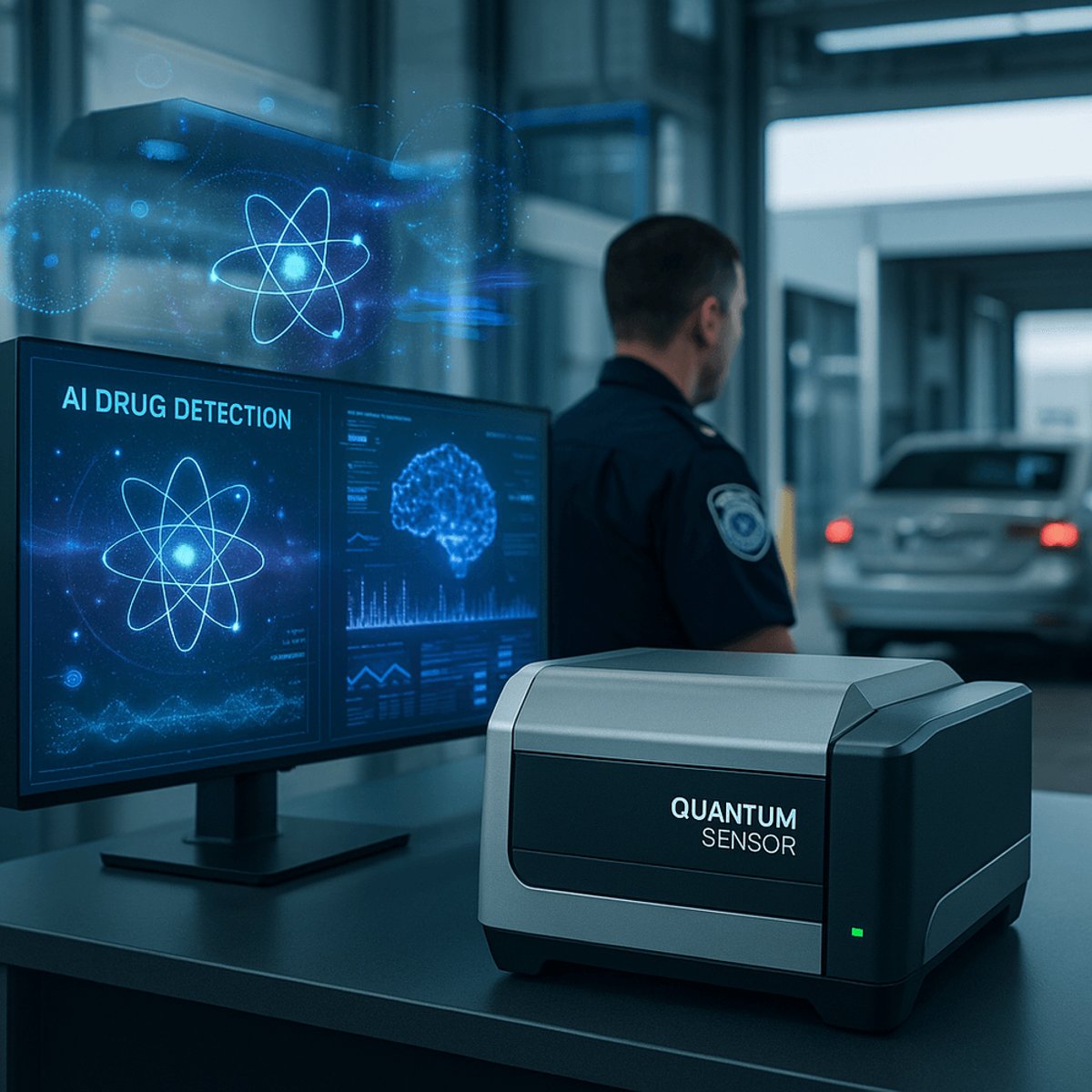
US Customs and Border Protection is betting on quantum physics to catch fentanyl at the border. The agency just handed General Dynamics a $2.4 million contract to build prototype quantum sensors paired with an AI database designed to detect drugs hidden in vehicles and cargo containers. The move marks CBP's latest attempt to crack one of border security's toughest problems - spotting microscopic amounts of synthetic opioids that existing handheld scanners keep missing.
US Customs and Border Protection is paying General Dynamics to build something that sounds straight out of sci-fi - quantum sensors that work with artificial intelligence to sniff out fentanyl. The $2.4 million contract, which went public in December but only got a formal justification last week, represents CBP's latest swing at a detection problem that's stumped border agents for years.
The contract justification describes a system that would "integrate advanced quantum and classical sensing technologies with Artificial Intelligence" to detect illicit substances in vehicles, containers, and other devices. CBP initially redacted General Dynamics' name from the document, but federal spending records confirmed the defense contractor's involvement.
Neither CBP nor General Dynamics responded to requests for comment, leaving key technical details murky. But the contract comes as the Department of Homeland Security pushes hard on AI deployment. A 2025 strategy memo laid out DHS's ambitions "to support the adoption and scaling of AI technologies" across its agencies.
The quantum sensor request follows months of CBP market research into better detection tools. Last July, the agency posted an information request seeking 35 handheld Gemini analyzers from Thermo Fisher Scientific. Those devices use Fourier Transform Infrared Spectroscopy and Raman spectroscopy - techniques that measure how light interacts with chemical samples - to identify unknown substances.
But here's the catch: CBP's latest justification mentions finding an American handheld analyzer that "cannot detect fentanyl." It's unclear if that refers to the Gemini or another device from DHS tests conducted in 2021 and 2023. Thermo Fisher Scientific pushed back when asked, insisting its Gemini analyzers "are designed to detect fentanyl."
The fentanyl detection challenge is real. A 2024 working paper on lab-based detection methods points out that portable Raman spectrometers and similar handheld tools - while fast and cheap - often "struggle with detection of fentanyl" and produce false positives and negatives. That's where quantum sensing might help.
So what exactly are quantum sensors? The term covers multiple approaches, but one promising method uses quantum dots - artificially created graphene-based nanomaterials that glow when combined with fluorescent dye. Matthew Webber, an engineering professor at the University of Notre Dame who co-authored the 2024 paper, explained how it works. When fentanyl is added to the quantum dot mixture, it binds to the dots and kicks out the fluorescent dye, causing a measurable drop in fluorescence. His lab's method can detect fentanyl and 58 related compounds.
Webber stressed that all fentanyl research happens in tightly controlled lab environments with tiny amounts - micrograms, not bags - for legal and safety reasons. But he sees potential for AI in the detection equation. "If you have signals coming from multiple agents within a mixture, the eye may not be able to deconvolve the spectra into individual components," Webber told Wired. "But there's potentially AI-based specialty convolution frameworks that could be powerful in that context."
That's the theory behind CBP's AI database - a system that could recognize patterns and process spectral data faster than human operators, catching fentanyl signatures that would otherwise slip past. Since street drugs constantly evolve with new chemical variations, an AI system that learns to spot shifting patterns could keep pace with what Webber calls the "moving goalposts of detection."
The CBP contract fits into a broader pattern of government agencies turning to AI for national security challenges. DHS has been particularly aggressive, positioning AI as critical infrastructure for everything from threat assessment to cargo screening. But quantum sensing paired with AI for border operations remains largely untested at scale.
General Dynamics has deep experience with defense and homeland security contracts, but this quantum sensor work appears to push into newer territory for the company. The July request for Gemini analyzers specified detection targets including fentanyl, ketamine, cocaine, methamphetamine, diazepam, and MDMA - substances CBP noted are showing up "in increasing numbers" at US borders.
The $2.4 million price tag suggests this is still prototype phase, not deployment-ready hardware. CBP's justification says the project will "ultimately deploy proven concepts and end products anywhere in the CBP environment," but that's aspirational language for what remains experimental tech.
What's unclear is how General Dynamics will bridge lab science and field operations. Webber's quantum dot research works in controlled lab settings. Translating that to border checkpoints where agents need to scan vehicles quickly in varying temperatures and conditions is a different challenge entirely. The contract documents don't specify whether General Dynamics is adapting existing quantum sensing methods or developing something new.
CBP's quantum sensor bet represents a significant gamble on cutting-edge detection technology that's barely left the lab. If General Dynamics can make quantum sensing work reliably in the chaos of border checkpoints - and if the AI database can actually improve on human pattern recognition without flooding agents with false alarms - this could reshape how border security approaches drug interdiction. But that's a lot of ifs for a $2.4 million prototype. The real test will come when these sensors face the messy reality of thousands of vehicles crossing daily, each potentially hiding drugs in creative new ways that confound even the smartest algorithms.