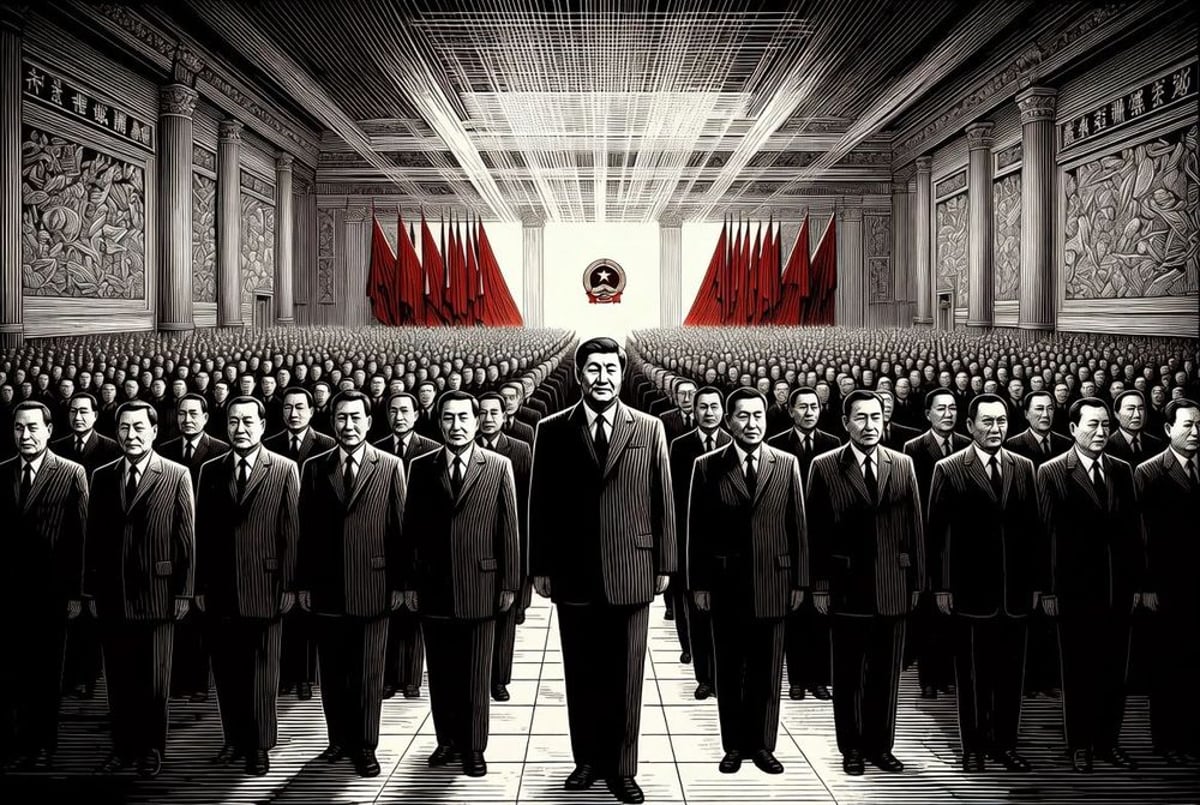
Ding Xuexiang, the first-ranked vice premier of the People's Republic of China, still carries a formal title he earned before politics arrived: professor-level senior engineer, granted after fourteen years working on forging and pressing technology at the Shanghai Research Institute of Materials. The designation appears in his official biography. In the governance culture that produced him, it is meant to be noticed.
Across the Pacific, the 118th United States Senate counted 47 lawyers among its hundred members. Four of the eight Americans who held the presidency between 1993 and 2025 graduated from law school — Clinton from Yale, Obama from Harvard, Biden from Syracuse, Hillary Clinton, who nearly made it, also from Yale. These were not accidents of biography. They were the expected résumé for a class of people who run the world's most powerful democracy.
The sentence that explains more about the shape of the present world than any diplomatic cable has been circulating in Washington and Beijing for years: China is run by engineers. America is run by lawyers. The line is reductive in the way slogans must be. It is also mostly true.
In 2002, when Hu Jintao took over as General Secretary, all nine members of the Politburo Standing Committee held engineering degrees. Hu himself studied hydraulic engineering at Tsinghua and spent nearly a decade building dams in Gansu province. His predecessor, Jiang Zemin, was an electrical engineer. The premier who signed off on Three Gorges, Li Peng, trained as a hydroelectric engineer in Moscow. Zhu Rongji, who negotiated China's entry into the WTO, was an electrical engineer from Tsinghua. Wen Jiabao, who followed as premier, was a geological engineer. For roughly two decades, the apex of the Chinese state functioned as a graduate seminar in applied science, and the graduates ran provinces of a hundred million people the way one runs a refinery.
What each profession is trained to do with a problem matters enormously at that scale. An engineer, from the first thermodynamics homework set, is taught that the world is a system, that the system has constraints, that the constraints are non-negotiable, and that any solution which violates them will eventually collapse. Engineers practice failure analysis as a discipline. The verb they reach for first is "build." A lawyer's training runs almost in reverse. The world a lawyer faces is not a system but a dispute — a plaintiff, a defendant, a precedent, an argument. Lawyers reason from precedent backward, not from first principles forward. They optimize brilliantly for the deal in front of them. Chris Roberts, the executive director of institutional advancement at Texas Law, has described the legal mind as "a good chess player, always considering everything on the board and thinking ahead by three or four moves." That is a genuine cognitive virtue. Scaled to the operating system of a country, it produces a state that is exquisite at blocking and incapable of building.
The evidence for that last sentence arrives most clearly in a comparison too clean to be polemical. In 2008, California voters approved a $9.95 billion bond to connect San Francisco to Los Angeles by high-speed rail in under three hours, with a 2020 completion target and a total cost estimated at $33 billion. By 2025, the project had spent $15.7 billion, laid no track for actual high-speed service, and watched its cost estimate climb past $128 billion. The Federal Railroad Administration moved to revoke $4 billion in remaining federal grants. The California Environmental Quality Act alone had consumed more than $765 million in environmental review. Lou Thompson, the project's longtime peer reviewer, stated the arithmetic plainly: on a $100 billion project at three percent interest, "every year's delay costs you $3 billion," so "a $50,000 lawsuit can delay you for a year." In March 2026, Thompson wrote to the state legislature that the project had "reached a dead end." During the same seventeen years California failed to lay any meaningful track, China built more than 45,000 kilometers of high-speed rail — a network longer than the rest of the world combined.
This is not, at its root, a story about money. It is a story about who decides where the money goes, and what their cognitive defaults are when they decide. The American Society of Civil Engineers gave U.S. infrastructure an overall C in its 2025 report card — the highest grade since the assessment began in 1998 — and attached to that news a $9.1 trillion gap between current conditions and good repair by 2033. China spent roughly 4.8 percent of GDP on inland transport in 2021. The United States spent roughly a tenth of that share.
The intellectual origins of China's engineering state trace back not to Mao — who was a poet and guerrilla, and whose most catastrophic projects killed tens of millions — but to Deng Xiaoping, the ruthless pragmatist who returned from internal exile to declare that it did not matter whether the cat was black or white as long as it caught mice. Deng rejected ideology as the test of policy and replaced it with results, which engineers are trained to measure and lawyers are trained to litigate. Through the 1980s and 1990s, he and his protégés systematically promoted engineers into the Party's bureaucratic spine. By 1997, 74 percent of provincial Party secretaries held four-year degrees in science or engineering. The political economist Yuen Yuen Ang calls the resulting model "directed improvisation" — central leadership defines hard outer boundaries, local governments compete to find concrete solutions inside them. Specifications at the top, iteration at the bottom, ruthless selection in the middle.
The case against this model is not primarily an argument about freedom. It is an argument about feedback. The Three Gorges Dam — the engineering monument of Hu Jintao's hydraulic-engineering generation — displaced 1.3 million people, submerged 13 cities and 140 towns and 1,350 villages, and triggered seismic and erosion concerns that scientists had flagged in 1989, before the Tiananmen crackdown silenced them. China's fertility rate fell to 1.0 by 2023, the direct legacy of the one-child policy — the most ambitious social engineering project in human history, now visible as a demographic catastrophe. Only 7.92 million babies were born in China in 2025, a 17 percent drop from the prior year and the lowest figure since the People's Republic was founded. The RAND Corporation projects that China's old-age dependency ratio will more than double from 0.21 in 2024 to 0.52 by 2050. Engineers can be wrong at scale, and when they are wrong without an adversarial system to catch the error, the error compounds for a generation before it can be corrected.
The same urban neighborhood committees that once enforced sterilization quotas are now visiting young women to ask why they have not yet had a second child. The same governance reflex that laid 45,000 kilometers of rail is trying to plan a baby boom. The builders, having spent forty years treating a country as a system to be optimized, are discovering that some variables do not respond to specifications.
If you are building a developing country in 2026, the question is not whether to copy China’s authoritarianism. It is whether to build a state in which the most respected profession is the profession that creates physical capacity in the world. Singapore answered yes. South Korea answered yes. Germany answered yes. China answered yes for forty years and is now beginning to forget, slowly, what made the answer work. The United States answered no for a long time and is now beginning to suspect that the answer was wrong. The next generation of governance debates, in Lagos and Addis Ababa and Jakarta as much as in Washington and Beijing, will turn on whether countries are willing to do the hard institutional work of training engineers, promoting engineers, listening to engineers, and giving them the political cover to build, while keeping the lawyers in the role for which they are needed, which is to make sure the engineers do not build over the wrong people.