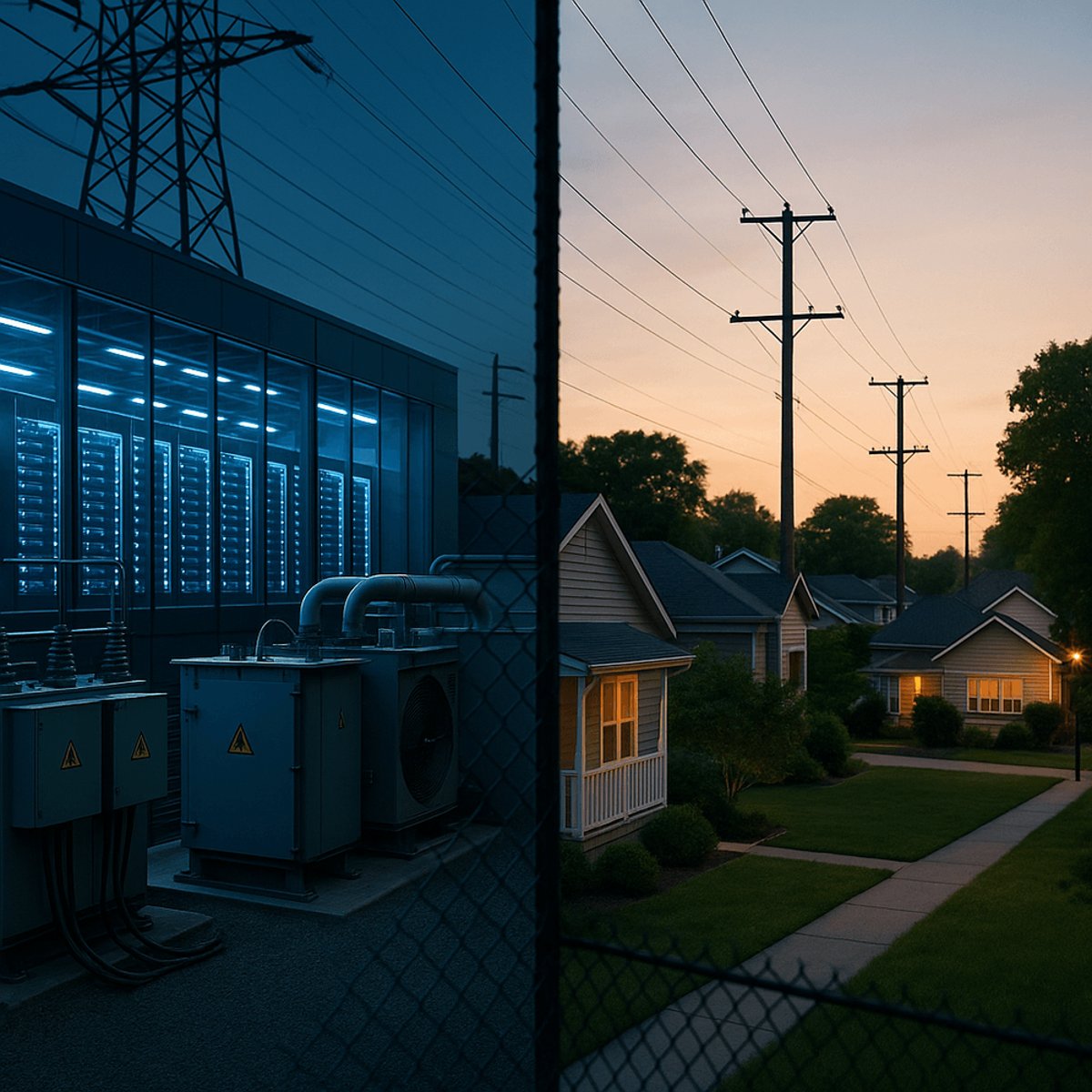
The AI industry's explosive growth just hit an unexpected wall - not technology or capital, but public opinion. A new poll published by TechCrunch reveals Americans would rather have an Amazon warehouse in their neighborhood than a data center, exposing a critical infrastructure challenge that could throttle the industry's expansion plans. As tech giants race to build the massive computing facilities needed to power AI models, they're discovering that local communities aren't rolling out the welcome mat.
The numbers tell a story the tech industry didn't want to hear. When Americans were asked to choose between having an Amazon fulfillment center or a data center in their community, the warehouse won handily. It's a stunning reversal for an industry that's been positioning data centers as the critical infrastructure of the digital age, essential for everything from cloud computing to artificial intelligence.
The poll arrives at a particularly awkward moment for tech giants. Microsoft, Google, Meta, and Amazon are all racing to build massive new data centers to support their AI ambitions. These facilities are essential for training the large language models that power tools like ChatGPT and Google's Gemini. But the construction boom is running headfirst into local resistance that's proving harder to overcome than any technical challenge.
The reasons for the public's preference aren't hard to understand. Amazon warehouses, despite their own controversies around working conditions, create hundreds or thousands of local jobs. Data centers, by contrast, are largely automated operations that might employ a few dozen technicians once operational. They're also notorious energy hogs, consuming electricity at rates that can strain local power grids and drive up costs for nearby residents.
Water usage has become another flashpoint. Modern data centers require enormous amounts of water for cooling systems, sometimes millions of gallons per day. In regions already facing water scarcity, that's become a dealbreaker for local officials and residents alike. Communities from Arizona to Virginia have pushed back against data center proposals, citing concerns about resource consumption and environmental impact.
The infrastructure challenge goes deeper than public opinion. Data centers need to be located near major fiber optic network hubs and reliable power sources, which limits where they can be built. They also need to be somewhat distributed geographically to provide low-latency service and redundancy. That means tech companies can't just concentrate all their facilities in a handful of friendly jurisdictions - they need buy-in from communities across the country.
For the AI industry, this creates a genuine bottleneck. Training advanced AI models requires massive computing clusters running for weeks or months at a time. OpenAI, Anthropic, and other AI labs are already competing for scarce GPU resources. If they can't build new data centers to house those chips, it doesn't matter how many processors Nvidia can manufacture.
The poll results suggest the industry has a serious messaging problem. While tech executives talk about AI as transformative technology that will reshape every industry, local communities see data centers as all cost and no benefit. The facilities don't generate significant tax revenue relative to their infrastructure demands, don't create many jobs, and often require upgrades to local power and water systems that other ratepayers end up subsidizing.
Some companies are trying to change the equation. Microsoft has experimented with using data center waste heat to warm nearby buildings. Others are investing in on-site renewable energy generation to reduce grid impact. But these efforts haven't yet shifted public perception in any meaningful way.
The situation has gotten bad enough that it's showing up in quarterly earnings calls and investor presentations. When executives talk about infrastructure constraints limiting AI deployment, they're not just referring to chip shortages anymore - they're also acknowledging that they simply can't get approval to build facilities fast enough to meet demand.
The contrast with Amazon warehouses is particularly striking because those facilities have faced their own waves of community opposition over traffic, noise, and labor practices. If data centers are losing the public opinion battle to Amazon fulfillment centers, that's a sign of just how poorly the value proposition is landing with ordinary Americans.
Some industry observers argue that the poll reveals a broader skepticism about AI itself. While tech leaders and investors are convinced that AI represents the next major computing platform, much of the public remains unconvinced that the technology justifies the resource consumption required to develop it. That disconnect could become more pronounced as electricity prices rise in regions with heavy data center concentration.
The poll results reveal something the AI industry can't afford to ignore - its infrastructure expansion plans are colliding with community priorities in ways that capital alone can't solve. As companies pour billions into AI development, the limiting factor may not be technology or talent, but simple social license to operate. Unless data center operators can find ways to create tangible local benefits beyond property taxes, they'll keep losing the narrative battle to warehouses, solar farms, and just about any other land use that creates more jobs and consumes fewer resources. For an industry built on disruption, that's an uncomfortable reminder that some constraints are political and social, not technical.