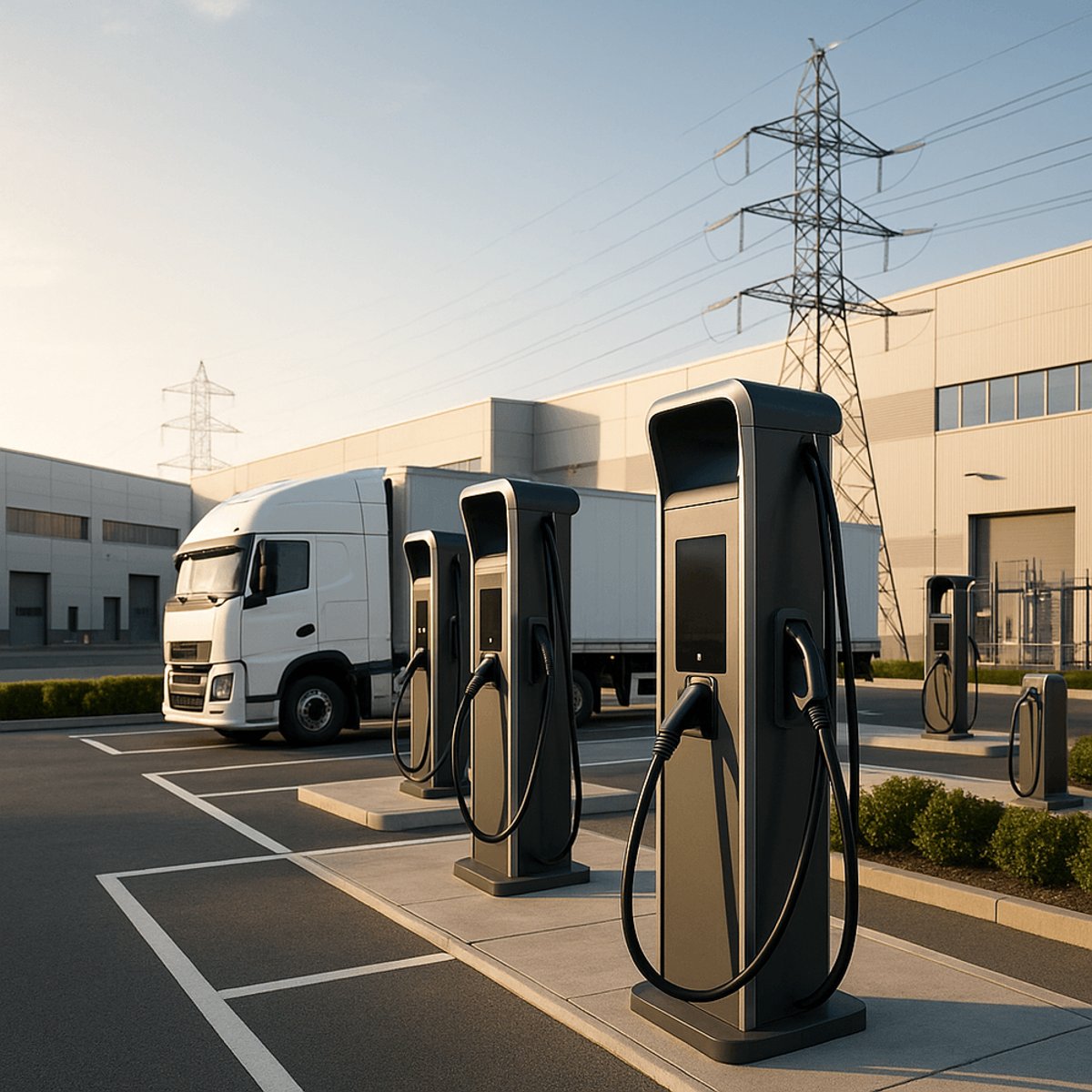
The electric truck revolution has a real estate problem - and EV Realty thinks it's found the solution. The startup just closed a $75 million funding round to build charging hubs on underutilized grid capacity near warehouses, creating what could become an entirely new asset class for commercial real estate investors.
Electric commercial trucks are hitting their stride, but there's a catch - the charging infrastructure isn't keeping up. EV Realty is betting big that the missing piece isn't just more chargers, but smarter real estate strategy around where to put them.
The California-based startup just secured $75 million in funding led by private equity firm NGP, with the company's management team participating. It's a significant vote of confidence in what founder Patrick Sullivan calls a "new sort of infrastructure class for real estate."
The funding comes at a critical moment for electric trucking. While only a few thousand electric commercial vehicles currently operate nationwide, over half of fleets are actively piloting the technology, according to McKinsey research. That pilot-to-production transition is creating infrastructure headaches that traditional charging companies haven't solved.
"We see, frankly, more interest right now from the customers that have made the switch," Sullivan told TechCrunch in an exclusive interview. "They see the opportunity and want to do more."
The company's approach mirrors Digital Realty's playbook for data centers - find underutilized grid capacity and build specialized infrastructure that multiple tenants can share. EV Realty currently operates five charging hubs across California, all strategically located near warehouses, ports, and industrial properties where truck traffic naturally concentrates.
Their secret weapon is proprietary software that maps electrical grid availability against vehicle density, traffic patterns, and real estate use. It's this data-driven site selection that led them to their next major project - a 76-stall fast-charging hub in San Bernardino that will feature four "pull through" stalls equipped with Megawatt Charging System plugs.
Those pull-through stalls solve a practical problem that's been slowing electric truck adoption - drivers can charge without unhooking their trailers. When fully operational, the San Bernardino hub should handle more than 200 Class 8 trucks daily, making it one of the largest commercial EV charging facilities on the West Coast.
The grid capacity angle is crucial. Unlike passenger car charging, commercial trucks need massive amounts of power delivered quickly. But finding available grid capacity near industrial corridors has become increasingly challenging as data centers, manufacturing facilities, and other energy-intensive users compete for the same electrical infrastructure.
"They're looking for hundreds and hundreds of megawatts, and we're looking for tens of megawatts," Sullivan explained, contrasting EV Realty's needs with hyperscale data centers. That smaller footprint gives the company more flexibility in site selection while still delivering industrial-scale charging capacity.
The timing couldn't be better. California's Advanced Clean Trucks Rule requires manufacturers to sell increasing percentages of zero-emission commercial vehicles, with the mandate reaching 75% for Class 8 trucks by 2035. Similar regulations are spreading nationwide, creating predictable demand for charging infrastructure.
But EV Realty isn't just building chargers - it's creating a new investment vehicle. By structuring as a real estate play rather than a pure charging company, they're attracting capital from institutional investors who understand property fundamentals better than energy markets. The model could prove especially attractive as commercial real estate investors look for new yield sources in an uncertain interest rate environment.
The company's hub-and-spoke approach also addresses range anxiety for fleet operators. Rather than building proprietary charging at every facility, fleets can rely on EV Realty's network for intermediate charging during longer hauls or overflow capacity during peak periods.
Industry observers see this as potentially transformative. The charging infrastructure gap has been one of the biggest barriers to electric truck adoption, alongside purchase price premiums and payload concerns. By treating charging hubs as real estate investments rather than utility plays, EV Realty could unlock capital sources that traditional charging companies can't access.
EV Realty's $75 million raise signals that smart money is betting on infrastructure-as-real-estate for the electric truck transition. As fleet electrification accelerates beyond pilot programs into full deployment, the companies that solve the grid capacity puzzle first could capture outsized returns. Sullivan's bet is that the winning formula combines Silicon Valley data analytics with old-school real estate fundamentals - find the right location, build the right infrastructure, and let the tenants come to you.