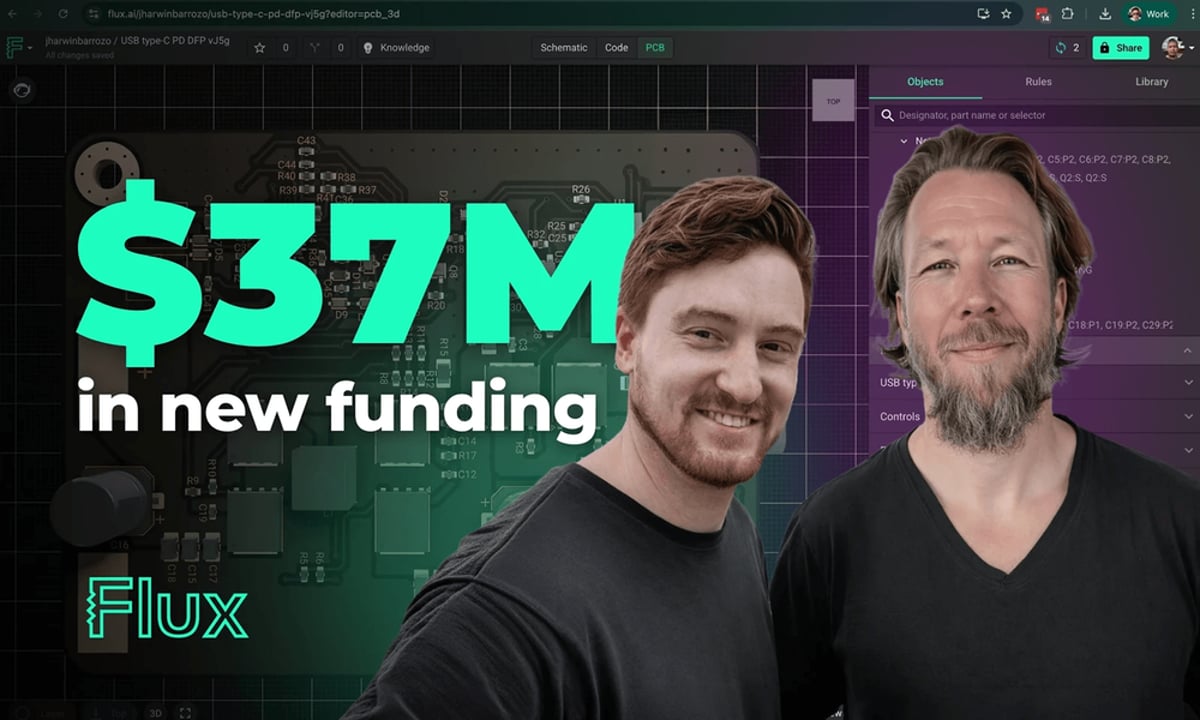
Flux has announced $37 million in new funding, including a $27 million Series B led by 8VC, with participation from Bain Capital Ventures, Liquid 2 Ventures and Outsiders Fund.
Before now, you either hired electrical engineers to design custom circuit boards from scratch, or you bought off the shelf components that did more than you needed and cost more than you liked. Flux wants to tear down that process and hand you the tools.
Flux calls itself the world’s first AI hardware engineer. Trained on hundreds of thousands of real world designs, its system lets users describe what they want in plain language. The AI then plans PCB layouts, sources components, runs tests and generates the files manufacturers need. It can even suggest ways to cut costs or sidestep supply chain bottlenecks.
All of it runs in a web browser.
More than 1 million makers and entrepreneurs have used Flux to design nearly 6.5 million devices, from wearables to drones to smart home controllers. One customer built an IoT tool for construction machinery without hiring an electrical engineer. Another is shipping custom electronics across Africa. A third is designing organ on chip platforms for drug discovery.
Flux’s pitch is simple: bring the cost of design close to zero and the audience explodes. Instead of giant manufacturers dictating what gets built, individuals and small teams can create bespoke electronics at near material cost.
CEO Matthias Wagner argues that hardware has long been constrained by complexity and expense. By lowering both, Flux hopes to make building physical products feel less like navigating a factory floor and more like sketching an app.