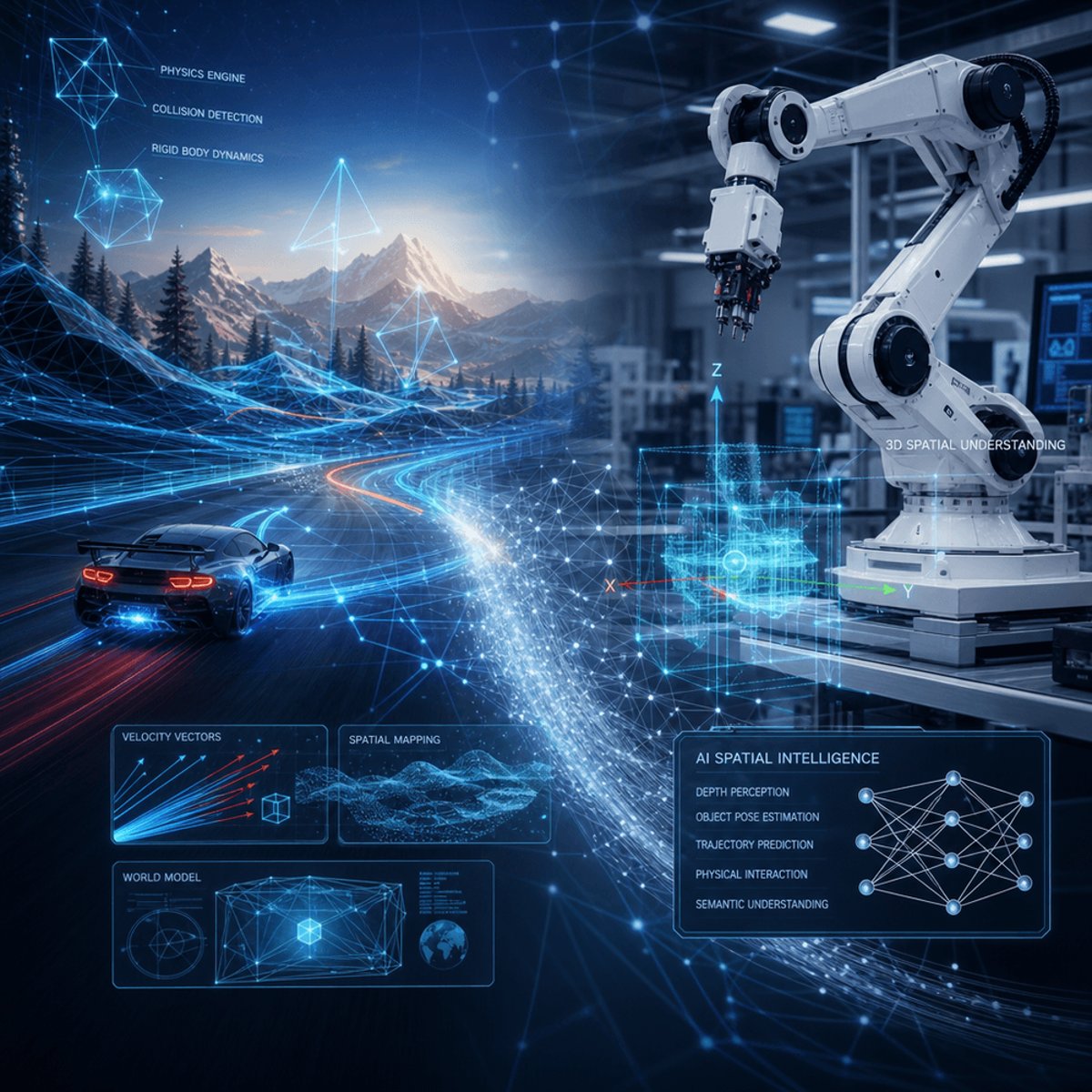
Large language models have a spatial blindness problem. While OpenAI's ChatGPT and Anthropic's Claude excel at text, they struggle with understanding how objects move through physical space - a critical gap on the path to artificial general intelligence. Now a startup called General Intuition is making a bold bet: video game data might be the missing ingredient that transforms today's text-focused AI into systems that truly understand the physical world.
The limitations of today's AI are becoming impossible to ignore. OpenAI and Anthropic have built impressive language models, but ask them to reason about physics or predict how objects interact in three-dimensional space, and the cracks show immediately. General Intuition thinks it has found an unconventional solution in an unexpected place - the millions of hours of gameplay data generated every day across gaming platforms.
The company's thesis is straightforward but radical. Text-based training data, scraped from the internet, teaches AI to manipulate language. But it doesn't teach models how a ball bounces, how water flows, or how a robot arm should move to grasp an object. Video games, on the other hand, are essentially massive physics simulations where every interaction follows rules about space, time, and causality.
"When it comes to achieving artificial general intelligence, large language models just don't have what it takes," according to TechCrunch's coverage of General Intuition's approach. "Models like ChatGPT and Claude are great at text, but they're less skilled at understanding how things actually move through space and time - an essential skill for producing intelligence that generalizes."
This gap isn't just academic. It's become a major bottleneck for robotics, autonomous systems, and what the industry now calls "physical AI." A language model can describe how to pick up a cup, but it can't generate the motor commands that would actually accomplish the task. It lacks what researchers call a "world model" - an internal representation of how physical reality works.
General Intuition's approach leverages the fact that modern video games contain incredibly sophisticated physics engines. From the cloth simulation in action games to the vehicle dynamics in racing simulators, these environments encode real-world physical principles. More importantly, they generate observational data at massive scale - player actions, environmental responses, object interactions - all tagged with precise spatial and temporal information.
The startup joins a growing movement rethinking AI training data. While OpenAI scrambles to find new text sources and navigates copyright battles, General Intuition is betting that the nature of training data matters more than the volume. Gaming data offers something the internet can't: consistent physical rules, controlled environments, and clear cause-and-effect relationships.
This pivot toward physical AI reflects broader industry trends. Robotics companies have struggled to deploy systems trained purely on language models. Self-driving cars need more than text comprehension. Even OpenAI's recent moves into robotics acknowledge that language models alone won't get us to AGI.
The technical challenge is substantial. Extracting useful training signals from gaming data requires new architectures that can learn spatial-temporal patterns, not just statistical correlations in text. General Intuition is essentially building world models - AI systems that can simulate physics, predict outcomes, and reason about three-dimensional space.
Industry observers see this as part of a larger recalibration. The transformer architecture that powers modern LLMs revolutionized language understanding, but it wasn't designed for physical reasoning. New approaches are emerging - neural radiance fields, spatial transformers, physics-informed neural networks - all trying to bridge this gap.
The gaming industry itself may become an unexpected AI infrastructure provider. If video game data proves valuable for training physical AI, game developers could find themselves sitting on goldmines of structured physical data. Partnerships between AI labs and gaming companies could reshape both industries.
For robotics applications, the implications are immediate. A robot trained on gaming data might better understand object permanence, collision dynamics, and spatial relationships - fundamental capabilities that current systems lack. For autonomous vehicles, world models trained on racing games and driving simulators could complement real-world data collection.
But questions remain. Can insights learned from game physics transfer to real-world robotics? Do gaming environments introduce biases or limitations? How much gaming data is needed to match the scale of internet text? General Intuition is betting it can answer yes, navigate the challenges, and prove that the path to AGI runs through gaming servers, not just web scrapers.
General Intuition's gaming data thesis represents more than a novel training approach - it's a fundamental challenge to the assumption that more text equals better AI. If the startup succeeds, it could unlock the spatial intelligence that separates today's chatbots from tomorrow's physically capable AI systems. The real test will come when these models leave the virtual worlds of gaming and confront the messy, unpredictable physics of reality. For now, the race to AGI has opened a surprising new front, and the gaming industry may hold keys that Silicon Valley's web scrapers can't find.