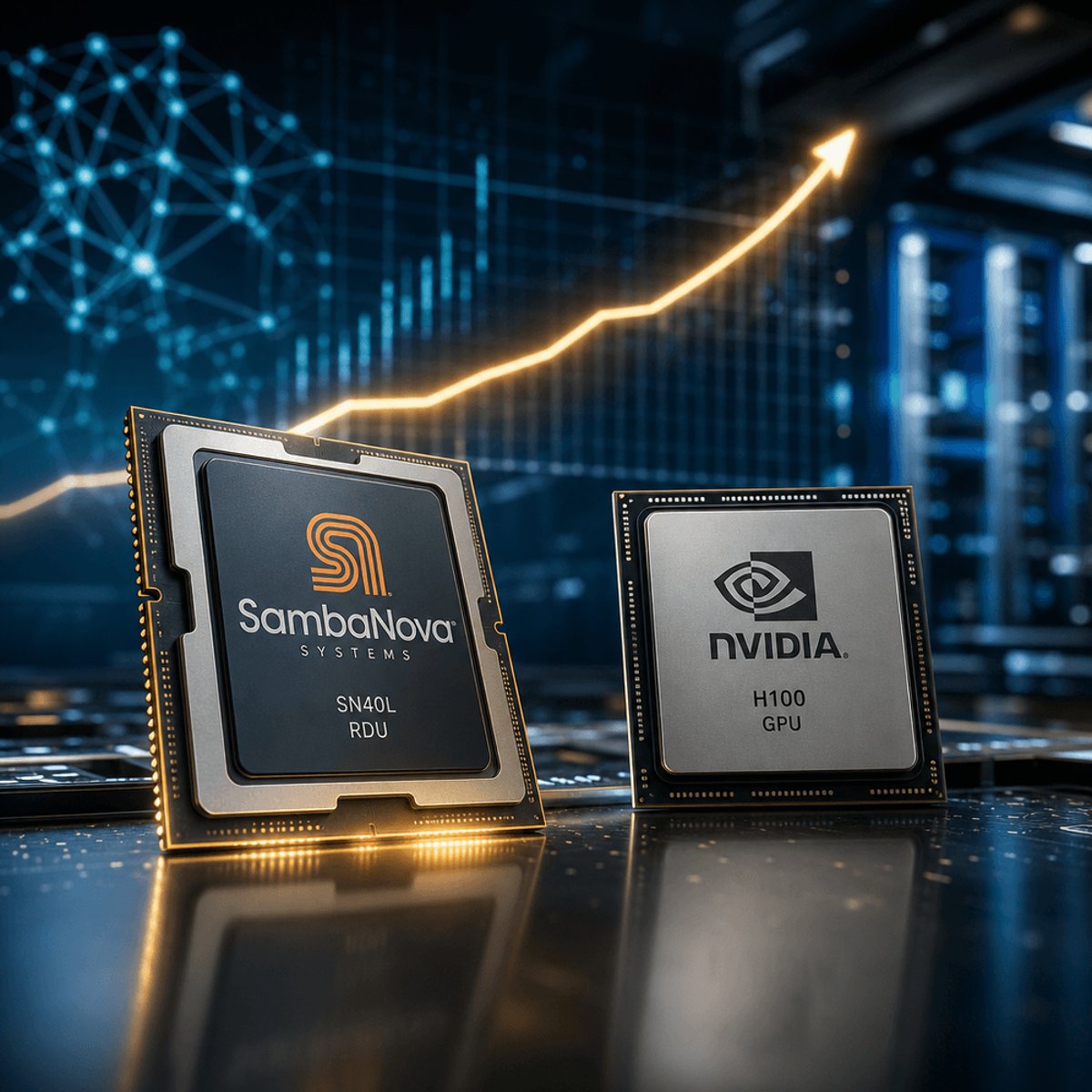
SambaNova Systems just vaulted into the AI chip elite with an $11 billion valuation, powered by fresh funding led by General Atlantic. The Palo Alto-based startup joins a growing cohort of challengers taking aim at Nvidia's stranglehold on AI infrastructure, as investors bet big that the $3 trillion chip market has room for more than one winner. The deal marks one of 2026's largest AI hardware rounds and signals that venture capital is doubling down on alternatives to Nvidia's dominant H100 and B200 chips.
SambaNova Systems just landed an $11 billion valuation, cementing its position as one of the most valuable AI chip startups gunning for Nvidia's throne. The fresh financing round, led by investment firm General Atlantic, arrives at a moment when the AI infrastructure market is simultaneously booming and desperately seeking alternatives to Nvidia's near-monopoly on high-performance AI accelerators.
The deal represents one of the largest AI hardware funding rounds of 2026, though SambaNova hasn't disclosed the exact amount raised or the round's structure. What's clear is that investors are placing billion-dollar bets that the AI chip market can sustain multiple players, even as Nvidia continues to command over 80% of the data center GPU market, according to recent industry estimates.
SambaNova's rise reflects a broader shift in enterprise AI strategy. Companies like Microsoft, Meta, and Amazon have already started designing custom chips to reduce dependence on Nvidia's hardware, while startups like SambaNova, Cerebras, and Groq are pitching purpose-built architectures optimized specifically for AI inference and training workloads. The pitch is compelling - specialized chips that can run large language models faster and cheaper than Nvidia's general-purpose GPUs.
The Palo Alto company has been building its DataScale platform since 2017, focusing on what it calls a "dataflow architecture" that processes AI workloads differently than traditional GPU designs. Instead of moving data back and forth between memory and processors, SambaNova's chips keep data flowing continuously through the system, which the company claims delivers better performance per watt for transformer-based models that power everything from ChatGPT to enterprise AI assistants.
Timing matters here. Nvidia's latest Blackwell chips have faced reported production delays, creating an opening for competitors to court frustrated customers. Meanwhile, the total addressable market for AI chips keeps expanding - analysts project the sector will hit $400 billion by 2030, up from roughly $50 billion today. That explosive growth means challengers don't need to dethrone Nvidia outright; capturing even 10% of a $400 billion market would justify today's valuations.
General Atlantic's involvement signals institutional confidence in the AI infrastructure build-out. The firm has previously backed enterprise tech giants and typically invests in growth-stage companies with proven revenue traction. While SambaNova hasn't disclosed financials, the $11 billion valuation suggests the company is generating meaningful revenue, likely through a combination of chip sales and cloud services where customers can access SambaNova hardware without buying it outright.
But skepticism remains. The chip industry is notoriously capital-intensive and dominated by incumbents with decades of software ecosystem advantages. Nvidia's CUDA platform has become the de facto standard for AI development, giving it a moat that goes far beyond hardware performance. Startups need to not only match Nvidia's chips on speed and efficiency but also convince developers to learn new tools and frameworks - a chicken-and-egg problem that has killed many hardware challengers before.
The competitive landscape is getting crowded fast. Cerebras recently announced plans to go public, OpenAI is reportedly exploring custom chip designs with semiconductor partners, and Google continues expanding its TPU offerings for both internal use and cloud customers. Every major cloud provider now has a custom silicon strategy, fragmenting a market that was nearly monolithic just three years ago.
What happens next will likely depend on whether SambaNova can convert funding momentum into customer wins. The company has been relatively quiet about its client roster compared to more vocal competitors, though it's known to be working with government agencies and enterprise customers on AI deployment projects. The $11 billion valuation gives SambaNova plenty of runway to scale manufacturing, expand its engineering team, and potentially pursue strategic acquisitions of smaller chip designers or software companies that could strengthen its ecosystem.
For Nvidia, deals like this represent both validation and threat. Validation that AI infrastructure is a massive, durable market worth hundreds of billions. Threat that a dozen well-funded competitors are now attacking from every angle - custom chips for hyperscalers, specialized inference accelerators for edge computing, and full-stack alternatives like SambaNova that bundle hardware with software and services. The chip wars are just getting started, and $11 billion says there's room for more than one champion.
SambaNova's $11 billion valuation isn't just about one company's success - it's a signal that the AI infrastructure wars are entering a new phase where capital and competition are both intensifying. Whether SambaNova can translate funding into market share against Nvidia's entrenched dominance remains the billion-dollar question, but for now, investors are betting that specialized AI chips represent a genuine alternative rather than just a niche play. The next 18 months will reveal whether this wave of well-funded challengers can actually crack Nvidia's moat or if they're just expensive experiments in a market with room for only one real winner.