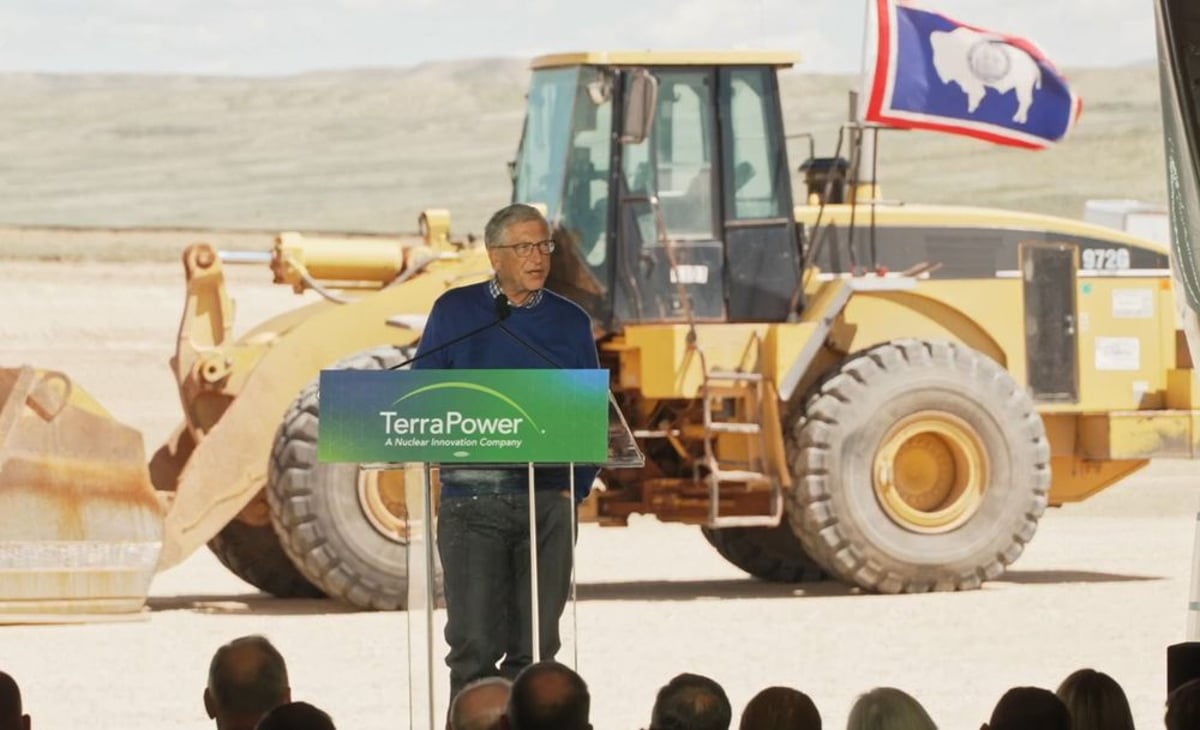
Bill Gates' nuclear energy company TerraPower just cleared a historic regulatory hurdle. The Nuclear Regulatory Commission approved the company's construction permit for a next-generation reactor in Wyoming - marking the first time a commercial-scale advanced nuclear plant has received federal blessing. It's also the first commercial reactor to break ground in the US in nearly a decade, arriving just as AI data centers push electrical grids to their limits.
TerraPower just made nuclear history. The Bill Gates-founded startup landed approval from the Nuclear Regulatory Commission to build its Natrium reactor in Kemmerer, Wyoming - the first commercial-scale advanced nuclear plant to ever receive the federal green light, according to the company's announcement.
The timing couldn't be more critical. As Microsoft, Google, and other tech giants race to build massive AI infrastructure, they're running into a hard wall: power. Data centers training large language models consume staggering amounts of electricity, and the grid is struggling to keep up. TerraPower is betting that smaller, more efficient reactors can solve that crunch.
This isn't just a milestone for TerraPower - it's a watershed moment for the entire US nuclear industry. The country hasn't built a commercial reactor since 2016, when the Watts Bar Unit 2 plant came online in Tennessee after decades of delays and cost overruns. That gap left American nuclear development stuck in neutral while China and other nations pushed ahead with next-generation designs.
The Wyoming facility targets completion by 2030, though nuclear projects have a notorious history of schedule slippage. TerraPower's Natrium design diverges sharply from traditional reactors by using liquid sodium as a coolant instead of water, paired with a molten salt energy storage system that can ramp output up or down based on grid demand. That flexibility is crucial for integrating with renewable energy sources that produce intermittent power.
Bill Gates told The Verge in a 2024 interview that he views advanced nuclear as essential for meeting both climate goals and growing energy needs. The Microsoft co-founder has poured significant personal capital into TerraPower since launching it in 2008, positioning the company to capitalize on renewed interest in nuclear power.
That interest is surging across Silicon Valley. Amazon announced plans to explore small modular reactors near its data centers. Google signed a deal with Kairos Power to purchase nuclear energy. Even Meta is reportedly evaluating nuclear options to power its AI ambitions. The common thread? All of them need reliable, carbon-free baseload power that solar and wind alone can't consistently provide.
TerraPower already broke ground on non-plant construction at the Wyoming site in June 2024, preparing the foundation and support infrastructure. The NRC approval lets the company move forward with the actual reactor components - the high-stakes part where precision and safety become paramount. The facility will sit on the grounds of a retired coal plant, offering a symbolic transition from fossil fuels to clean energy in a state long dependent on coal mining.
The Natrium design outputs 345 megawatts in standard mode but can boost to 500 megawatts for over five hours when demand spikes, thanks to its thermal storage system. That's enough to power roughly 400,000 homes at peak capacity - or several large-scale data centers running AI workloads around the clock.
But TerraPower isn't operating in a vacuum. Companies like NuScale, Kairos Power, and X-energy are all racing to deploy their own small modular reactor designs. The first company to prove commercial viability and navigate the regulatory maze stands to capture enormous market share as utilities and tech companies hunt for clean firm power.
The NRC's approval signals that regulators are getting more comfortable with novel reactor designs, potentially accelerating timelines for other advanced nuclear projects waiting in the queue. That regulatory momentum could prove just as valuable as the technical achievement itself, opening pathways for faster deployment across the industry.
Wyoming Governor Mark Gordon celebrated the approval as a major economic win for the state, promising hundreds of construction jobs and long-term employment once the plant becomes operational. The Kemmerer community, facing economic uncertainty after coal's decline, has largely embraced the project as a lifeline.
Still, questions remain about fuel supply chains, long-term waste management, and whether TerraPower can deliver on its 2030 timeline without the cost explosions that plagued previous nuclear builds. The company's success or failure will likely shape investor confidence in advanced nuclear for years to come, influencing how quickly the technology can scale to meet AI's voracious appetite for electricity.
TerraPower's NRC approval represents more than a regulatory checkbox - it's a proof point that advanced nuclear can navigate America's notoriously difficult licensing process. As AI continues pushing power grids toward breaking points, the race for clean, reliable electricity is intensifying. Whether TerraPower delivers on its 2030 promise will determine if next-generation nuclear becomes a real solution to tech's energy crisis or remains a promising idea stuck in perpetual development. The clock is ticking, and the entire industry is watching Wyoming.