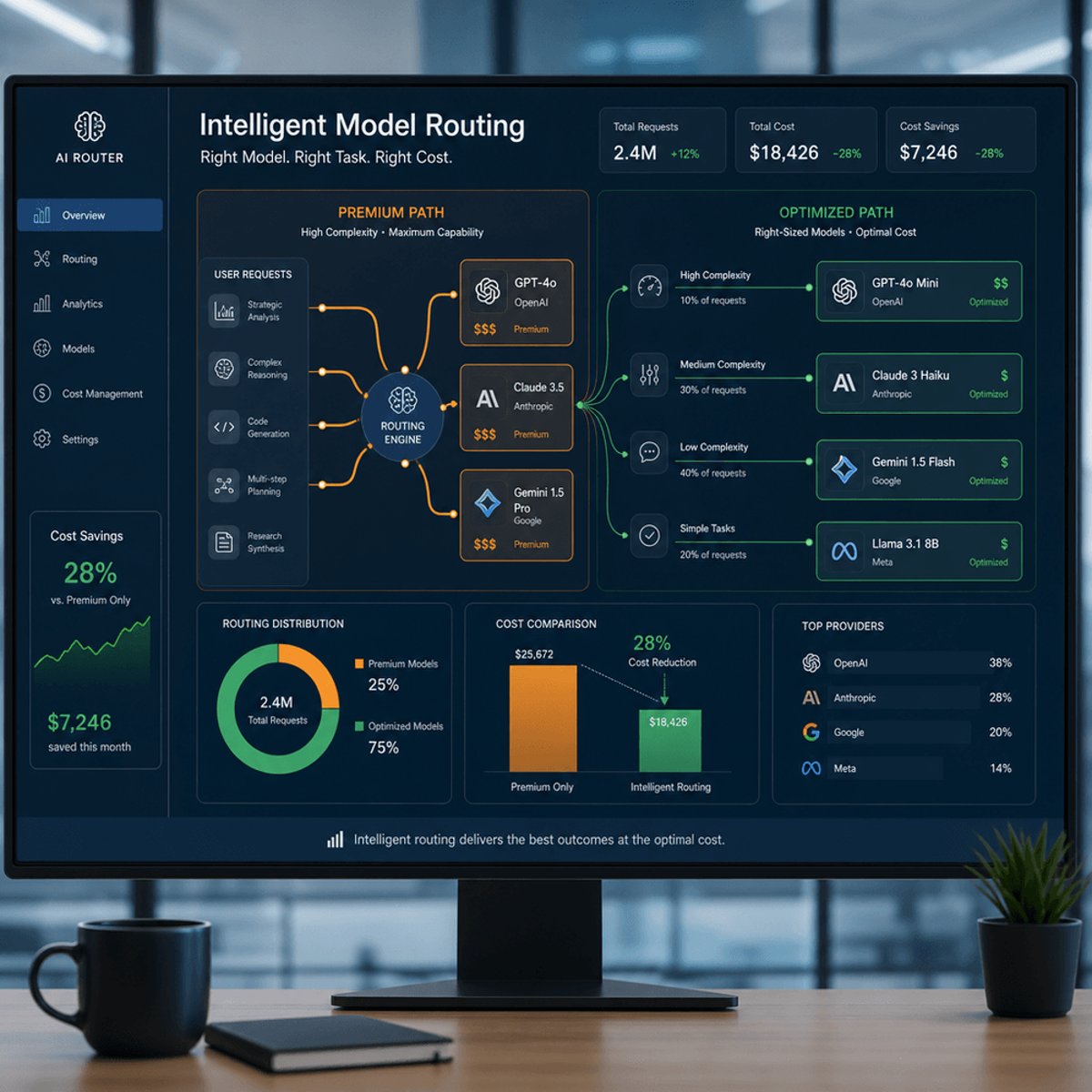
The enterprise AI spending party is over, and OpenAI and Anthropic are feeling the squeeze. Companies are rapidly adopting model routing - a cost optimization practice that matches AI tasks to the cheapest capable model rather than defaulting to premium options like GPT-4 or Claude. The shift marks a fundamental threat to the business models of leading AI providers, who've built their valuations on the assumption enterprises would keep paying top dollar for their most powerful models.
The AI spending boom that propelled OpenAI to a reported $157 billion valuation and Anthropic to unicorn status is hitting an unexpected speed bump. Enterprises are waking up to a simple reality - they don't need a sledgehammer to crack a nut.
Model routing is spreading through corporate IT departments like wildfire. The concept is straightforward but devastating for premium AI providers. Instead of running every task through GPT-4 or Claude 3 Opus at premium rates, companies are building intelligent routing systems that send simple queries to cheaper models and reserve the expensive firepower for complex problems. It's like flying economy for domestic trips instead of booking first class everywhere.
The economics are compelling. While OpenAI's GPT-4 can cost up to $60 per million tokens for output, smaller models from the same company run as low as $0.40 per million tokens. When you're processing millions of queries daily, that difference adds up fast. Enterprises that bought into AI with unlimited budgets during the hype cycle are now facing CFOs demanding ROI, and model routing is the obvious solution.
For OpenAI and Anthropic, this represents an existential challenge to their business models. Both companies have positioned themselves as premium providers, betting that enterprises would pay top dollar for cutting-edge capabilities. But model routing undermines that entire value proposition. Why pay for Claude 3 Opus when Claude 3 Haiku can handle 80% of your workload at a fraction of the cost?
The practice reveals a maturing market. Early AI adopters threw money at the problem, running everything through the biggest models available. Now they're optimizing, and that optimization directly cuts into the revenue streams that justified sky-high valuations. It's reminiscent of the cloud computing evolution, when enterprises moved from over-provisioning AWS instances to right-sizing everything.
The threat extends beyond direct revenue impact. Model routing creates an incentive for enterprises to maintain relationships with multiple AI providers, reducing lock-in and commoditizing the technology. If you're already routing between GPT-4, Claude, and smaller models, switching providers becomes trivial. The moat that OpenAI and Anthropic thought they were building - enterprises deeply integrated with their flagship models - evaporates when those models are just one option in a routing table.
Some AI providers are already adapting. Companies like Microsoft and Google have natural advantages here, offering integrated suites where model routing can be built into broader cloud platforms. Pure-play AI companies like OpenAI and Anthropic face a tougher challenge - they need to figure out how to monetize intelligence rather than just compute cycles.
The timing couldn't be worse for these companies. Both are reportedly raising new funding rounds at valuations that assume continued premium pricing. But if enterprises are systematically routing away from expensive models, those projections look shaky. Investors are starting to ask hard questions about unit economics in a world where model routing is standard practice.
What makes this particularly tricky is that the AI providers themselves are partly responsible. By releasing multiple model tiers - OpenAI's GPT-3.5 versus GPT-4, Anthropic's Claude Haiku versus Opus - they've essentially admitted that not every task requires their most powerful model. Enterprises are simply taking that logic to its natural conclusion.
The shift also highlights a broader question about AI economics. If the value isn't in always using the most powerful model, what exactly are customers paying for? Is it the occasional access to frontier capabilities? The ecosystem and tooling? The brand name? These are uncomfortable questions for companies built on the premise that bigger and more expensive is always better.
Model routing represents the enterprise AI market growing up - moving from experimentation to optimization. For OpenAI and Anthropic, it's a wake-up call that premium positioning only works if customers see premium value in every interaction. The companies that figure out how to monetize intelligence rather than raw compute will thrive. Those that can't adapt may find their valuations were built on assumptions that no longer hold. The AI race isn't over, but the rules just changed.