Google just doubled down on small business AI adoption with a $5 million commitment to train 40,000 companies nationwide. The tech giant announced the funding at the U.S. Chamber of Commerce CO-100 Conference, launching 'Small Business B(AI)sics' - a national program that comes as more than half of small business leaders already consider AI tools critical to their success.
Google is making its biggest bet yet on small business AI adoption. The company announced a $5 million partnership with the U.S. Chamber of Commerce at today's CO-100 Conference, launching what could become the largest small business AI training initiative in the country.
The funding launches 'Small Business B(AI)sics,' a national program designed to equip 40,000 U.S. small businesses with foundational AI skills. It's a significant escalation of Google's enterprise AI strategy, targeting the 33 million small businesses that form the backbone of the American economy.
"Small businesses are the lifeblood of communities everywhere. And they are embracing technology," said Lisa Gevelber, Founder of Grow with Google, during the announcement. The timing couldn't be more strategic - recent research shows more than half of small business leaders already consider AI tools critical to their success.
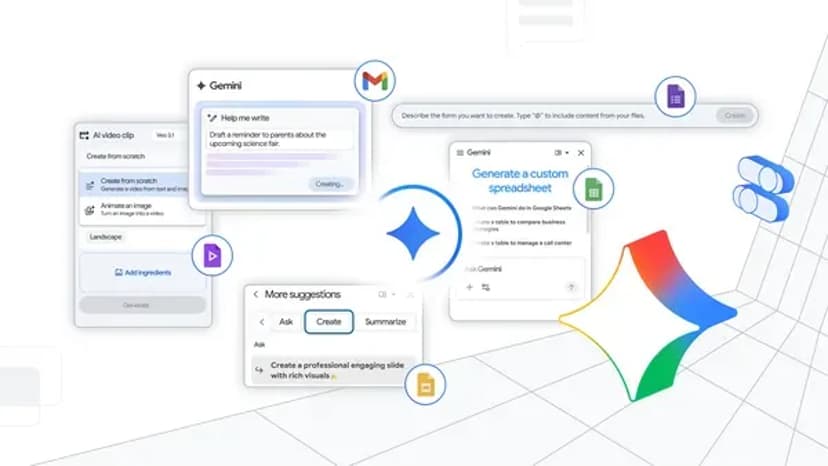
The centerpiece is Google's new "Make AI Work for You" course, which goes beyond basic AI literacy to tackle real business challenges. Participants learn to use AI for creating sales pitch decks, building advertising materials, and analyzing business results. The curriculum features case studies from companies like Chicago-based Heritage Bikes & Coffee, which uses AI tools including Gemini and NotebookLM for everything from costing kitchen supplies to employee onboarding.
What sets this apart from typical corporate training programs is the hands-on approach. Workshop attendees don't just learn theory - they leave with personalized AI implementation plans for their specific businesses. The program combines online resources with in-person workshops delivered through local chambers of commerce across the nation.
Google's timing reflects the company's broader push to democratize AI tools beyond tech-savvy enterprises. While competitors focus on high-end enterprise clients, Google is betting that small business adoption will drive the next wave of AI growth. The approach mirrors successful strategies from Google's previous small business initiatives, which have reached millions of companies through local partnerships.
The workshops are already rolling out in cities from San Diego to Clarksville, Tennessee, with each session tailored to regional business needs. Early participants report immediate applications, from automating customer service responses to streamlining inventory management.
This initiative positions Google ahead of rivals in the small business AI market. While Microsoft focuses on enterprise Copilot adoption and Amazon pushes AWS services, Google is building grassroots AI adoption from the ground up. The Chamber of Commerce partnership gives Google access to established business networks that could accelerate adoption rates significantly.
The program also addresses a critical gap in AI education. Most existing training focuses on technical implementation rather than practical business applications. Google's curriculum bridges that divide, showing small business owners exactly how AI can solve their daily challenges without requiring technical expertise.
For Google, the investment represents more than corporate goodwill. Small businesses trained on Google's AI tools are likely to become long-term customers for Workspace, Cloud services, and advertising platforms. It's a strategic play that could cement Google's position in the small business market for years to come.
Google's $5 million small business AI initiative signals a major shift in how tech giants approach AI democratization. By partnering with the Chamber of Commerce and focusing on practical applications rather than technical complexity, Google is positioning itself to capture the next wave of AI adoption. For the 40,000 small businesses set to participate, this represents a rare opportunity to access enterprise-level AI training at no cost. The real test will be whether these companies can translate training into measurable business results - and whether Google can convert participants into long-term customers across its ecosystem.