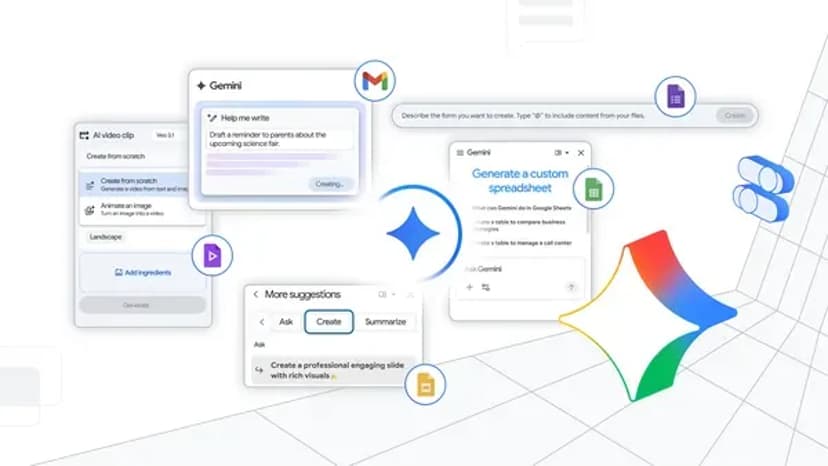
Google just hit a massive milestone in educational AI deployment - Gemini for Education is now integrated across over half of Italian higher education institutions, reaching more than one million students. This isn't just another product rollout; it's the largest documented deployment of enterprise AI in European education, complete with enterprise-grade data protection and specialized learning features.
Google is quietly reshaping European higher education through its biggest AI deployment yet. The company announced that Gemini for Education now reaches over one million Italian university students across more than half of the country's higher education institutions - a scale that dwarfs most enterprise AI rollouts globally.
The deployment goes far beyond basic chatbot access. Italian universities are integrating Gemini's API directly into specialized academic platforms, creating custom AI-powered learning experiences that would cost millions to develop independently. The University of Pavia exemplifies this approach, embedding Gemini into their Eduomics bioinformatics platform to generate detailed clinical scenarios from genetic data, bridging the gap between technical analysis and real-world medical applications.
"This allowed students to grasp the real-world clinical context and purpose behind their data analysis, significantly enhancing engagement and understanding," according to Google's announcement. The integration creates complete family histories and diagnostic clues, showing students why they're analyzing specific datasets rather than just how to crunch numbers.
What makes this deployment particularly significant is Google's enterprise-grade approach. Unlike consumer AI tools, Gemini for Education includes enterprise-level data protection and access to Gemini 2.5 Pro - described by Google as "the world's leading model for learning" - all provided free to accredited institutions.
The University of Ferrara has become a showcase for comprehensive AI integration, positioning AI literacy as "a fundamental competency and shared responsibility across the community." Their deep integration within Google's existing ecosystem ensures intellectual property protection while enabling both educational and administrative use cases.
Meanwhile, the University of Cassino demonstrates practical impact through NotebookLM, particularly for students with dyslexia who use the tool to generate visual mind maps for better comprehension. The AI is also streamlining administrative workflows, allowing staff to query large document volumes for efficient paperwork management.
The rollout includes Guided Learning, a specialized tutoring mode that acts as a personalized AI instructor focused on building deep conceptual understanding rather than providing quick answers. This represents a significant evolution from basic AI assistance toward structured pedagogical support.
Google is backing the technology deployment with comprehensive training infrastructure, including the Gemini Academy - a free, five-module online program designed specifically for educators. The company also provides on-campus training events and integrates with existing programs like Google Career Certificates and the Google Skills platform.
This Italian deployment serves as a proof-of-concept for enterprise AI in education, demonstrating how major tech companies can scale AI tools across entire national education systems. The approach contrasts sharply with piecemeal implementations seen elsewhere, offering a template for comprehensive AI integration that other countries are likely watching closely.
For Google, the deployment represents a strategic foothold in European education markets while generating valuable data on large-scale AI usage patterns in academic settings. The company is positioning itself as the infrastructure provider for educational AI, much like it became the backbone for email and productivity tools in academic institutions over the past decade.
Google's Italian university deployment represents the largest documented enterprise AI rollout in European education, reaching over one million students with specialized learning tools and enterprise-grade protections. The success offers both a template for national-scale AI integration and a glimpse of how major tech companies plan to embed AI infrastructure into educational institutions globally. As universities worldwide grapple with AI adoption, Italy's comprehensive approach - combining free access, robust training, and institutional integration - provides a roadmap that could reshape higher education's relationship with artificial intelligence.