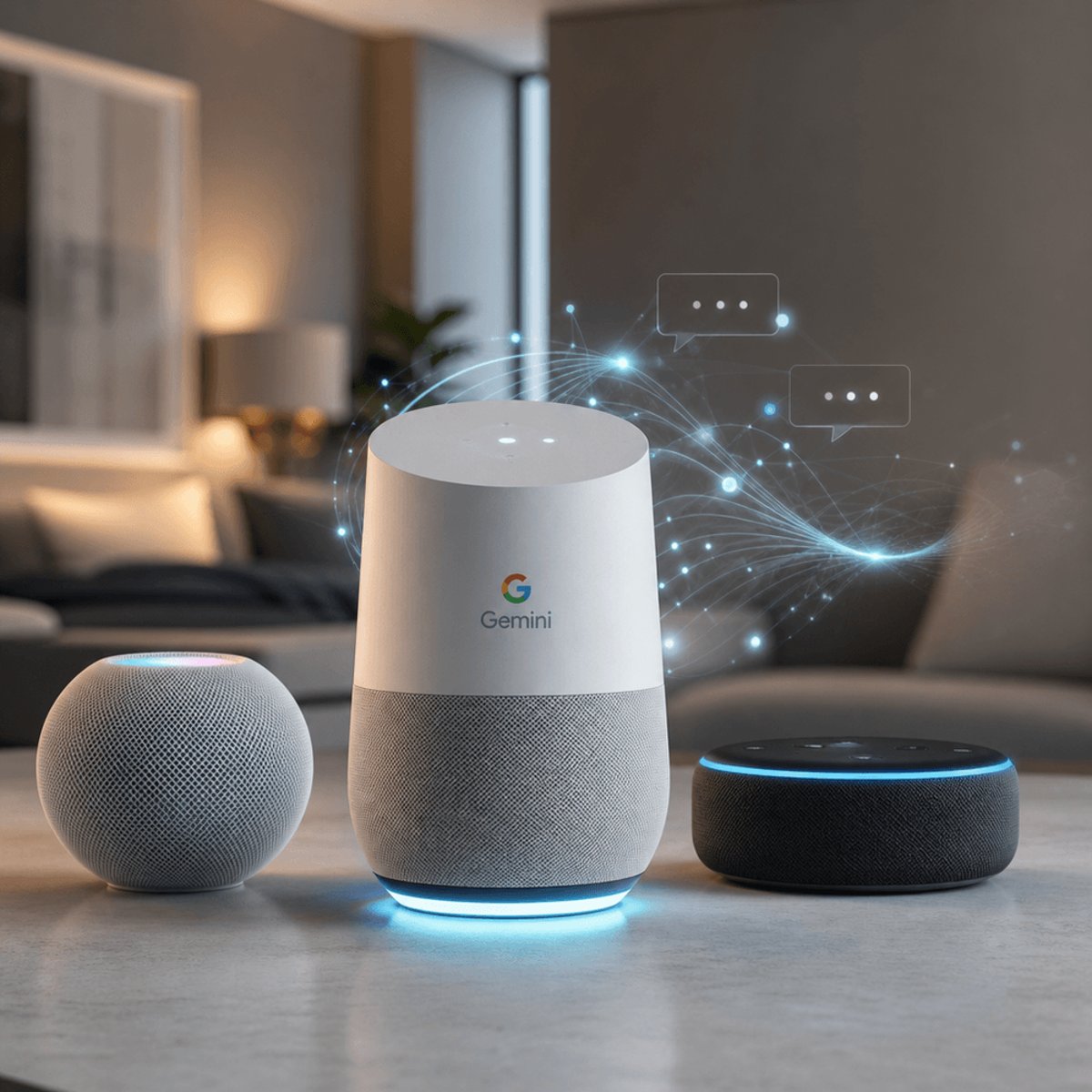
Google just made its boldest play yet in the smart speaker wars. The new Google Home Speaker, powered by Gemini AI, is showing early promise in a 48-hour hands-on test that pits it directly against Apple's HomePod Mini and Amazon's Echo Dot Max. While the smart speaker market has stagnated in recent years, Google's integration of its most advanced AI could finally give voice assistants the intelligence upgrade they've been desperately needing.
Google is making its move. After years of watching Amazon's Alexa dominate living rooms and Apple's HomePod carve out the premium segment, Google's betting that Gemini AI can finally tip the scales.
The new Google Home Speaker hit shelves this week, and early testing reveals what might be the company's strongest hand yet in the smart speaker game. Unlike previous iterations that relied on the aging Google Assistant, this device runs on Gemini - the same multimodal AI that's been powering Google's push into enterprise and consumer AI applications.
What makes this different? It's all about context. During a 48-hour test period documented by ZDNet, the speaker demonstrated an ability to maintain conversation threads and understand follow-up questions without requiring users to repeat context. Ask it about the weather, then follow up with "Should I bring an umbrella?" and it connects the dots. That might sound basic, but it's exactly where existing voice assistants stumble.
The competitive landscape is getting interesting. Apple has locked its HomePod Mini into the iOS ecosystem, banking on seamless integration with iPhones and Apple Music. Amazon's Echo Dot Max, meanwhile, leans heavily on its shopping integration and vast library of third-party Skills. Google's approach with Gemini takes a different angle - it's going for conversational intelligence over feature breadth.
But there's a crucial question hanging over this launch: Does anyone still care about smart speakers? The market has cooled considerably since its 2017-2019 peak. According to industry data, global smart speaker shipments have plateaued, with consumers increasingly questioning what these devices actually do beyond setting timers and playing music. Google needs Gemini to prove that AI-powered speakers can be genuinely useful, not just novelty gadgets.
The technical implementation matters here. Gemini processes queries differently than traditional voice assistants. Instead of matching keywords to predetermined responses, it can interpret intent and generate contextually appropriate answers. In practice, this means more natural interactions - users can speak casually rather than learning specific command phrases.
Early impressions suggest the audio quality sits somewhere between the Echo Dot Max and HomePod Mini. Google isn't trying to compete with audiophile-grade speakers, but the sound is reportedly clear enough for casual listening and podcast playback. The real test will be whether Gemini's conversational abilities make up for any hardware compromises.
The timing of this launch is strategic. Google has been aggressively positioning Gemini across its product line - from search to workspace tools to now smart home devices. The company is clearly trying to establish Gemini as a household name, literally and figuratively. If the Home Speaker can demonstrate tangible improvements over Alexa and Siri, it could validate Google's massive AI investments to consumers who've grown skeptical of incremental upgrades.
There are legitimate concerns about privacy and data collection, especially with an always-listening device powered by advanced AI. Google will need to address these head-on as reviews continue rolling in. The company has added hardware mute switches and on-device processing for certain commands, but the trust factor remains a significant hurdle in the post-Cambridge Analytica era.
The real test starts now. A 48-hour evaluation can reveal first impressions and basic functionality, but smart speakers live or die based on daily utility over months of use. Can Gemini maintain its conversational edge when dealing with edge cases and complex home automation scenarios? Will it integrate smoothly with existing Google Home ecosystems, or will it require users to rebuild their smart home setups?
What we're watching for next is how quickly Google can iterate based on user feedback. One advantage of AI-powered assistants is that they can improve through software updates rather than requiring new hardware. If Gemini can learn from real-world usage patterns and continuously get smarter, Google might finally have a sustainable competitive advantage in the voice assistant wars.
Google's Home Speaker with Gemini represents more than just another smart speaker refresh - it's a test of whether advanced AI can reinvigorate a stagnant product category. The early 48-hour impressions are promising, particularly in conversational context and natural language understanding. But the real question isn't whether Gemini is technically impressive - it's whether consumers will care enough to replace their existing speakers or buy into the smart home ecosystem for the first time. Google has the technology advantage right now, but translating that into market share against entrenched competitors like Amazon and Apple will require more than just better AI. It'll require proving that voice assistants can finally become indispensable rather than just convenient.