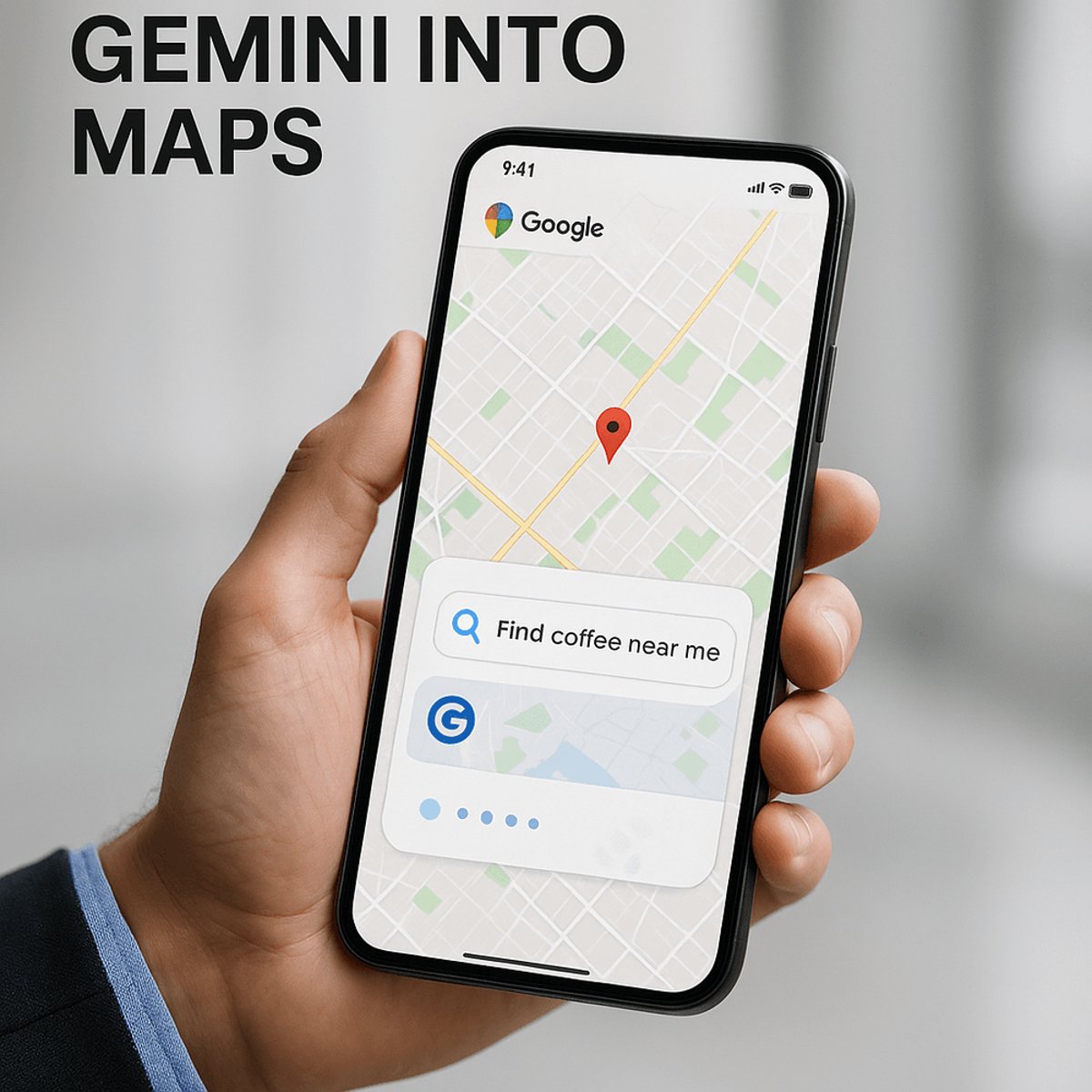
Google just made its biggest consumer AI push yet. The company's rolling out Gemini-powered features across Google Maps, bringing conversational search and immersive AR navigation to over a billion users worldwide. The move, announced by VP Miriam Daniel in a company blog post, signals Google's shift from experimental AI tools to embedding large language models directly into its most-used consumer products. This isn't a research preview - it's AI at scale.
Google isn't waiting around while OpenAI and Microsoft chip away at search. The company just announced it's weaving Gemini AI directly into Google Maps, transforming how more than a billion people navigate and discover places. The rollout includes two major features: Ask Maps, which replaces rigid keyword searches with conversational queries, and Immersive Navigation, an AR-powered system that overlays AI-generated directions onto live camera views.
The timing's no accident. As OpenAI's SearchGPT gains traction and threatens Google's core business, the company's racing to prove its AI chops where it matters most - in the apps people actually use every day. "We're reimagining how people interact with the world around them," Miriam Daniel, VP and GM of Google Maps, wrote in the announcement. The language is careful, but the stakes are clear: Google needs to show it can deploy cutting-edge AI at consumer scale, not just in demos.
Ask Maps is the headline feature here. Instead of typing "coffee shops near me" or hunting through categories, users can now ask questions like they're texting a local friend: "Where can I find a quiet spot to work with good WiFi and pastries?" Gemini processes the natural language query, cross-references Maps' vast database of reviews, photos, and ratings, then surfaces personalized recommendations. It's conversational search applied to local discovery - the exact territory where Google's been dominant for years but vulnerable to AI disruption.
The technical lift behind this is significant. Google has been training Gemini on multimodal data - text, images, location signals - to understand context that goes way beyond simple keyword matching. When you ask about "date night restaurants with a view," the model's parsing sentiment from millions of reviews, analyzing uploaded photos for ambiance cues, and weighing factors like price range and reservation availability. It's the kind of nuanced reasoning that traditional search algorithms struggle with but large language models excel at.
Immersive Navigation takes a different approach, blending AI with augmented reality. Users point their phone cameras at the street ahead, and the app overlays directional arrows, landmark callouts, and turn-by-turn guidance directly onto the live feed. Google has been experimenting with AR navigation since 2019, but the Gemini integration adds real-time scene understanding. The AI can identify visual landmarks, adjust directions based on changing conditions, and even suggest alternate routes if it detects construction or crowds through computer vision analysis.
This puts Google in direct competition with emerging players in spatial computing. Apple has been quietly building out AR mapping features for Vision Pro, while startups like Niantic have raised hundreds of millions to build a "real-world metaverse" anchored by visual positioning systems. Google's advantage? It already has the distribution, the data, and now the AI to make it feel seamless.
The broader context here is Google's hurried pivot to prove it hasn't lost the AI race. After ChatGPT blindsided the industry in late 2022, Google fast-tracked Gemini's development and has been systematically integrating it across products. It started with experimental features in Search, then rolled into Gmail's Smart Compose and Workspace tools. Maps is the next domino - and arguably the most important one for demonstrating everyday utility.
Wall Street's been watching this closely. Alphabet stock took a hit when Bard's rushed launch stumbled, and analysts have questioned whether Google can maintain its search dominance as AI reshapes how people find information. Embedding Gemini into Maps is a strategic counter: it shows the model handling complex, real-world queries at massive scale, not just parlor tricks in a chatbot interface.
There are risks, of course. Large language models are notorious for hallucinations - generating plausible but false information. In a navigation context, that could mean recommending closed businesses, nonexistent shortcuts, or misinterpreting ambiguous queries. Google's betting its extensive grounding in real-world data - reviews, Street View imagery, real-time traffic - will keep Gemini anchored to reality. But one viral story about AI directions leading someone astray could dent user trust fast.
The rollout appears to be gradual. Google hasn't specified exact availability dates or geographic coverage in the announcement, which suggests a phased deployment typical of features this complex. Expect it to hit high-traffic urban markets first - places like San Francisco, New York, London - where Google has the densest data and can monitor performance closely before expanding globally.
Competitors are already scrambling to respond. Apple Maps has been gaining ground with cleaner design and tighter iPhone integration, but it lacks Google's AI firepower and review ecosystem. Microsoft could theoretically leverage OpenAI's models for Bing Maps, but that product's been an afterthought for years. The reality is Maps has always been Google's to lose, and Gemini integration widens the moat.
What's fascinating is how this fits into the larger AI narrative unfolding right now. We're past the hype cycle of "AI will change everything" and into the messy middle where companies have to prove the technology actually works in production. Google's making a big bet that conversational interfaces and real-time visual AI are ready for prime time - and that users will prefer asking questions naturally over hunting through menus and filters.
The implications stretch beyond navigation. If Ask Maps succeeds, it validates a broader shift toward AI-mediated discovery across all kinds of consumer services - travel booking, restaurant reservations, event planning. Google's essentially using Maps as a proving ground for how Gemini handles complex, multi-factor queries in domains where accuracy really matters. Nail this, and the playbook scales to countless other products.
Google's Gemini integration into Maps isn't just a product update - it's a statement. The company's proving it can deploy sophisticated AI at consumer scale, handling billions of queries across messy, real-world contexts where mistakes have consequences. If Ask Maps delivers on its promise and Immersive Navigation feels genuinely useful rather than gimmicky, Google strengthens its position as the infrastructure layer for how we navigate physical and digital spaces. But the pressure's on: every hallucinated restaurant recommendation or glitchy AR overlay becomes ammunition for competitors claiming Google's rushing AI into production before it's ready. The next few months will reveal whether this ambitious deployment was visionary or premature.