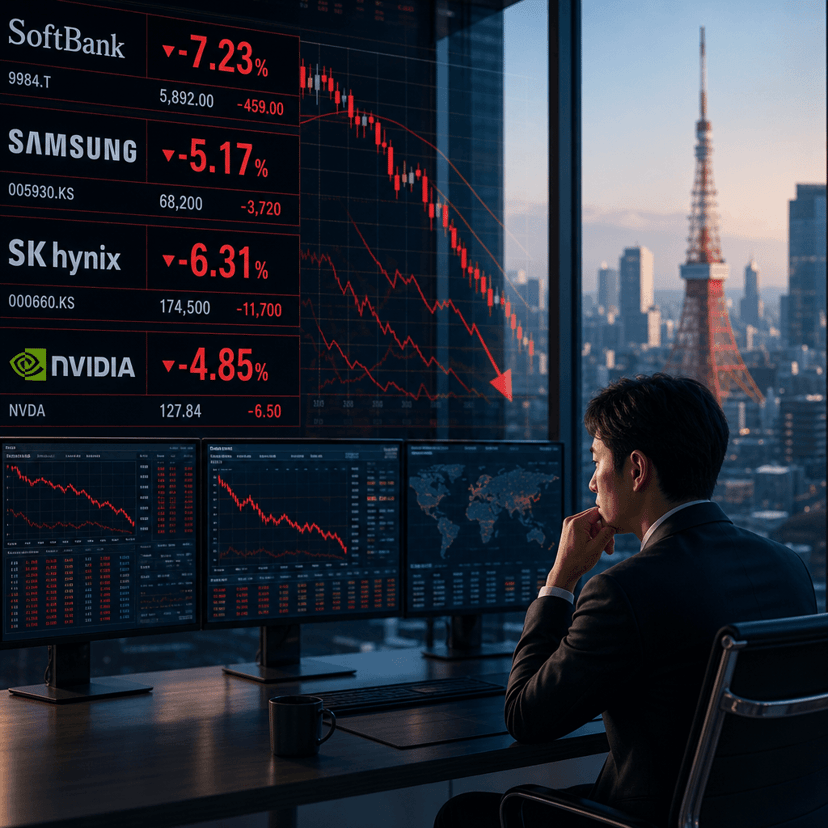
South Korea's finance minister issued a rare public apology today as retail investors nursed devastating losses from leveraged semiconductor ETFs, with the chip stock rout exposing how January's regulatory overhaul created a perfect storm for mom-and-pop traders. The KODEX SK Hynix leveraged fund and similar products have cratered alongside the global semiconductor selloff, but regulatory changes that increased leverage limits earlier this year turned what would've been painful losses into account-wiping disasters for hundreds of thousands of Korean households.
The apology came during an emergency parliamentary session where opposition lawmakers grilled financial regulators about their decision to loosen leverage restrictions on retail investment products. What seemed like market modernization in January has morphed into a political crisis as the human cost becomes impossible to ignore.
Korean retail investors poured an estimated $12 billion into leveraged semiconductor ETFs in the first half of 2026, according to Korea Exchange data. The products promised amplified returns on chip stock rallies, but they delivered amplified destruction when the sector turned. Some leveraged SK Hynix funds are down more than 80% from their February peaks, with daily rebalancing mechanics accelerating the decay during volatile trading.
The timing couldn't have been worse. Just as regulators increased allowable leverage from 2x to 3x on certain equity products, Korean retail investors were going all-in on the AI chip boom. Samsung and SK Hynix had become national pride stories, their stocks seemingly unstoppable as global AI demand surged. Online trading communities swapped tips on maximizing exposure, with leveraged ETFs presented as smart ways to ride the semiconductor supercycle.
But leveraged products are designed to track daily moves, not long-term trends. When chip stocks started their descent in late June - triggered by concerns about AI spending slowdowns and inventory corrections - the math turned vicious. A 5% daily drop in the underlying stock translates to a 15% drop in a 3x leveraged fund. String together weeks of volatility, and the compounding effect destroys capital even if the underlying stock eventually recovers.
"We failed to adequately communicate the risks of these complex products to retail investors," the finance minister told lawmakers, according to transcripts from the session. The admission represents a stunning reversal for regulators who had championed the leverage expansion as evidence of Korea's maturing capital markets.
The crisis has exposed the dangerous intersection of financial innovation, national industrial policy, and retail speculation. Korean officials had actively encouraged domestic investment in homegrown chip champions as part of broader semiconductor self-sufficiency goals. State media regularly featured stories of young investors building wealth through tech stock investments. When regulators simultaneously made it easier to leverage those bets, they created conditions for a wealth destruction event.
Financial advisors are now dealing with the aftermath. One Seoul-based wealth manager described clients who invested their entire severance packages or home down payments into leveraged chip ETFs, believing the products were simply "turbo-charged" versions of owning Samsung stock. The reality of daily rebalancing, decay from volatility, and compounding losses wasn't clearly understood.
The damage extends beyond individual accounts. Korea's Financial Services Commission is facing calls for leadership changes, with critics arguing the regulator prioritized market size over investor protection. Opposition parties have seized on the crisis as evidence of pro-business policies run amok, demanding compensation schemes and stricter product approval processes.
Global asset managers who operated the leveraged ETFs find themselves in an uncomfortable spotlight. While the products functioned exactly as designed - delivering leveraged daily exposure to their benchmarks - the scale of retail adoption in Korea far exceeded patterns in other markets. Some fund operators are privately questioning whether they should've voluntarily limited marketing or imposed suitability requirements beyond regulatory minimums.
The semiconductor selloff shows no signs of stabilizing, which means losses could deepen before any recovery begins. Chip inventory concerns, questions about AI infrastructure spending sustainability, and broader tech sector rotation have created persistent selling pressure. For leveraged ETF holders, each day of volatility eats away at remaining capital, making recovery mathematically harder even if the underlying stocks eventually rebound.
Regulatory responses are already taking shape. The Financial Services Commission announced it would review leverage limits on all retail investment products and consider mandatory suitability assessments for complex instruments. Some lawmakers are pushing for outright bans on marketing leveraged products to non-professional investors, similar to restrictions in several European markets.
But policy changes won't help the current generation of investors nursing catastrophic losses. Online forums that once buzzed with chip stock euphoria now overflow with stories of financial ruin, missed mortgage payments, and family crises. The psychological toll mirrors previous retail investor disasters in Korean markets, from the dot-com crash to cryptocurrency collapses.
The crisis also raises uncomfortable questions about financial literacy in an era of democratized but increasingly complex investing. Mobile trading apps made it trivially easy to buy leveraged ETFs, but understanding how they actually work required parsing dense prospectuses filled with mathematical formulas. The gap between access and comprehension created ideal conditions for mis-selling, even if no explicit fraud occurred.
For Korea's chip industry, the retail investor crisis adds another complication to an already challenging moment. Both SK Hynix and Samsung face questions about memory chip demand sustainability, Chinese competition, and the pace of AI-driven growth. Now they're also associated with household financial destruction, potentially complicating future efforts to rally retail support for the sector.
International regulators are watching closely. The Korean experience provides a real-world stress test of what happens when complex leveraged products meet retail enthusiasm in a concentrated sector bet. As other countries consider their own approaches to retail access versus investor protection, Korea's leveraged ETF crisis offers a cautionary tale about the unintended consequences of well-intentioned market liberalization.
The Korean leveraged ETF crisis stands as a stark reminder that financial innovation and investor protection exist in constant tension. What began as market modernization has ended in ministerial apologies and billions in retail losses, with the full reckoning still ahead. As global chip stocks continue their volatile descent, Korean households are learning the brutal mathematics of leveraged products in the hardest way possible. The regulatory response will likely reshape Asian retail investment markets for years, but for the current generation of investors, those changes come too late. The question now is whether other markets will learn from Korea's experience before replicating its mistakes.