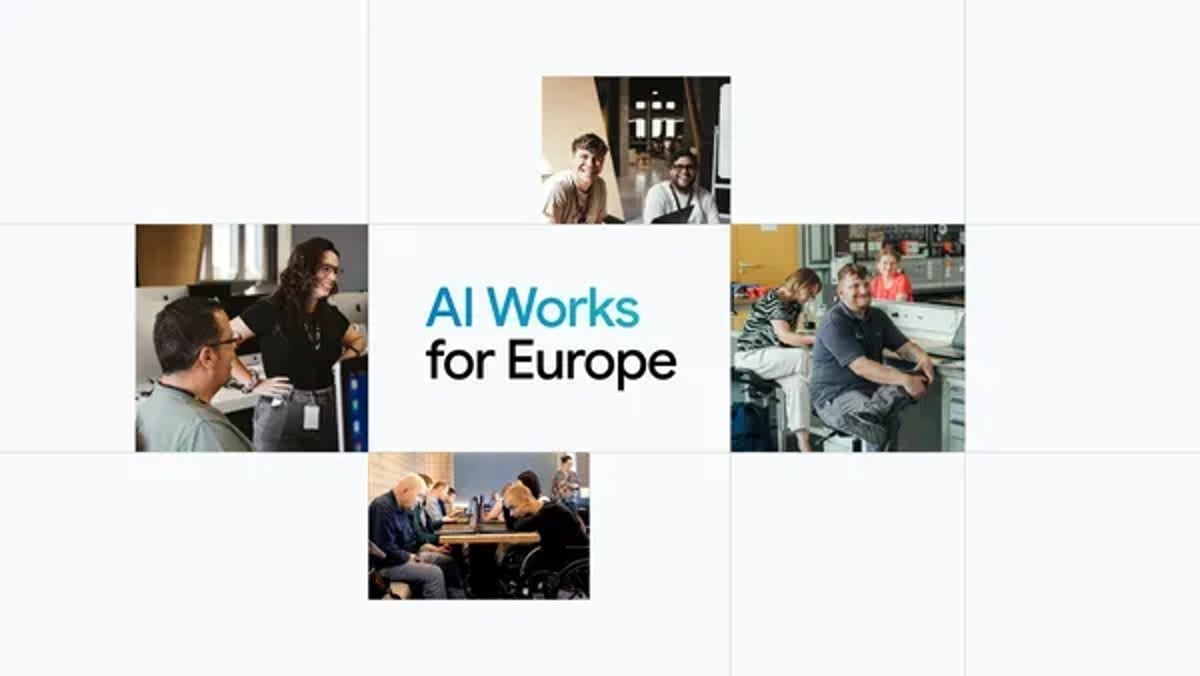
Google just rolled out AI Works for Europe, a sweeping new initiative designed to bring AI skills and training to workers and businesses across the continent. Announced by Debbie Weinstein, President of Google EMEA, the program marks the search giant's biggest bet yet on closing Europe's AI talent gap as companies scramble to integrate AI tools into their operations. The move comes as European businesses face mounting pressure to compete in an AI-driven economy while grappling with workforce readiness challenges.
Google is making its move on Europe's AI skills crisis. The company unveiled AI Works for Europe on March 16, a training initiative that aims to equip workers and businesses across the continent with the AI capabilities they need to stay competitive. The announcement came directly from Debbie Weinstein, President of Google EMEA, signaling just how seriously the tech giant is taking Europe's workforce readiness problem.
The timing couldn't be more critical. European businesses are caught in a squeeze - they're racing to adopt AI tools to keep pace with global competitors, but they're running into a wall when it comes to finding people who actually know how to use them. Recent industry reports suggest millions of European workers will need AI skills training by 2027, and companies from retail to manufacturing are already feeling the pinch.
Google's framing this as a solution for "people and businesses across the continent," according to the official announcement. But the details remain surprisingly thin. The company hasn't yet disclosed how many people it plans to train, which countries will get priority access, or what specific AI skills the curriculum will cover. Will it focus on prompt engineering for everyday workers? Or dive deeper into machine learning fundamentals for technical roles?
What's clear is that Google sees this as both a public service and a strategic play. By training Europeans on AI - likely with a heavy emphasis on Google's own tools and platforms - the company builds goodwill with regulators while creating a pipeline of workers already fluent in its ecosystem. It's a playbook Microsoft has run successfully with its cloud certifications, and one Amazon deployed with AWS training programs.
The European angle matters here. Google's been under intense regulatory pressure across the continent, facing antitrust investigations, hefty fines, and strict AI regulations through the EU AI Act. A splashy workforce development initiative gives the company a positive story to tell Brussels while its lawyers battle in courtrooms. It's corporate diplomacy wrapped in upskilling.
For European businesses, particularly small and medium enterprises, this could be a lifeline. Many lack the resources to build in-house AI training programs or send employees to expensive bootcamps. If Google can deliver accessible, practical training at scale - and that's still a big if - it might actually help level the playing field between European firms and their better-resourced American and Chinese competitors.
But there's a competitive dimension too. OpenAI has been aggressively courting European businesses with ChatGPT Enterprise. Anthropic is expanding its European presence. If Google can get workers trained on Gemini and its enterprise AI tools first, that's a significant advantage in the battle for European enterprise customers.
The enterprise AI market in Europe is projected to hit massive growth over the next few years, and workforce readiness is the biggest bottleneck. Companies aren't just looking for AI tools - they need employees who can actually deploy them effectively. Google's betting that by solving the training problem, it positions itself as the partner of choice when those businesses are ready to scale.
What we're seeing is a familiar pattern in tech: the company that educates the workforce often captures the market. It's why tech giants have been pouring resources into developer programs, certifications, and training initiatives for decades. AI Works for Europe is that strategy applied to the AI age, with the entire European workforce as the target audience.
The initiative also underscores a broader shift in how tech companies are approaching Europe. Rather than treating it purely as a market to extract value from, they're investing in local capacity building - partly out of necessity, partly to stay ahead of regulations that increasingly demand it. Europe's AI Act and digital sovereignty push have made it clear that foreign tech companies need to demonstrate real commitment to European priorities.
Still, questions linger. Will the training be free? How will Google measure success? And critically, will the curriculum be platform-agnostic or essentially a prolonged marketing pitch for Google Cloud and Gemini? The answers will determine whether AI Works for Europe becomes a genuine game-changer or just another corporate PR exercise.
Google's AI Works for Europe could reshape how the continent approaches workforce readiness in the AI era - if it delivers on scale and accessibility. For businesses struggling to find AI-literate talent, this might be the bridge they need. For Google, it's a chance to build loyalty, soften regulatory headwinds, and lock in market share before competitors can do the same. The real test will come in the execution: whether this becomes a meaningful upskilling engine or just another feel-good announcement without teeth. European workers and businesses are watching, and so are Google's rivals.