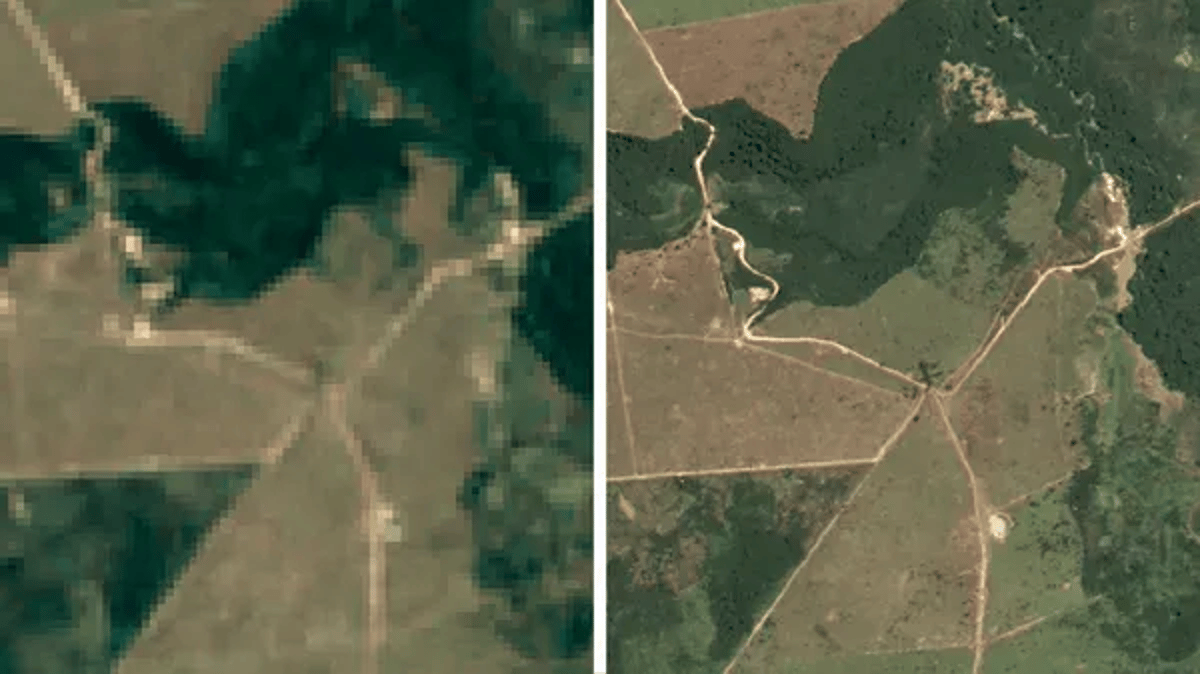
Google just launched a satellite imagery mapping initiative with the Brazilian government to combat deforestation in the Amazon and Atlantic forests. The partnership leverages Google's AI-powered Earth Engine platform to provide real-time monitoring of forest cover changes, marking a significant expansion of the company's environmental technology efforts. The move comes as Brazil faces mounting pressure to reduce deforestation rates that hit a 15-year high in recent years, and positions Google's geospatial AI as a critical tool for conservation efforts.
Google is putting its satellite imaging and AI muscle behind one of the world's most urgent environmental challenges. The company announced a partnership with the Brazilian government to deploy an advanced satellite imagery mapping system designed to protect the country's forests from accelerating deforestation.
The collaboration centers on Google Earth Engine, the company's cloud-based geospatial analysis platform that processes petabytes of satellite data using machine learning algorithms. Brazilian environmental agencies will now have access to near real-time monitoring of forest cover changes across the Amazon rainforest and Atlantic Forest regions, enabling faster response to illegal logging and land clearing activities.
The timing couldn't be more critical. Brazil's Amazon has been hemorrhaging forest cover at alarming rates, with deforestation jumping significantly over the past several years. According to data from Brazil's National Institute for Space Research, the Amazon lost more than 10,000 square kilometers of forest annually between 2020 and 2022. That's roughly the size of Jamaica disappearing each year.
Google's system works by analyzing multispectral satellite imagery captured by NASA's Landsat satellites and the European Space Agency's Copernicus program. The AI models can distinguish between natural forest, cleared land, regrowth areas, and active deforestation zones by examining changes in vegetation indices and land surface temperatures over time. What used to take environmental monitors weeks to detect manually can now be flagged within days.
The partnership represents a significant commitment from Google to apply its AI capabilities beyond commercial applications. The company has been steadily building out its environmental technology portfolio, from helping cities reduce carbon emissions to powering renewable energy grid optimization. But this marks one of its most direct interventions in conservation work.
Brazil's environmental enforcement agencies have struggled with limited resources and vast territories to monitor. The Amazon alone covers 5.5 million square kilometers, an area larger than the entire European Union. Traditional satellite monitoring systems often deliver data too slowly for authorities to intercept illegal loggers before they've cleared massive swaths of forest.
Google Earth Engine changes that dynamic by automating the detection process. The platform can process daily satellite passes and alert Brazilian authorities to suspicious clearing patterns almost immediately. Environmental officers can then cross-reference these alerts with land registry data to identify property owners and deploy enforcement teams to active deforestation sites.
The technology has already proven effective in smaller-scale pilots. Researchers at the University of Maryland used Google Earth Engine to build the Global Forest Watch platform, which has documented forest loss across 98 countries since 2014. That system has been credited with helping reduce deforestation rates in Indonesia and other countries by increasing transparency around forest clearing activities.
What makes this partnership particularly significant is the Brazilian government's direct integration of the technology into its enforcement workflow. Rather than serving as a research tool, Google's system will feed directly into operational decision-making for environmental protection agencies. That operational commitment could amplify the platform's impact considerably.
The initiative also highlights how cloud computing giants are increasingly positioning their AI infrastructure as public goods for addressing climate challenges. Amazon Web Services has launched similar programs supporting climate research, while Microsoft committed $1 billion to its AI for Earth initiative focused on environmental applications.
But questions remain about long-term sustainability and data governance. The partnership relies on Google's proprietary technology and cloud infrastructure, raising concerns about what happens if the company shifts priorities or if the Brazilian government changes its environmental policies. Ensuring the monitoring system remains operational and independent of political pressures will be crucial for its effectiveness.
The collaboration comes as Brazil seeks to rebuild its environmental credibility after years of rising deforestation under previous administrations. The current government has pledged to eliminate illegal deforestation by 2030 and restore 12 million hectares of forest. Advanced monitoring technology like Google's platform will be essential for meeting those ambitious targets.
For Google, the partnership offers a high-profile demonstration of how its AI and cloud capabilities can tackle problems beyond advertising optimization and consumer products. As tech companies face increasing scrutiny over their environmental impact and social responsibility, projects like this provide tangible evidence of technology's potential for positive impact at planetary scale.
Google's Brazilian forest monitoring partnership signals a meaningful shift in how tech giants are deploying their AI infrastructure for environmental protection. If the system delivers on its promise of near real-time deforestation detection, it could provide a blueprint for similar collaborations across the developing world where forest loss remains a critical challenge. The real test will be whether the technology translates into measurable reductions in deforestation rates over the coming years, and whether the partnership can withstand political and economic pressures that have historically undermined conservation efforts. For now, it represents one of the most ambitious applications of satellite AI to environmental enforcement, putting Google's computational power squarely in the fight to save the world's remaining tropical forests.