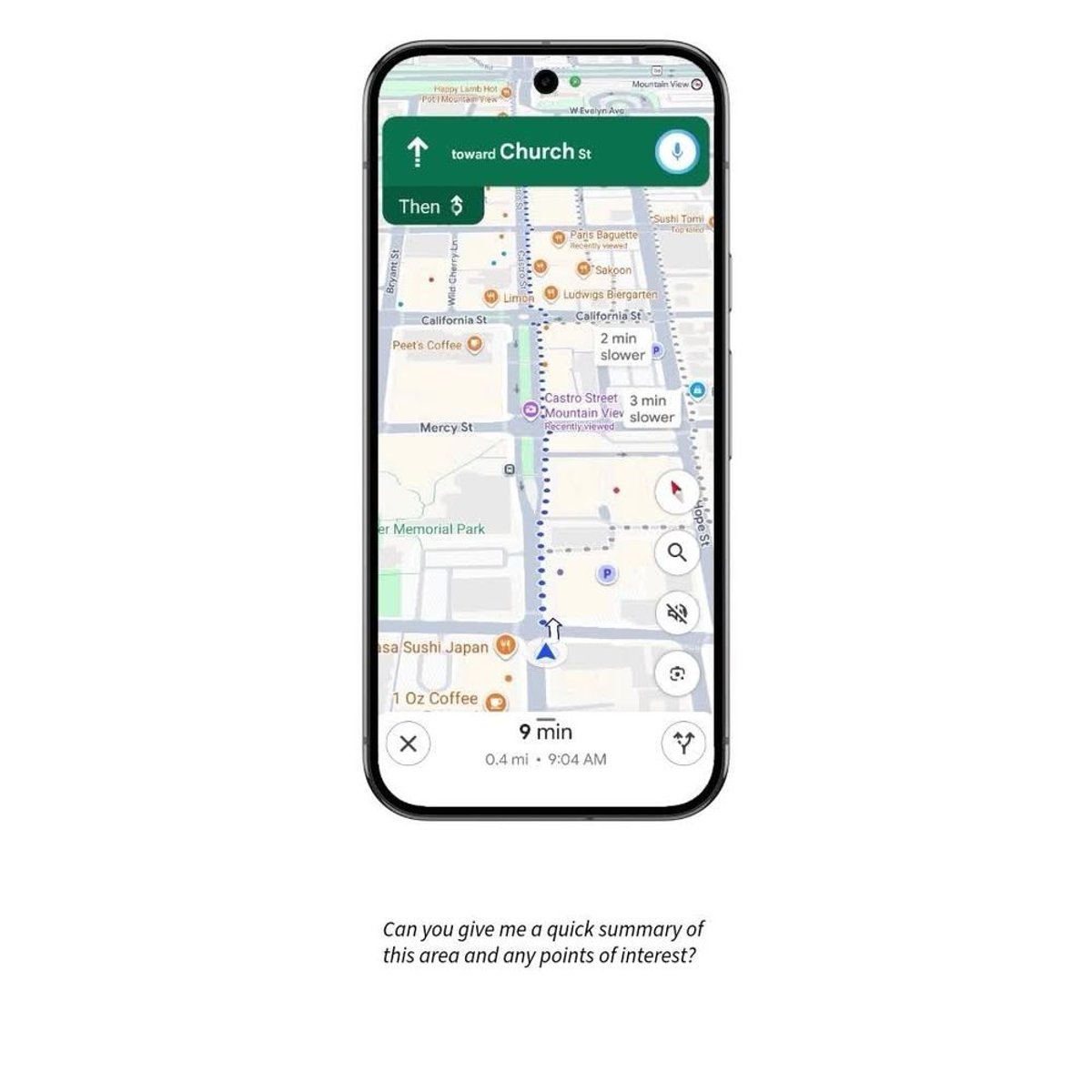
Google just made walking directions a lot smarter. The company announced Thursday it's embedding Gemini AI directly into Google Maps for pedestrians and cyclists, letting users ask contextual questions without stopping or typing. The hands-free feature, now rolling out worldwide on iOS and Android, marks Google's latest push to transform Maps from a static GPS tool into a real-time conversational assistant that understands where you are and what you need.
Google is betting that the future of navigation isn't about better maps - it's about better conversations. The company announced Thursday that Google Maps now lets pedestrians and cyclists access Gemini hands-free while navigating, marking a significant expansion of the AI assistant's reach into everyday mobility.
The update builds on Google's November rollout of Gemini-powered conversational driving features, but this time it's designed for people on foot and bikes. Walk through an unfamiliar neighborhood and you can now ask "Tell me more about the neighborhood I'm in" or "What are some must-see attractions?" without breaking stride. Cyclists can keep both hands on the handlebars while asking "What's my ETA?" or even dictating messages like "Text Emily I'm 10 minutes behind."
Google's pitch is simple: walking and typing don't mix well. According to the company's announcement, the feature solves the awkward dance of stopping, pulling out your phone, typing a query, and then trying to remember which direction you were heading. Instead, Gemini stays active within the navigation screen, ready to field multi-part questions like "Is there a budget-friendly restaurant with vegan options along my route, something within a couple of miles? What's parking like there?"
The integration represents Google's broader strategy to weave Gemini into every corner of users' daily routines. Earlier this week, the company updated Chrome with enhanced Gemini integration and agentic features that can navigate websites autonomously, taking direct aim at AI-first browsers from OpenAI, Perplexity, and The Browser Company. Google also recently previewed Gemini features for TV at CES and embedded AI overviews directly into Gmail.
For Maps specifically, this isn't just about adding voice commands. Google's been systematically transforming the app from a static GPS into an ambient intelligence layer. In November, the company rolled out a Gemini-powered "know before you go" section that surfaces hyper-local intel - think secret menu items, best parking spots, or reservation tips - before you even arrive. The app also added EV charger availability predictions and an improved Explore tab designed to surface trending spots based on real-time activity.
What makes this update noteworthy isn't the technology itself - voice assistants have existed for years - but rather the context-aware intelligence. Gemini can now understand that "cafes with a bathroom along my route" means you want options within walking distance, not a comprehensive city guide. It knows you're moving, it knows where you're going, and it can filter suggestions accordingly.
The competitive implications are subtle but significant. While Apple Maps has long integrated Siri, it hasn't matched Google's contextual depth. Meanwhile, AI-native startups like Perplexity have struggled to build the foundational location data that Google's spent two decades perfecting. By embedding Gemini into Maps, Google's essentially defending its navigation moat while simultaneously attacking the AI assistant battleground.
The feature launches worldwide on iOS wherever Gemini is available and is rolling out now on Android, according to Google's announcement. There's no mention of subscription requirements, suggesting it's available to all Maps users in supported regions - a notable contrast to OpenAI's premium ChatGPT features or Perplexity's Pro tier.
For cyclists specifically, the safety angle is hard to ignore. Being able to dictate messages or check ETAs without fumbling for your phone could reduce distracted riding incidents. Google didn't cite safety data in its announcement, but the implication is clear: hands-free means eyes on the road.
The bigger question is whether users will actually talk to their Maps app. Voice interfaces have historically struggled with adoption outside of cars, where hands-free operation is essential. Pedestrians might feel self-conscious asking their phone about neighborhood history while walking through a crowded street. But Google's betting that utility will override awkwardness - and that once users experience contextual AI assistance, they won't want to go back to typing.
What's notably absent from the announcement: any mention of how Gemini handles privacy when processing location-based queries, or whether these conversational interactions are stored and used for training. Google's faced ongoing scrutiny over location data practices, and embedding AI into real-time navigation only amplifies those concerns.
Google's Gemini integration into Maps walking and cycling navigation signals a broader industry shift from static GPS to ambient conversational intelligence. While the immediate utility is clear - hands-free queries about nearby spots without stopping - the strategic play is about locking users into Google's AI ecosystem before competitors can build comparable location intelligence. As OpenAI, Perplexity, and others race to build AI-first experiences, Google's leveraging its two-decade head start in mapping data to make Gemini indispensable for everyday mobility. The real test won't be whether the technology works, but whether people actually want to have conversations with their navigation app when they're walking down the street.