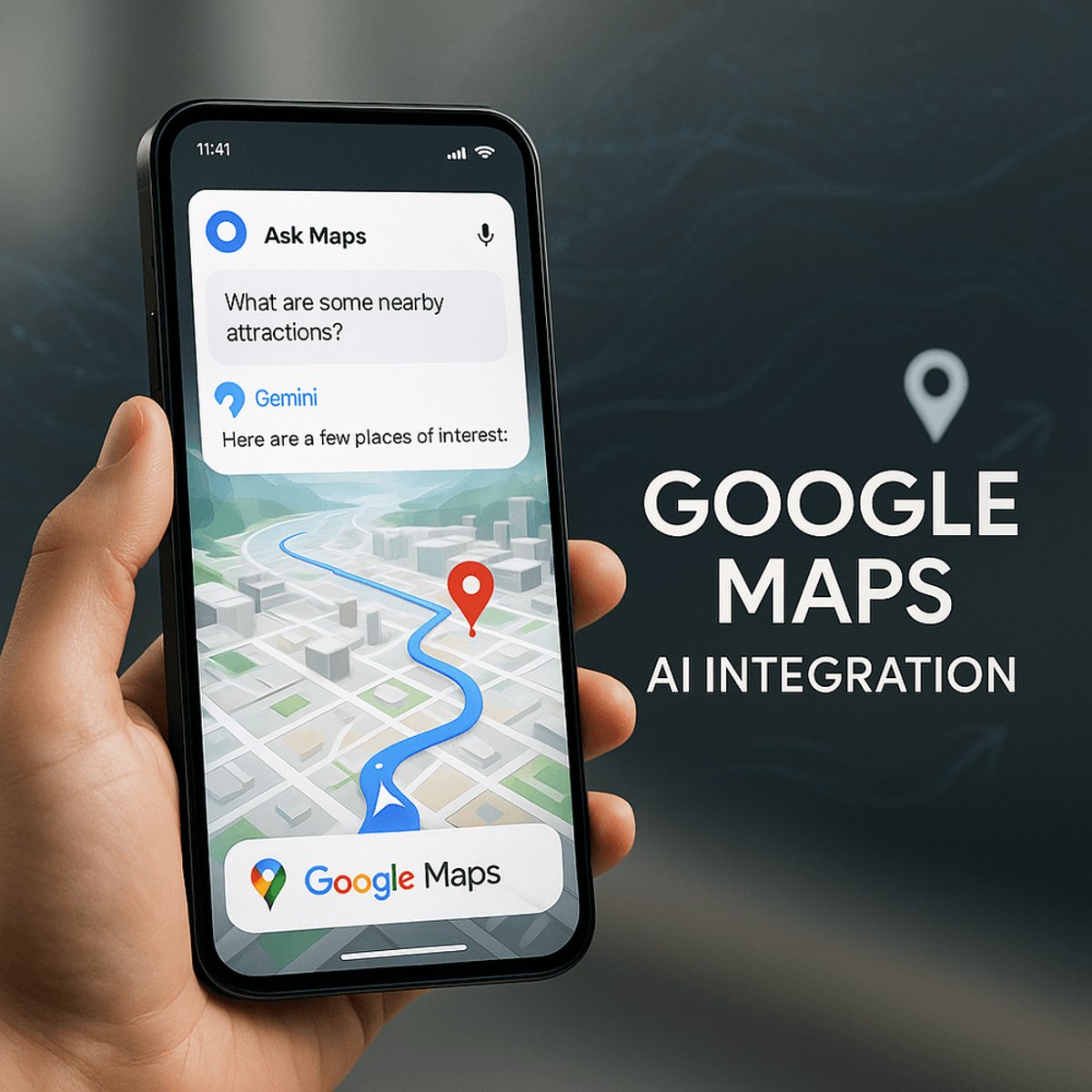
Google just dropped its most ambitious Maps update in over a decade, and it's bringing the company's Gemini AI directly into the navigation experience used by more than a billion people worldwide. The new 'Ask Maps' feature lets users have conversational interactions with the app, while upgraded Immersive Navigation promises to transform how we visualize routes. It's Google's boldest move yet to inject AI into everyday consumer tools, and it could fundamentally reshape how we interact with mapping services.
Google is making its biggest bet yet that people want to talk to their maps, not just search them. The company's rolling out 'Ask Maps,' a Gemini-powered conversational interface that transforms the world's most popular navigation app into an AI assistant that actually understands context.
Instead of typing 'coffee shops near me,' users can now ask things like 'where can I grab a quick espresso before my 2pm meeting?' and get personalized suggestions that factor in location, time, and preferences. It's the kind of natural language interaction that Google's been perfecting with Gemini, now deployed at scale to an app that processes billions of queries daily.
The timing isn't coincidental. Google is racing to embed AI everywhere before users default to asking ChatGPT or other AI assistants for local recommendations. By intercepting those queries inside Maps, the company keeps users in its ecosystem and captures valuable behavioral data that feeds back into its AI models.
But Ask Maps is just the headline feature. The company's also launching what it calls Immersive Navigation, a dramatically enhanced version of the AR-powered directions Google's been testing for years. According to the company, this represents the biggest technical overhaul to Maps in more than a decade - a bold claim for an app that's been continuously evolving since 2005.
Immersive Navigation combines AI-generated 3D visualizations with real-time data to create what amounts to a photorealistic preview of your entire route. Think of it as Google Earth's Street View having a baby with turn-by-turn directions, all powered by machine learning models that can predict traffic patterns, suggest alternate routes, and even highlight parking spots before you arrive.
The feature taps into the same AI infrastructure that powers Google's search improvements and Gemini responses. The company's been quietly building out the computer vision and predictive models needed to render these immersive views at scale, leveraging the massive dataset collected from years of Street View cars, satellite imagery, and anonymized user location data.
For Google, this is about maintaining dominance in a market it's owned for years but can't afford to take for granted. Apple has been steadily improving Apple Maps with its own 3D features and detailed city views. Meanwhile, upstarts like Waze (which Google owns but operates separately) continue to innovate on community-driven navigation.
The AI integration also gives Google a new revenue opportunity. While the company hasn't announced specifics, conversational search opens doors for more sophisticated local advertising. Imagine asking for restaurant recommendations and getting sponsored suggestions that feel native to the conversation - that's the monetization play lurking beneath the surface.
What makes this launch particularly significant is the scale. Google Maps isn't some experimental product with a few million early adopters. It's a core utility for over a billion people, many of whom rely on it daily for basic navigation. Pushing AI features to that user base is the kind of mass-market deployment that could actually shift how consumers perceive and use AI tools.
The company's also betting that people will trust AI recommendations more when they're tied to navigation and location - contexts where Google already has credibility. It's easier to accept an AI suggesting a coffee shop when you can see it's actually on your route, versus some abstract recommendation with no geographic anchor.
There are obvious privacy questions here, though Google's been navigating those waters for years with Maps. The conversational data from Ask Maps will presumably train future Gemini models, creating a feedback loop where user queries improve the AI's ability to understand location-based intent. The company has location data already; now it's getting natural language context to match.
Competitors will be watching closely. If Ask Maps gains traction, expect Apple to rush similar Siri integration into Apple Maps, while Microsoft might push Copilot deeper into its mapping products. The race to own conversational local search is officially on.
For now, Google's got the advantage of scale, data, and an AI model in Gemini that's proven capable of handling complex, multi-turn conversations. Whether users actually want to chat with their maps, or if they'll stick with quick typed searches, remains to be seen. But Google's clearly betting that the future of navigation is conversational, immersive, and AI-powered.
Google's pushing AI into Maps at a scale that could define how billions of people interact with location services. The Ask Maps feature brings conversational search to navigation, while Immersive Navigation leverages AI for photorealistic route previews. It's the kind of mass-market AI deployment that goes beyond novelty features - this could actually change daily behavior. The real test comes when users decide whether they want to chat with their maps or stick with the search boxes they've used for years. Either way, Google's forcing competitors to respond and establishing a new baseline for what mapping apps should do. The AI arms race just hit your daily commute.