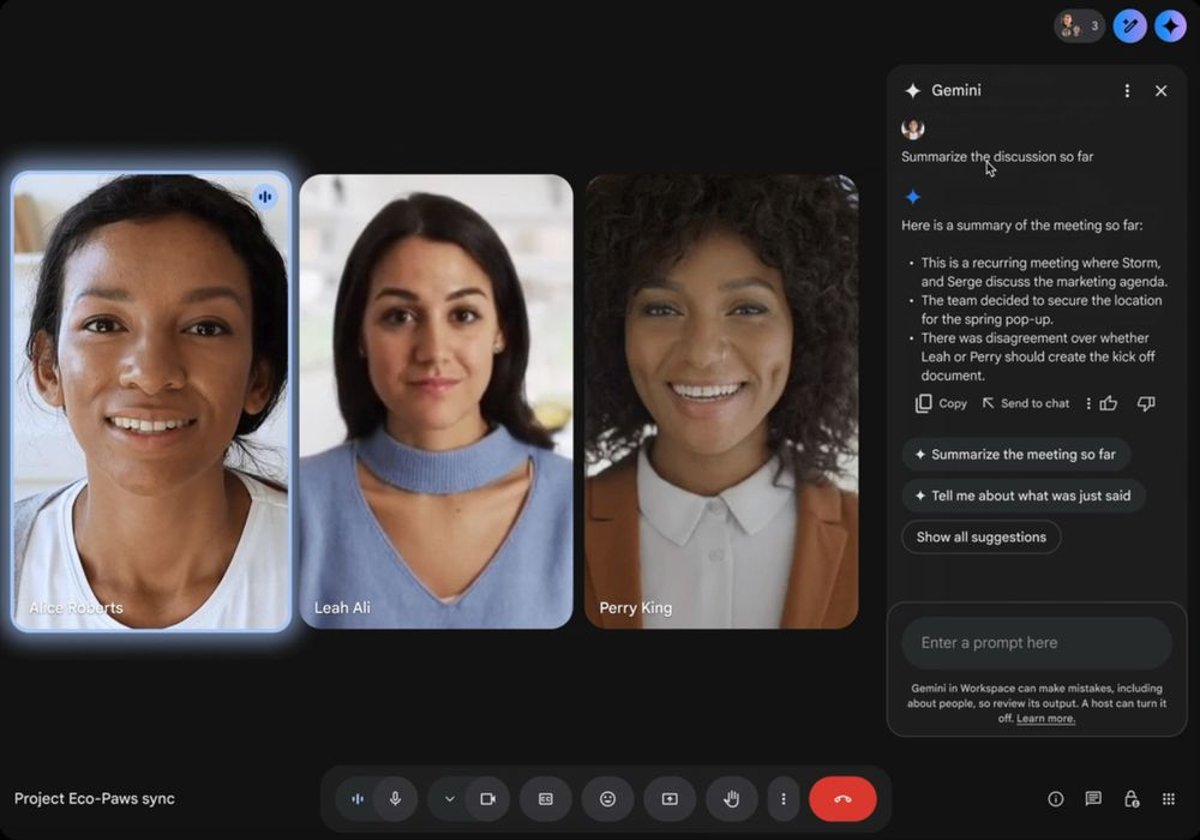
Google just launched Ask Gemini for Meet, bringing AI-powered meeting assistance to select Workspace enterprise customers. The assistant can answer questions, summarize what participants missed, and identify key decisions - all while keeping responses private and deleting data after calls end.
Google is making meetings smarter with the rollout of Ask Gemini for Meet, but don't expect to see it in your personal Google account anytime soon. The AI assistant launches exclusively for select Google Workspace enterprise customers, marking another strategic move to monetize AI through business subscriptions rather than consumer features.
The timing couldn't be better for Google's enterprise push. As remote and hybrid work cement themselves as permanent fixtures, companies are desperately seeking tools that make virtual meetings more productive. Ask Gemini promises to be that invisible assistant everyone wishes they had - answering questions, summarizing key points, and helping late arrivals catch up without awkward interruptions.
[embedded image of Google Meet interface showing Ask Gemini notification]
Here's how it works: The AI taps into live captions generated during calls, plus any Google Docs, Sheets, or Slides that participants can access. It can also pull from public websites, creating a comprehensive knowledge base for answering questions on the spot. "What did Sarah say about the Q4 projections?" becomes a query the AI can actually answer by referencing specific moments in the conversation.
But Google's being careful about privacy and transparency. According to the official announcement, Ask Gemini's responses stay private to each participant - your AI-generated meeting summary won't be visible to others. More importantly, all meeting data including captions gets wiped when the call ends, addressing the growing enterprise concern about AI systems storing sensitive business discussions.
The feature builds on Google's existing Take Notes for Me capability, which already generates meeting summaries automatically. Ask Gemini takes this a step further by making that information interactive and queryable in real-time.
Google's rollout strategy reveals its enterprise priorities clearly. The feature launches first for Workspace Enterprise Plus, Enterprise Standard, Business Plus, and Business Standard customers - the premium tiers that generate the highest per-user revenue. Google won't expand to Business Starter and other lower-tier plans until Q1 2026, and only after "collecting and applied critical user feedback to improve the feature."
The desktop-only, English-language launch also signals Google's methodical approach to enterprise AI deployment. Unlike consumer AI features that often launch globally simultaneously, enterprise tools get careful, controlled rollouts to ensure reliability and compliance with business requirements.
This cautious approach makes sense given Google's warning that "Gemini in Workspace can make mistakes, including about people, so users should review its output." In enterprise settings, AI hallucinations aren't just embarrassing - they can derail deals, miscommunicate strategic decisions, or create compliance issues.
Ask Gemini represents Google's broader strategy of embedding AI throughout its Workspace suite rather than launching standalone AI products. While competitors like Microsoft push Copilot as a distinct AI brand, Google integrates Gemini more subtly into existing workflows.
The feature also highlights the competitive dynamics in enterprise video conferencing. While Zoom and Microsoft Teams offer their own AI meeting assistants, Google's advantage lies in deep integration with its workspace ecosystem. Ask Gemini can reference your Google Drive files during meetings - something external AI tools can't match without complex permissions and integrations.
For IT administrators, Google provides granular controls typical of enterprise software. While Ask Gemini enables by default, hosts can disable it mid-meeting, and admins can flip the default to off for their entire organization. Every participant sees clear notifications when the AI assistant activates, maintaining the transparency that enterprise customers demand.
The Q1 2026 timeline for broader availability suggests Google expects significant iteration based on early enterprise feedback. This measured approach contrasts sharply with the rapid-fire AI feature releases we've seen in consumer products, reflecting the higher stakes and longer sales cycles in enterprise software.
Ask Gemini for Meet represents Google's calculated bet that enterprise customers will pay premium prices for AI that makes meetings genuinely more productive. By starting with high-tier Workspace customers and emphasizing privacy controls, Google is positioning itself as the reliable AI partner for business-critical communications. The real test will be whether enterprise users find the AI actually saves time or becomes another digital distraction in already overloaded meeting schedules.