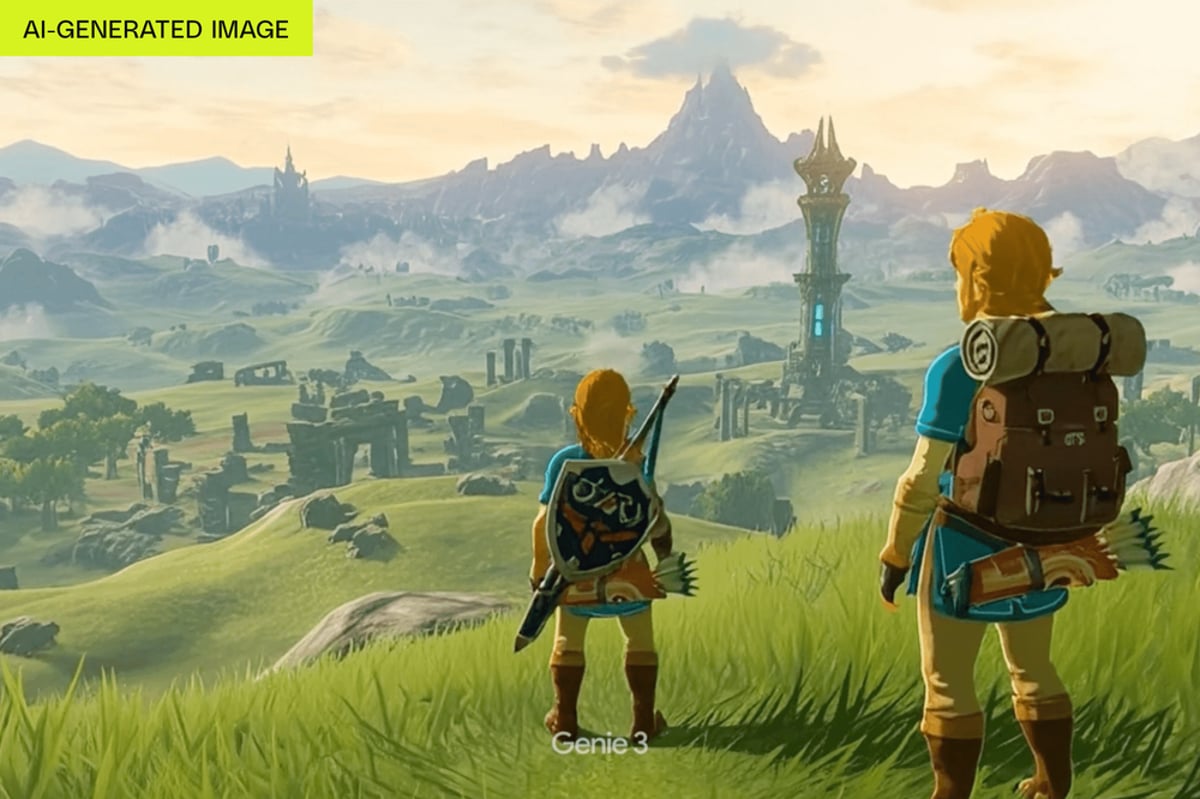
Google just dropped Project Genie, an experimental AI tool that generates playable 3D game worlds from text prompts, and The Verge got early access. The tool, built on Google DeepMind's Genie 3 world model, is rolling out today to Google AI Ultra subscribers in the US. It's the first public test of technology that could reshape everything from filmmaking to robotics, though right now it's best at creating janky Super Mario and Zelda clones that barely work.
Google DeepMind is letting people play with fire. The company's new Project Genie tool generates interactive 3D game worlds from simple prompts, and early testers immediately started recreating Nintendo franchises. The results are messy, laggy, and sometimes hilarious, but they point to where AI-generated interactive media might be heading.
Project Genie builds on the Genie 3 model that Google announced last year, previously available only as a limited research preview. Starting today, Google AI Ultra subscribers in the US can access the experimental prototype through a new interface. You type a prompt describing an environment and character, wait a few moments, and Genie generates a thumbnail preview before rendering a full explorable world.
Each generated experience lasts exactly 60 seconds, runs at roughly 720p resolution and 24 frames per second, and responds to WASD movement controls plus spacebar jumps. In theory, anyway. In practice, The Verge's early testing revealed significant technical limitations that make the experiences feel more like tech demos than actual games.
"It's really for us to actually learn about new use cases that we hadn't thought about," Diego Rivas, a product manager at Google DeepMind, told The Verge. The company envisions applications beyond gaming: visualizing film scenes, creating interactive educational content, even helping robots navigate physical spaces. Parents could photograph their kid's favorite toy and generate a custom world around it.
But Shlomi Fruchter, a Google DeepMind research director, stressed that Project Genie isn't yet "an end-to-end product that we expect people to just use every day." That's putting it mildly. Google's pre-built worlds like "Rollerball" (a blue orb painting trails in snow) and "Backyard Racetrack" demonstrated the technology's current ceiling: simple environments with no objectives, no sound, and frustrating input lag worse than cloud gaming services.
The real test came when reporters started pushing boundaries. Simple prompts like "spunky anime teenager with spiky brown hair wielding a blade that is like a key" generated worlds that looked suspiciously like Kingdom Hearts, complete with recognizable character designs. More direct prompts created functioning knockoffs of Super Mario 64, Metroid Prime, and The Legend of Zelda: Breath of the Wild, complete with a paraglider that deployed automatically.
How'd the AI know to add that paraglider? The Genie 3 model was "trained primarily on publicly available data from the web," according to Rivas. At its core, Genie constantly predicts the next frame based on user input, and the internet is flooded with videos of Breath of the Wild players jumping and gliding. The model simply learned the pattern.
The Nintendo recreations exposed both the technology's potential and its glaring flaws. Worlds suffered from severe memory issues, sometimes forgetting to render paint trails or randomly transforming roads into grass mid-experience. Input lag made precise movement nearly impossible. Characters occasionally became uncontrollable while the camera still responded. The 60-second time limit felt arbitrary and limiting.
Then came the content moderation whiplash. Project Genie initially generated worlds based on copyrighted Nintendo franchises with minimal resistance. A Kingdom Hearts world made it to thumbnail stage before blocking generation. Shortly before The Verge published its hands-on report, Google restricted Super Mario 64-themed worlds "due to interests of third-party content providers."
Nintendo is notorious for aggressively protecting its IP, so the company likely won't appreciate Google's AI casually recreating its iconic franchises from text prompts. The situation mirrors broader tensions in generative AI around training data, copyright, and fair use. If Genie learned from publicly available gameplay videos, does that make generated worlds derivative works? Google's inconsistent moderation suggests the company is still figuring out those boundaries in real-time.
Rivas emphasized that "Project Genie is an experimental research prototype designed to follow prompts a user provides" and that the team is "monitoring closely and listening to user feedback." Translation: they're learning what problems emerge when normal people get access to powerful generative tools.
Compared to other AI-generated interactive experiences from 2024, Project Genie shows meaningful progress in consistency and visual coherence. But it remains far behind handcrafted video games in every meaningful dimension: responsiveness, visual fidelity, gameplay depth, and basic reliability. Fruchter described a future where lines blur between different media types thanks to technology like Genie, but that vision feels distant given current limitations.
The underlying technology represents significant AI research progress. Generating coherent 3D spaces that respond to user input in real-time requires predicting physics, lighting, object permanence, and spatial relationships frame by frame. That Genie works at all is impressive. That it works well enough for a 60-second demo suggests the technology could eventually mature into something genuinely useful.
For now, though, Project Genie serves mostly as a research playground. Google is explicitly positioning this as an experiment to discover unexpected applications rather than a finished product. AI Ultra subscribers paying for early access should expect more frustration than fun, more technical curiosities than actual entertainment.
The genie isn't out of the bottle yet, but you can see it rattling around in there.
Project Genie offers a glimpse at AI-generated interactive worlds, but the technology isn't ready for prime time. The 60-second time limits, significant input lag, memory inconsistencies, and copyright minefield make this feel like a research curiosity rather than a practical tool. Google's real goal is discovering unexpected use cases, from filmmaking to robotics training. For now, the most interesting discovery might be how quickly users push AI tools toward recreating existing IP, and how unprepared platforms are to handle the legal and ethical implications. The genie's still in the bottle, but it's testing the cork.