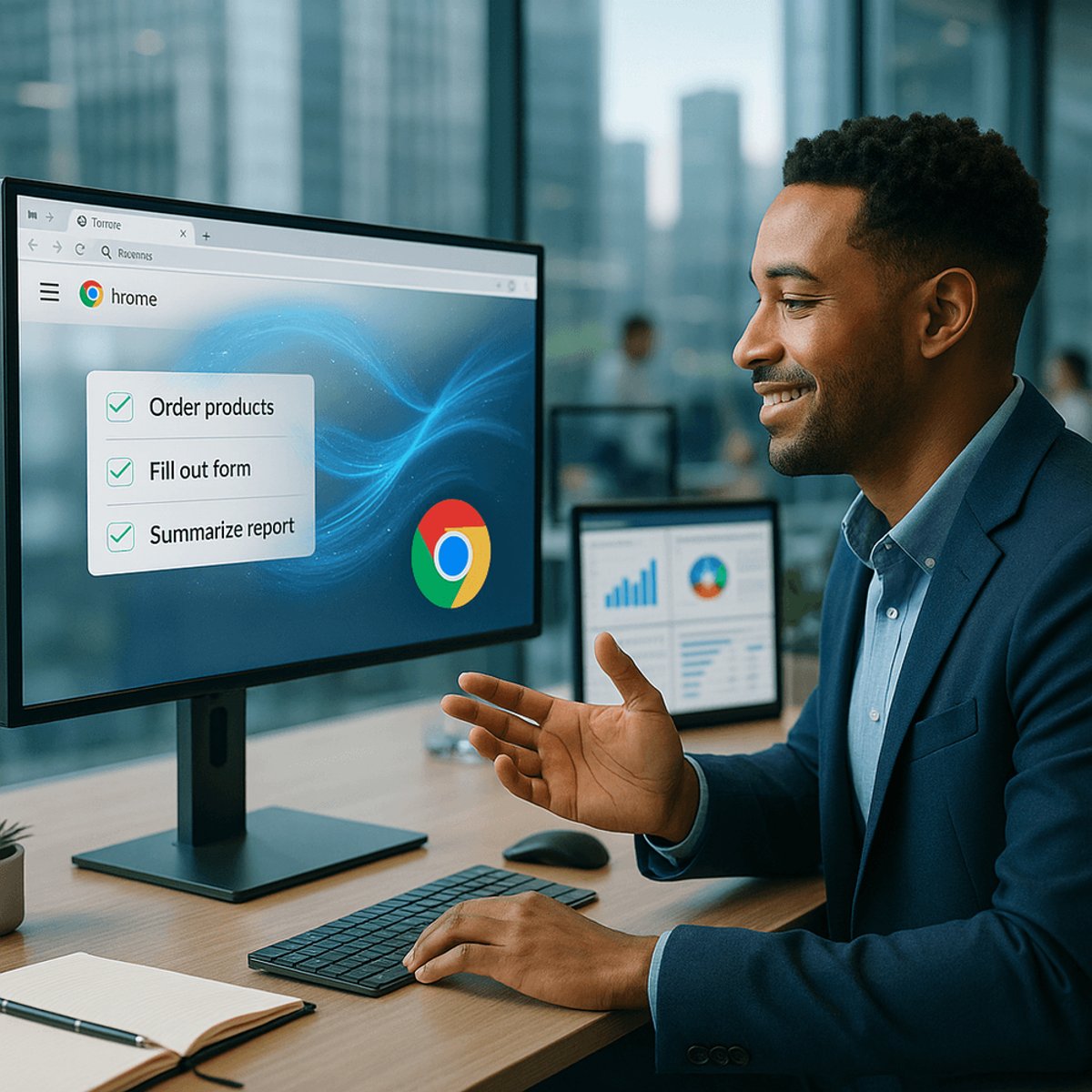
Google just transformed the world's most popular browser into an AI-powered workplace assistant. The company unveiled auto-browse capabilities for Chrome Enterprise users at Google Cloud Next, letting Gemini autonomously handle tasks like web research, data entry, and form filling. For the 3 billion Chrome users worldwide, it's a glimpse of how AI agents will soon reshape daily workflows - and for Google, it's a direct shot at Microsoft's Copilot dominance in enterprise productivity.
Google is betting that the future of work happens inside the browser - and it wants Gemini to do the heavy lifting. At Google Cloud Next, the company announced auto-browse capabilities for Chrome Enterprise, a feature that lets Google's Gemini AI autonomously navigate websites, fill forms, extract data, and complete multi-step research tasks without human intervention.
The timing couldn't be more strategic. While Microsoft has dominated enterprise AI headlines with Copilot integrations across Office 365, Google's been quietly fortifying Chrome's position as the gateway to workplace productivity. With over 3 billion active users and dominant market share among enterprise customers, Chrome represents Google's most direct pipeline into daily workflows.
Auto-browse works by letting employees delegate browser-based tasks to Gemini through natural language commands. Need to compile competitor pricing from a dozen websites? Gemini can crawl them, extract the data, and populate a spreadsheet. Filling out repetitive vendor forms? The AI handles it while you focus on strategic work. According to Google's announcement at Cloud Next, the feature is designed specifically for the kind of tedious, time-consuming browser work that eats up hours each week.
What makes this launch significant isn't just the automation - it's where Google's placing the intelligence. Instead of requiring employees to switch between apps and AI interfaces, Gemini lives directly inside the browser layer where most knowledge work actually happens. That's a fundamentally different approach than bolt-on AI assistants that sit adjacent to workflows.
For enterprise IT teams, Google's packaging this as a controlled deployment through Chrome Enterprise policies. Administrators can define which sites and tasks are eligible for automation, set guardrails around data handling, and monitor AI activity through existing Chrome management consoles. That level of control matters when you're letting AI loose on corporate systems and sensitive data.
The competitive implications are immediate. Microsoft has been aggressively positioning Copilot as the connective tissue across enterprise software, but most of those interactions still require users to work within Microsoft's ecosystem. Google's browser-first strategy bypasses that lock-in entirely - Chrome works everywhere, with every web app, regardless of vendor.
There's also the AI model advantage to consider. Gemini's multimodal capabilities mean it can understand not just text but images, PDFs, and complex web layouts. That's crucial for browser automation, where extracting meaning from visually dense pages separates useful agents from glorified macros.
But questions remain about reliability and edge cases. Browser automation has been a holy grail for productivity tools for years, with robotic process automation vendors building entire businesses around it. The challenge has always been handling the long tail of site variations, CAPTCHAs, authentication flows, and unexpected errors. If Gemini can't gracefully fail or ask for help when it hits a wall, enterprise adoption will stall quickly.
Google's also threading a delicate needle around data privacy. Enterprise customers are notoriously cautious about AI systems that can read and interact with everything employees see in their browsers. The company will need to prove that auto-browse doesn't create new data exposure risks or compliance headaches, especially for regulated industries.
The launch positions Google Cloud squarely in the emerging AI agent wars. While OpenAI focuses on general-purpose agents and Anthropic emphasizes safety, Google's leveraging its distribution advantage - Chrome is already installed on virtually every enterprise device. The company doesn't need users to adopt a new tool; it just needs them to enable a feature.
For workers, the promise is straightforward: let AI handle the boring stuff while humans focus on judgment, creativity, and relationships. If auto-browse delivers on that premise, it could accelerate the broader shift toward AI augmentation in knowledge work. If it creates more problems than it solves, it'll join the long list of automation features that sounded better in demos than in practice.
Google's Chrome auto-browse feature represents a fundamental bet on where enterprise AI is heading - not as a separate copilot you consult, but as ambient intelligence woven into the tools people already use every day. If Gemini can reliably automate the browser-based busywork that consumes knowledge workers' time, Google gains a powerful wedge into enterprise productivity that doesn't require ripping out existing software stacks. But the company faces the same challenge every AI automation play confronts: the gap between demos and daily reliability. Enterprise customers will give it a shot because Chrome's already there, but they'll only keep using it if it actually works when no one from Google is watching.