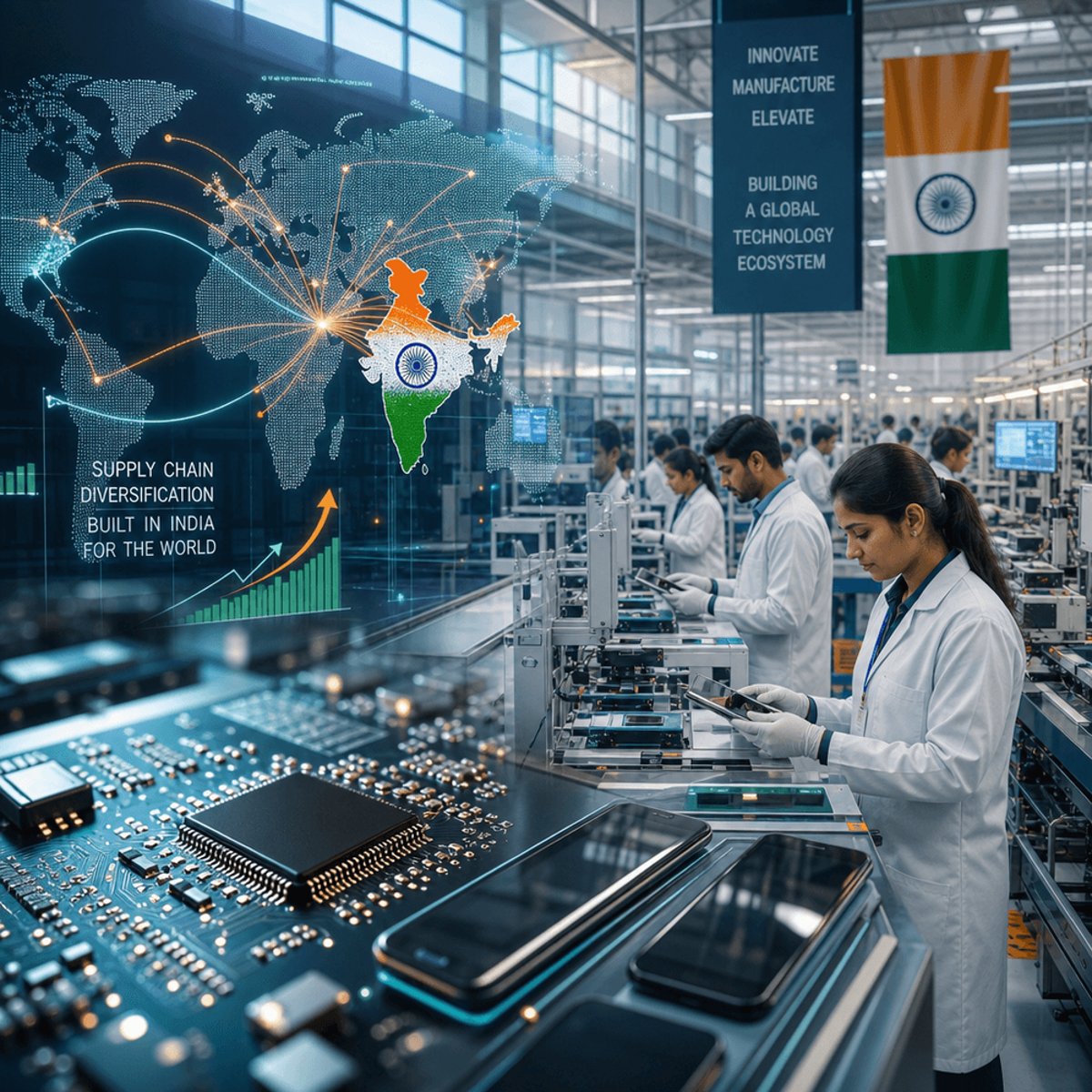
India just threw down $19.8 billion to challenge China's dominance in smartphone manufacturing. New Delhi unveiled a $6.5 billion smartphone production program alongside a $13.3 billion semiconductor initiative, marking the country's most aggressive push yet to reshape global electronics supply chains. The move comes as companies like Apple and Xiaomi face mounting pressure to diversify beyond Chinese manufacturing, and it could fundamentally alter where your next phone gets made.
India's government just went all-in on breaking China's lock on smartphone manufacturing. The dual-pronged $19.8 billion commitment announced Wednesday represents New Delhi's boldest attempt yet to position the country as a viable alternative to Chinese production dominance.
The $6.5 billion smartphone manufacturing program comes alongside a separate $13.3 billion semiconductor initiative, creating what industry observers are calling the most comprehensive electronics manufacturing push outside of China in recent memory. For companies like Apple, which has been quietly expanding its India footprint, the timing couldn't be better.
Apple already manufactures a growing portion of its iPhones in India through partners like Foxconn and Pegatron, but production remains heavily concentrated in China. The new incentives could accelerate that shift dramatically. Xiaomi, which already has significant operations in India, stands to benefit even more directly from the manufacturing subsidies.
The move reflects broader geopolitical tensions that have been reshaping tech supply chains for years. As US-China relations remain strained and companies face pressure to reduce dependency on single-country manufacturing, India has positioned itself as the logical alternative with its massive workforce and improving infrastructure.
But it's not just about assembly lines. The $13.3 billion semiconductor push tackles the deeper supply chain issue that's plagued electronics manufacturers since the chip shortage exposed just how fragile global component supply really is. India currently produces virtually no semiconductors domestically, importing nearly all the chips needed for its burgeoning electronics sector.
The semiconductor program aims to establish India as a chipmaking hub, though experts caution that building fab capacity takes years and requires technical expertise that's currently concentrated in Taiwan, South Korea, and to some extent, China. Previous Indian semiconductor initiatives have struggled to gain traction, but the scale of this commitment suggests New Delhi is serious about playing the long game.
For the smartphone industry specifically, the implications are massive. China currently dominates global smartphone production, manufacturing roughly 70% of all devices worldwide. India has been steadily climbing, hitting around 11% of global production in recent years, but mostly for domestic consumption. These new incentives could push India toward becoming a genuine export powerhouse.
The program includes production-linked incentives that reward companies for hitting manufacturing targets, a strategy India tested successfully with earlier, smaller electronics programs. Companies that meet production and export thresholds can receive direct subsidies, making Indian manufacturing cost-competitive with China while offering the geopolitical advantage of diversification.
Xiaomi has been particularly aggressive in India, where it's long been the market leader in smartphone sales. The company already operates several manufacturing facilities in the country and could use these new incentives to deepen that commitment. For Xiaomi, which faces increasing scrutiny in Western markets over its Chinese origins, expanding Indian production offers both cost benefits and political cover.
The wildcard is whether India's infrastructure and supply chain ecosystem can actually support this level of manufacturing ambition. China's dominance stems not just from cheap labor but from decades of investment in supplier networks, logistics, and technical expertise. India has made progress but still lags significantly in areas like component sourcing and manufacturing precision.
Timing matters here too. The smartphone market has matured, with global shipments relatively flat after years of explosive growth. Companies are looking to cut costs and improve margins rather than chase volume. If India can prove it offers comparable quality at competitive prices, manufacturers will move. But any quality issues or supply chain disruptions could send them running back to established Chinese partners.
The semiconductor portion faces even steeper challenges. Building modern chip fabs requires not just billions in capital but years of technical development and access to cutting-edge manufacturing equipment largely controlled by a handful of companies. India will need to attract not just money but expertise, likely from Taiwanese and Korean firms with established chipmaking know-how.
What happens next depends largely on how quickly companies respond. Apple tends to move deliberately, testing production capacity before making major commitments. If the India manufacturing ramp proceeds smoothly over the next 12-18 months, expect the company to accelerate its plans significantly. Xiaomi and other Chinese brands may move faster, both to access incentives and to reduce their own China concentration risk.
India's $19.8 billion bet represents more than just manufacturing incentives - it's a direct challenge to the China-centric electronics supply chain that's dominated for decades. Whether New Delhi can actually deliver on the promise of becoming a genuine alternative depends on execution, infrastructure development, and whether major players like Apple and Xiaomi commit to the shift. But the money's on the table now, and for an industry desperately seeking supply chain diversification, that alone makes this worth watching closely. The next 18 months will reveal whether India can convert cash into capacity, or whether China's manufacturing machine remains too entrenched to displace.