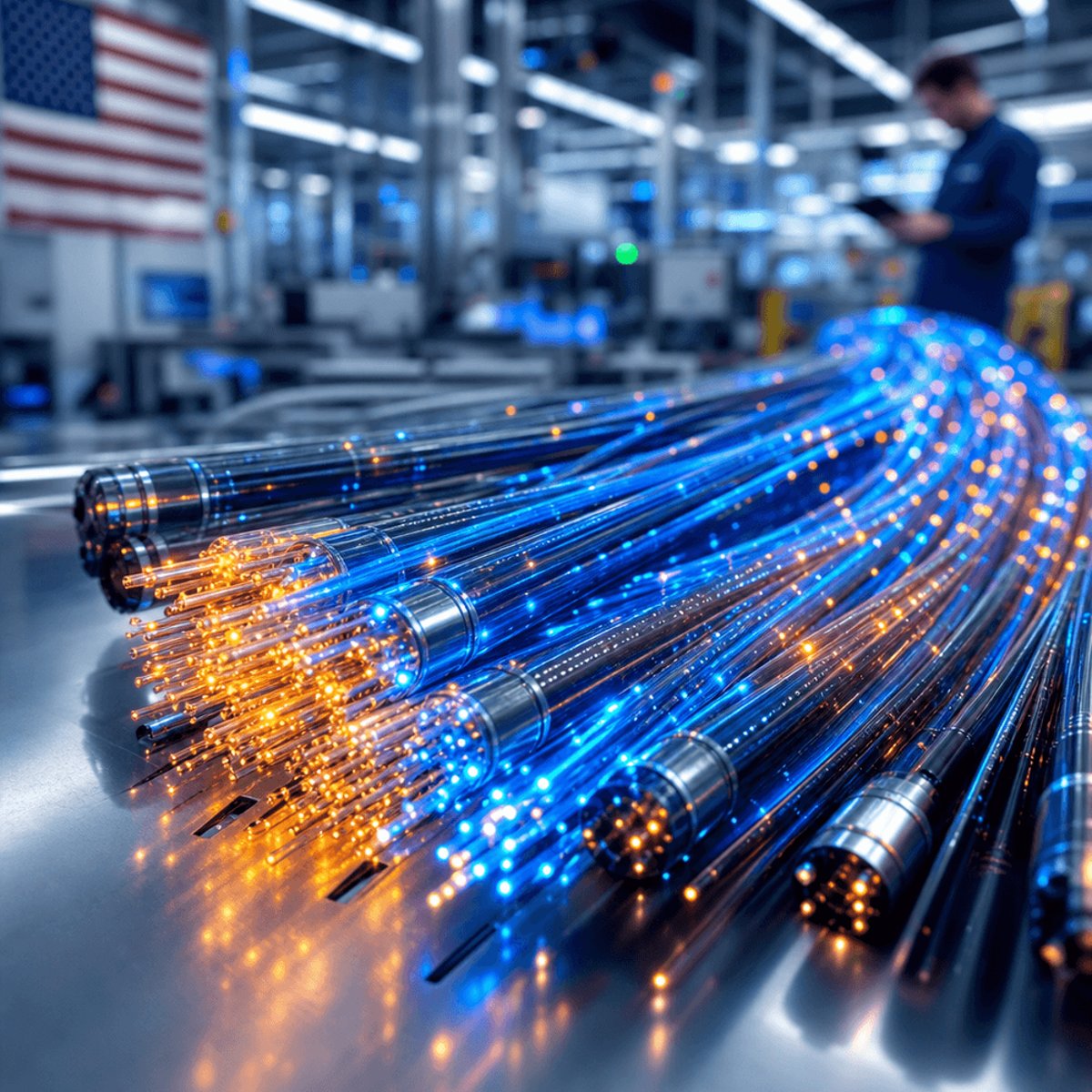
Amazon just made a multibillion-dollar bet on American manufacturing that signals how serious Big Tech is about controlling its infrastructure destiny. The company announced a sweeping agreement with Corning to massively expand US fiber optic cable production, creating 1,000 advanced manufacturing jobs in North Carolina while supporting hundreds more construction positions. The deal represents one of the largest domestic infrastructure investments by a tech giant this year and underscores the growing urgency around supply chain sovereignty as AI data centers devour bandwidth.
Amazon is bringing fiber optic manufacturing home in a big way. The tech giant's multibillion-dollar partnership with Corning will dramatically expand US production capacity for the fiber optic cables that form the backbone of modern cloud infrastructure, according to Amazon's announcement.
The deal creates 1,000 permanent advanced manufacturing jobs at Corning's North Carolina facilities, with hundreds more construction workers needed to build out the expanded production lines. It's a significant jobs infusion for the region and a clear signal that hyperscalers aren't content relying on overseas supply chains for critical components anymore.
What's driving this? The AI boom is creating unprecedented demand for fiber optic infrastructure. Every new data center Amazon Web Services brings online requires massive amounts of fiber to connect servers, link facilities, and pipe data to customers. As large language models and AI training workloads explode, that demand only intensifies. By securing domestic production capacity now, Amazon is essentially future-proofing its infrastructure buildout against supply chain disruptions and geopolitical uncertainty.
Corning has been the dominant player in fiber optics for decades, but this deal represents a new model - a tech hyperscaler essentially bankrolling manufacturing expansion in exchange for guaranteed supply. It's similar to how cloud providers have locked in chip production capacity, but applied to the physical networking layer. The company's North Carolina operations will see substantial facility upgrades to meet Amazon's appetite for fiber.
The timing isn't coincidental. The CHIPS Act and broader push for domestic semiconductor manufacturing has created momentum around reshoring critical tech infrastructure. Fiber optics don't get the same headlines as AI chips, but they're just as essential - you can't run a distributed AI system without the networking to connect it all. Amazon clearly sees this as strategic infrastructure worth billions in upfront investment.
Beyond the immediate job creation, the agreement includes a workforce development program designed to train the next generation of advanced manufacturing workers. That's crucial because modern fiber optic production requires sophisticated technical skills - it's not traditional factory work. Corning and Amazon are essentially building their own talent pipeline, which could become a model for other tech manufacturing partnerships.
The competitive implications are significant too. Microsoft and Google are racing to build out AI infrastructure, and they'll be watching this deal closely. If Amazon secures preferential access to domestic fiber production, it could translate into faster data center deployments and potentially lower costs over time. That matters in a market where every millisecond of latency and every basis point of margin counts.
For North Carolina, it's a major economic development win. Advanced manufacturing jobs typically pay well above regional averages, and the construction phase will provide an immediate boost. State officials have been aggressively courting tech manufacturing, and landing a multibillion-dollar Amazon-backed expansion validates that strategy.
The deal also highlights a broader shift in how Big Tech thinks about infrastructure. Rather than simply buying components on the open market, companies like Amazon are increasingly willing to fund entire supply chains to ensure availability and control. It's vertical integration for the cloud era - own the cables, own the chips, own the power supply, own the entire stack.
Amazon's multibillion-dollar Corning partnership is about more than job creation - it's a strategic play for infrastructure independence as AI drives exponential demand for connectivity. By funding domestic manufacturing expansion, Amazon secures critical supply while reshaping how Big Tech thinks about vertical integration. The 1,000 new manufacturing jobs are real and significant, but the bigger story is how hyperscalers are increasingly willing to bankroll entire supply chains rather than compete for capacity on the open market. As Microsoft and Google watch this unfold, expect more deals that trade upfront capital for guaranteed access to the physical infrastructure that makes cloud computing possible.