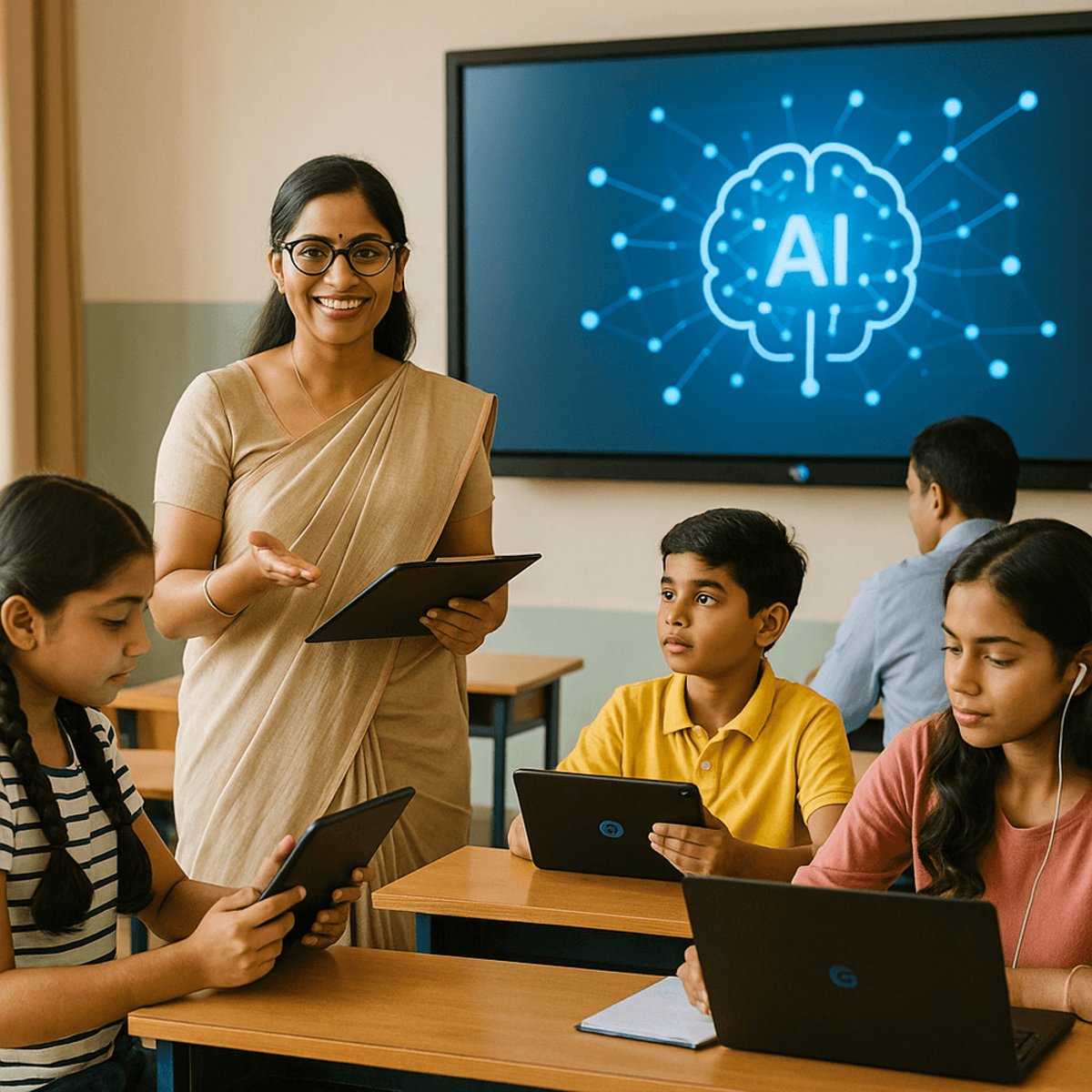
As AI races into classrooms worldwide, Google is discovering its toughest lessons on scaling education technology aren't coming from Silicon Valley - they're emerging from India's schools. The country now drives the highest global usage of Gemini for learning, forcing the tech giant to rethink everything from product design to deployment strategy. With 247 million students across 1.47 million schools and intense competition from OpenAI and Microsoft, India has become the proving ground where Google's education AI either adapts or fails.
Google just got schooled - literally. The company's Gemini AI is seeing its highest education usage globally in India, and the lessons emerging from that market are fundamentally reshaping how the tech giant thinks about AI in classrooms.
Chris Phillips, Google's vice president and general manager for education, revealed the India data this week on the sidelines of the company's AI for Learning Forum in New Delhi. He was meeting with K-12 administrators and education officials to understand how AI tools are actually being used in Indian classrooms - and what he's learning is forcing Google to abandon some deeply held Silicon Valley assumptions.
"We are not delivering a one-size-fits-all," Phillips told TechCrunch. "It's a very diverse environment around the world."
That diversity is putting pressure on Google in ways the company didn't anticipate. India's education system serves about 247 million students across nearly 1.47 million schools, supported by 10.1 million teachers, according to the Indian government's Economic Survey 2025-26. Higher education adds another 43 million students - a 26.5% jump since 2014-15. But scale isn't the challenge. It's that curriculum decisions sit at the state level, ministries play an active role, and access to devices and connectivity varies wildly from classroom to classroom.
Google has had to redesign its education AI so schools and administrators decide how and where it gets used. That's a significant shift for a company that traditionally builds products to scale globally, not bend to individual institutions. In India, that approach doesn't work.
The country is also accelerating Google's thinking on multimodal learning. Phillips said India is seeing faster adoption of AI that combines video, audio, and images alongside text - reflecting the need to reach students across different languages, learning styles, and access levels. Many Indian classrooms aren't built around text-heavy instruction, so AI tools that rely primarily on reading and writing hit a wall.
"Access is universally critical, but how and when it happens is very different," Phillips noted, pointing to schools where devices are shared, connectivity is inconsistent, or learning jumps directly from pen and paper to AI - skipping the laptop era entirely.
Google is also learning that teacher-centric design matters more than it expected. The company has focused on tools that help educators with planning, assessment, and classroom management rather than creating direct-to-student AI experiences. "The teacher-student relationship is critical," Phillips said. "We're here to help that grow and flourish, not replace it."
That philosophy is translating into deployments. Google just launched AI-powered JEE Main exam preparation through Gemini, targeting one of India's most competitive entrance exams. The company is also running a nationwide teacher training program covering 40,000 Kendriya Vidyalaya educators and partnering with government institutions on vocational and higher education initiatives, including India's first AI-enabled state university.
But Google isn't operating in a vacuum. OpenAI has begun building a local leadership presence focused on education, hiring former Coursera APAC managing director Raghav Gupta as its India and APAC education head. The company also launched a Learning Accelerator program last year. Microsoft has expanded partnerships with Indian institutions, government bodies, and edtech players like Physics Wallah to support AI-based learning and teacher training.
The competitive pressure is mounting at the same moment education has become one of the top use cases for generative AI overall. Phillips said entertainment dominated AI usage last year, but learning has now emerged as one of the most common ways people - especially younger users - engage with the technology. Students are turning to AI for studying, exam prep, and skill-building, making education a more immediate battleground for Google, OpenAI, and Microsoft.
But India's government is sounding notes of caution. The country's latest Economic Survey flags risks to students from uncritical AI use, including over-reliance on automated tools and impacts on learning outcomes. Citing studies by MIT and Microsoft, the survey warned that "dependence on AI for creative work and writing tasks is contributing to cognitive atrophy and a deterioration of critical thinking capabilities." That's a sharp reminder that the race to get into classrooms is happening alongside growing concerns about what AI actually does to how students learn.
For Google, India is serving as a preview of challenges likely to surface elsewhere as AI moves deeper into public education systems globally. The company expects issues around control, access, and localization - now obvious in India - to increasingly shape how education AI scales in other markets. Whether Google's India playbook becomes the model for the rest of the world remains an open question. But as GenAI embeds itself in public schools, the pressures now visible in India are going to be hard for the industry to ignore.
Google's India experience is becoming the template for how AI actually scales in education - not through top-down product launches, but through bottom-up adaptation to local governance, infrastructure constraints, and teaching cultures. As OpenAI and Microsoft pour resources into the same market and governments worldwide grapple with AI's cognitive impacts on students, the lessons Google is learning in India's 1.47 million schools will likely determine which companies succeed in bringing AI to classrooms globally. The question isn't whether AI belongs in education anymore - it's whose AI will survive the transition from demo to deployment at massive scale.