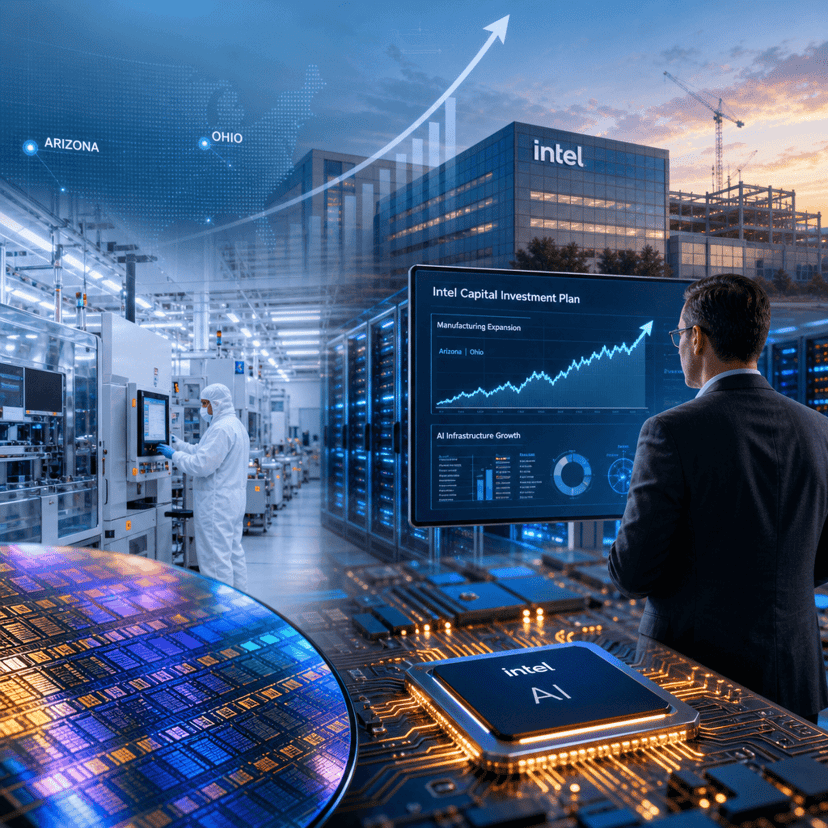
Intel just made its biggest capital raise in years, launching a $15 billion stock offering as the company scrambles to catch up in the AI chip race. The massive equity raise comes as technology giants pour trillions into AI infrastructure buildout, with Nvidia commanding roughly 80% of the data center GPU market. Intel's move signals the chipmaker isn't backing down from the fight, but it also reveals just how much capital it takes to stay relevant in the AI era.
Intel is throwing everything at the AI chip war. The company's $15 billion stock offering, announced Monday, represents one of the largest equity raises in semiconductor industry history and a clear signal that Intel CEO Pat Gelsinger isn't giving up the fight against Nvidia's dominance.
The timing couldn't be more critical. Technology companies have collectively spent trillions building out AI infrastructure over the past two years, and that spending shows no signs of slowing. Microsoft, Google, Amazon, and Meta have each committed to capital expenditures exceeding $50 billion annually, with the bulk going toward data center expansion and AI accelerator purchases.
But here's Intel's problem - most of those chips aren't coming from Santa Clara. Nvidia has captured roughly 80% of the data center GPU market, with its H100 and newer H200 chips becoming the de facto standard for training large language models. The company's revenue from data center GPUs alone hit $47.5 billion last quarter, more than Intel's entire revenue for the same period.
Intel's capital raise will fund two critical initiatives: expanding its foundry business and accelerating development of its Gaudi AI accelerator chips. The company's foundry strategy, which aims to manufacture chips for other companies while rebuilding Intel's own process technology leadership, requires massive capital investment. Intel's opening advanced packaging facilities in Arizona and New Mexico, plus expanding its Ohio fab campus - all projects that demand billions before generating returns.
The Gaudi chips represent Intel's direct assault on Nvidia's AI accelerator dominance. Intel acquired Habana Labs in 2019 for roughly $2 billion, and the Gaudi line has evolved into a legitimate alternative for AI inference workloads. But inference is just one part of the AI pipeline - training is where the real money flows, and that's where Nvidia's CUDA software ecosystem creates a nearly impenetrable moat.
"The infrastructure buildout we're seeing is unprecedented," one semiconductor analyst told investors last week. "But it's not just about having chips - it's about having the entire stack: silicon, software, and ecosystem. Intel's trying to build all three simultaneously while also fixing its manufacturing problems."
The $15 billion raise comes as Intel faces mounting pressure from activist investors and questions about its capital allocation strategy. The company's stock has lagged semiconductor peers over the past five years, and some investors have pushed for Intel to split its design and manufacturing operations. Gelsinger has resisted, arguing that vertical integration remains Intel's competitive advantage.
Intel's not alone in needing massive capital for AI infrastructure. AMD has invested billions acquiring AI software companies and expanding its data center GPU lineup. Startups like Cerebras and Groq have raised hundreds of millions developing specialized AI chips. Even Amazon and Google design their own AI accelerators to reduce dependence on Nvidia.
But the capital requirements keep escalating. Leading-edge semiconductor manufacturing now costs upwards of $20 billion per fab, and that's before accounting for research and development. Taiwan Semiconductor Manufacturing Company spends roughly $40 billion annually on capital expenditures, setting the benchmark that Intel must match if it wants to reclaim process technology leadership.
The stock offering's success will depend heavily on investor confidence in Intel's turnaround narrative. The company's recent quarters have shown progress - its foundry business secured several major customers, and Gaudi chips are gaining traction with cloud providers seeking alternatives to Nvidia. But Intel remains years behind in process technology, and Nvidia's lead in AI software makes switching costs prohibitively high for many customers.
Wall Street appears cautiously optimistic. Intel's stock rose modestly in after-hours trading following the announcement, suggesting investors view the capital raise as necessary rather than alarming. The company's maintaining its dividend, which helps, and the foundry business is starting to show promise with external customers.
What makes this moment different from past Intel capital raises is the sheer scale of the AI opportunity. Analysts project the AI accelerator market will exceed $300 billion annually by 2027, up from roughly $50 billion in 2023. That growth trajectory justifies massive capital investment - but only if Intel can actually capture meaningful market share from Nvidia and establish its foundry as a viable TSMC alternative.
Intel's $15 billion bet reveals both the massive opportunity and the brutal economics of the AI chip war. The capital raise gives Intel ammunition to fight on multiple fronts - foundry expansion, AI accelerator development, and process technology catch-up. But Nvidia's ecosystem advantages and TSMC's manufacturing lead mean Intel's burning through capital just to stay in the race. The next 18 months will show whether Intel's integrated strategy pays off or whether the company's trying to do too much at once. For now, Intel's message is clear: it's all-in on AI, whatever the cost.