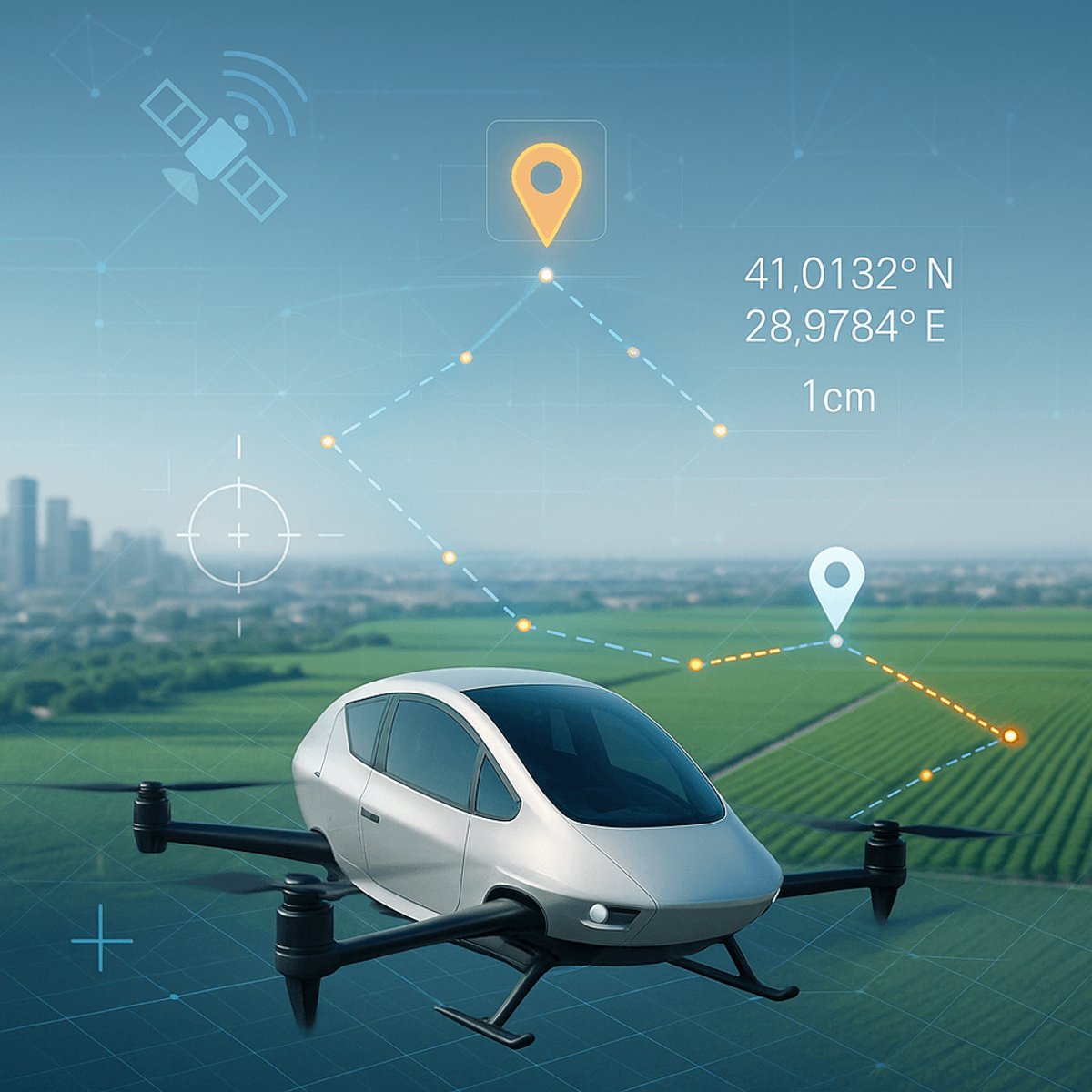
Point One Navigation just secured $35 million in Series C funding led by Khosla Ventures, pushing the precision location startup's valuation to $230 million. The San Francisco company's technology can track drones, robotaxis, and farm equipment within one centimeter - a capability that's driving massive adoption across industries from autonomous vehicles to precision agriculture.
For San Francisco-based Point One Navigation, the phrase 'location, location, location' takes on an entirely new meaning. The startup just closed a $35 million Series C round led by Khosla Ventures, bringing its post-money valuation to $230 million - a significant leap for a company that's quietly revolutionizing how autonomous systems navigate the world.
Point One's breakthrough isn't just another GPS improvement. The company's positioning engine can determine location within one centimeter under optimal conditions, according to co-founder Aaron Nathan. That level of precision transforms everything from autonomous lawnmowers cutting perfect lawn patterns to delivery drones navigating crowded urban corridors.
"You can't be off by 10 centimeters and go over in a flower bed," Tom Weeks, the company's COO, told TechCrunch. "Everything's pressing to the one to three centimeter range."
The technology combines augmented global navigation satellite systems, computer vision, and sensor fusion into a single API. Most modern vehicles already pack the necessary hardware, so Point One typically deploys as software. For older equipment like farm machinery or first responder vehicles, the company adds custom chipsets.
Point One's customer momentum tells the real story. The startup now supports advanced driver assistance systems in more than 150,000 vehicles from an unnamed EV manufacturer. It's also landed contracts with major mowing equipment makers, a distribution company running 300,000 last-mile delivery vehicles, and a global bicycle manufacturer.
But the automotive sector, while still driving significant revenue, represents just the beginning. Since announcing its $10 million Series A in 2021, Point One has expanded aggressively into robotics, industrial applications, and even wearable devices. Over the past year alone, the number of manufacturers using its platform jumped tenfold.
"And now it's just accelerating," Nathan said.
The secret sauce lies in Point One's Polaris RTK Network - eight years in development and a key focus for the new funding. These lunchbox-sized correction stations, installed in secure locations like cell tower facilities, provide real-time location adjustments. To maintain centimeter-level accuracy, stations must be positioned within 40 kilometers of any tracked vehicle or device.
That density requirement means serious infrastructure investment. Point One is systematically filling coverage gaps across North America, Europe, and Asia. "Midwestern states where farming is going on, all the way to the East Coast in the US, require solid density," Weeks explained. The company is close to completing this buildout.
The next frontier is indoor navigation. Point One's technology already maintains precision when vehicles move from outdoor to indoor environments, like parking structures. But Nathan wants to extend that capability to industrial settings where robots spend most of their operational time indoors.
"What we're building next is how we do long-term indoor navigation as well," he said. "We want to solve ubiquitous location, so eventually it will be indoors and all domains."
This expansion into indoor tracking could unlock entirely new markets. Manufacturing facilities, warehouses, and logistics centers increasingly rely on autonomous systems that need precise positioning. Traditional GPS fails indoors, creating a significant technology gap that Point One aims to fill.
The funding round's timing aligns with broader industry trends toward precision automation. Autonomous vehicle development continues despite recent setbacks, precision agriculture is booming, and industrial robotics adoption is accelerating. Point One sits at the intersection of these converging trends.
Khosla Ventures has a strong track record backing infrastructure companies that enable next-generation technologies. The firm's lead investment signals confidence in Point One's ability to become the positioning standard across multiple industries.
For Point One, founded in 2016, the $230 million valuation represents validation of nearly a decade spent perfecting centimeter-accurate positioning. As autonomous systems become more prevalent across industries, that precision becomes less luxury and more necessity.
Point One Navigation's $230 million valuation reflects the growing demand for precision positioning across autonomous systems. As industries from agriculture to robotics push toward full automation, centimeter-accurate location tracking shifts from nice-to-have to mission-critical infrastructure. With Khosla's backing and an accelerating customer base, Point One is positioned to become the GPS standard for the autonomous economy.