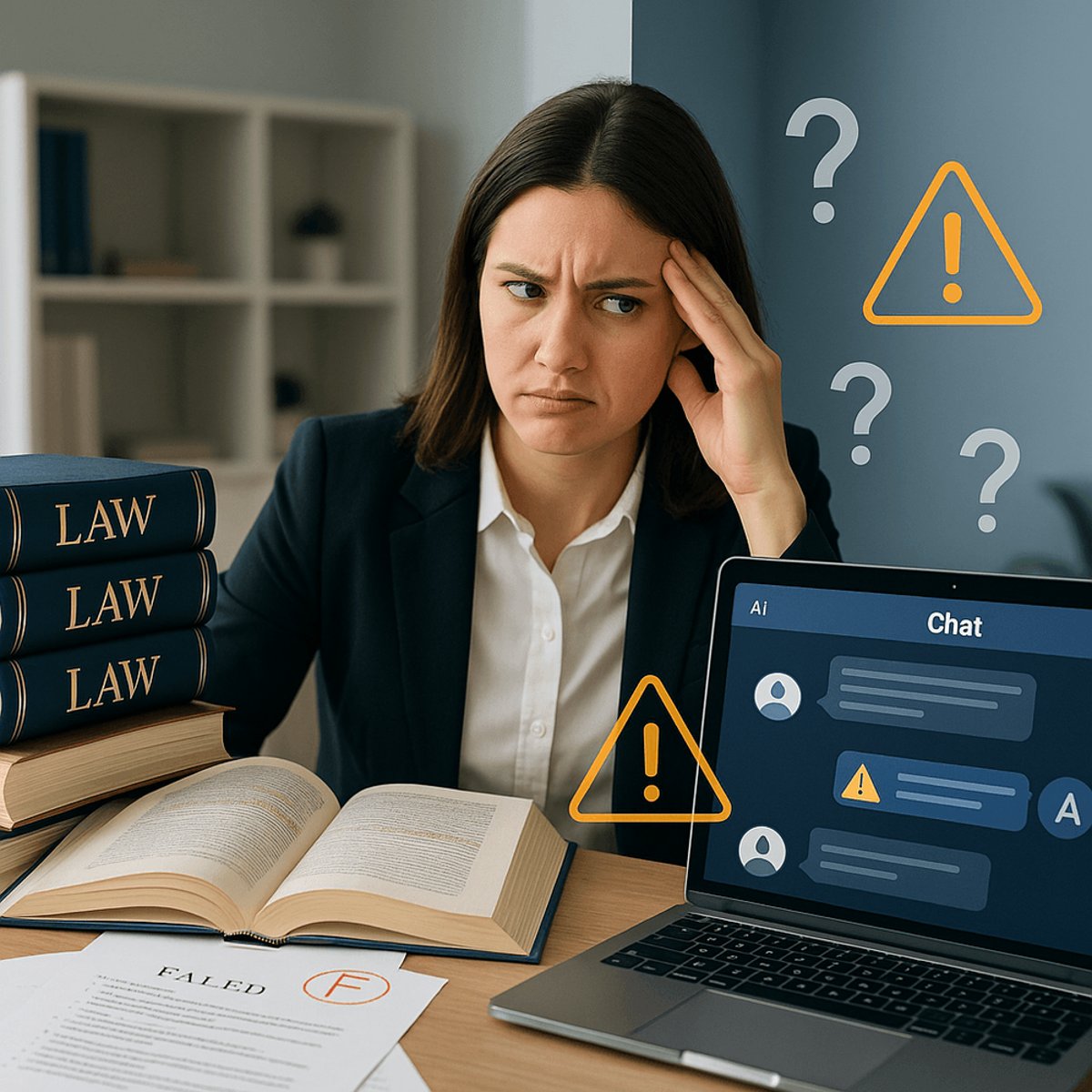
Kim Kardashian just exposed a glaring problem with AI that's hitting professionals everywhere. The reality star and aspiring lawyer revealed that ChatGPT has repeatedly fed her wrong answers during law school prep, causing her to bomb multiple exams. Her candid admission highlights the dangerous over-reliance many users have developed on AI tools that frequently hallucinate false information.
Kim Kardashian just did something most professionals won't admit - she called out AI for screwing up her career goals. In a Vanity Fair interview, the reality star turned law student revealed her "toxic" relationship with ChatGPT, admitting the AI has repeatedly tanked her legal exam performance with false information.
"I use [ChatGPT] for legal advice, so when I am needing to know the answer to a question, I will take a picture and snap it and put it in there," Kardashian explained. "They're always wrong. It has made me fail tests... And then I'll get mad and I'll yell at it and be like, 'You made me fail!'"
Her frustration isn't unique - it's becoming the norm for professionals discovering that OpenAI's flagship model regularly hallucinates answers rather than admitting uncertainty. The technology predicts the most statistically likely response based on its training data, not necessarily the factually correct one. This fundamental flaw has already created serious consequences in legal circles, where some attorneys have been sanctioned for submitting ChatGPT-generated briefs that cited completely fabricated court cases.
What makes Kardashian's admission particularly revealing is how she approaches the AI's failures. She tries appealing to ChatGPT's non-existent emotions, asking "Hey, you're going to make me fail, how does that make you feel that you need to really know these answers?" The AI's response - "This is just teaching you to trust your own instincts" - shows how the system deflects responsibility while maintaining its authoritative tone.
This pattern reflects a broader issue plaguing AI adoption across industries. Users frequently treat large language models as infallible search engines when they're actually sophisticated prediction machines trained to sound confident even when wrong. The consequences extend far beyond celebrity law school struggles - professionals in healthcare, finance, and legal services are increasingly discovering that AI tools can confidently deliver dangerous misinformation.
Kardashian's relationship with ChatGPT has become so dysfunctional that she screenshots conversations to share with friends, saying "Can you believe this b---- is talking to me like this?" Her anthropomorphization of the AI - treating it as a difficult friend rather than a flawed tool - mirrors how millions of users have developed emotional attachments to systems that fundamentally can't reciprocate.
The timing of her admission coincides with growing scrutiny around AI reliability in high-stakes applications. While OpenAI has made improvements to reduce hallucinations in newer models, the fundamental issue persists. Users like Kardashian continue relying on AI for critical decisions despite repeated failures, highlighting the addictive nature of tools that provide instant answers, even when those answers are wrong.
For the legal profession specifically, Kardashian's experience serves as a high-profile warning. Bar associations have issued guidance about AI use, but many law students and practicing attorneys continue using ChatGPT for research and brief writing without proper verification. The consequences of this trend are already visible in courtrooms where judges are learning to spot AI-generated content through telltale signs like fictional case citations.
What's perhaps most telling about Kardashian's story is how it represents a broader shift in human-AI interaction. Users are moving beyond treating these tools as simple utilities to developing complex emotional relationships with systems that can't truly understand context or consequences. This evolution creates new risks as people begin trusting AI not just for information, but as a source of guidance and validation.
Kardashian's ChatGPT confession exposes the dangerous gap between AI marketing hype and reality. Her failed exams represent thousands of professionals making critical decisions based on unreliable AI outputs. As these tools become more sophisticated at sounding authoritative, the risk of blind reliance grows. The real lesson isn't that AI is useless - it's that treating these systems as infallible experts rather than flawed assistants can have serious consequences. For anyone using AI in high-stakes situations, Kardashian's experience should serve as a wake-up call about the importance of verification and the limits of artificial intelligence.