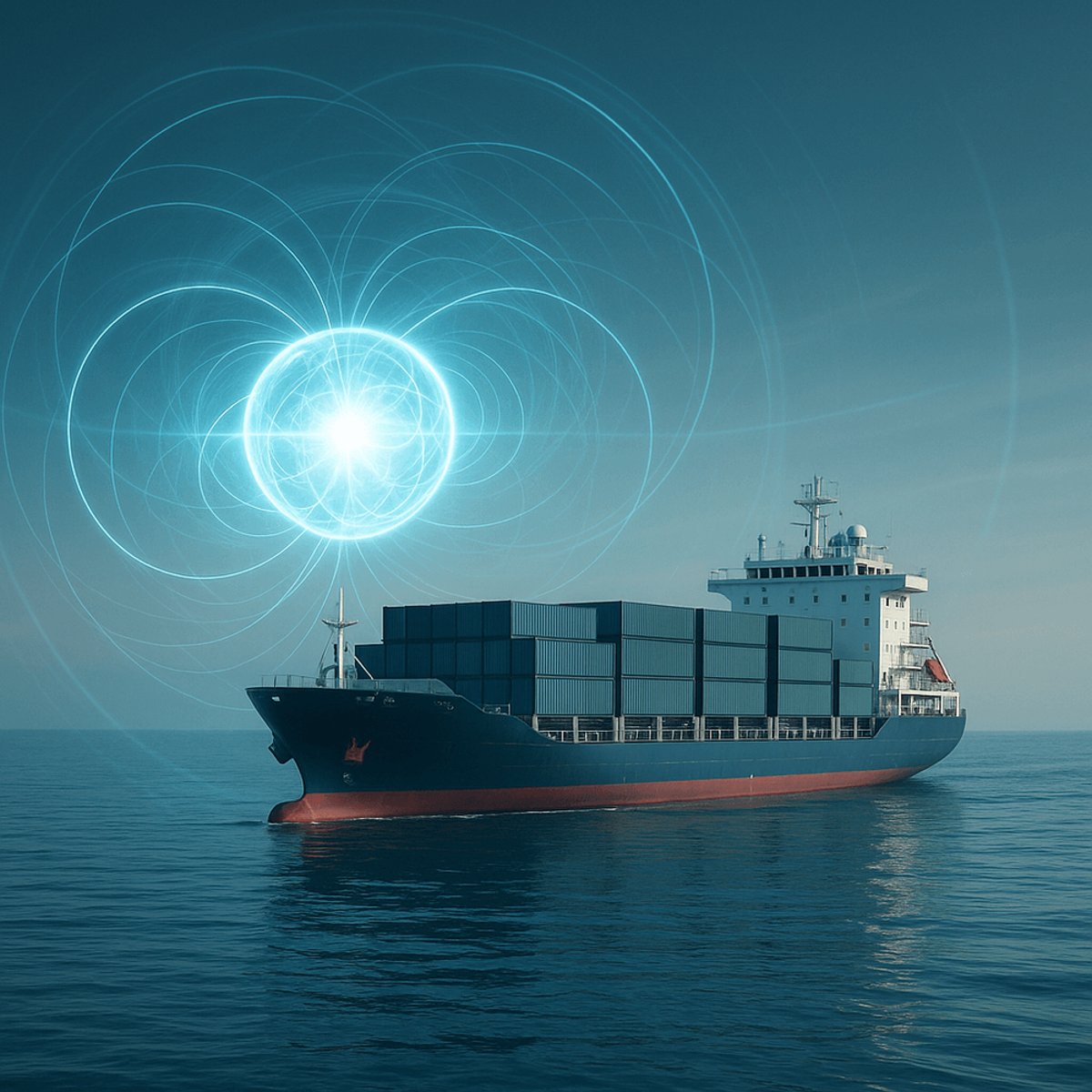
While the fusion industry races to build the first commercial reactor on land, Maritime Fusion just raised $4.5 million to take a completely different approach - putting tokamak reactors on ships. The Y Combinator startup believes maritime deployment could solve fusion's biggest commercial challenge by targeting expensive maritime fuels rather than competing with cheap solar and wind power.
The fusion startup landscape just got a nautical twist. Maritime Fusion closed a $4.5 million seed round to develop what CEO Justin Cohen claims is the first serious attempt at putting a tokamak fusion reactor on a ship. The round was led by Trucks VC with backing from Aera VC, Alumni Ventures, Paul Graham, and Y Combinator, where Maritime was part of the winter 2025 batch.
The concept isn't as outlandish as it sounds. Nuclear-powered submarines and aircraft carriers have been prowling the seas for decades, operating quietly for years between refueling. The civilian maritime sector even experimented with nuclear cargo ships in the 1960s and 70s. "Fission has definitely paved the way in terms of nuclear power on ships," Cohen told TechCrunch in an exclusive interview.
But Cohen's betting fusion offers something fission can't - massive clean power without meltdown risks, proliferation concerns, or radioactive waste. More importantly, he thinks the economics work better at sea than on land. While fusion struggles to compete with cheap solar and wind on the electrical grid, maritime fuels tell a different story. Ammonia and hydrogen - the leading candidates to replace diesel in cargo shipping - cost enough that first-generation fusion reactors could actually compete.
"Those are some of the other really expensive fuels that might actually be the only other things that are as expensive as first-of-a-kind fusion," Cohen explained. "In those cases, we actually do compete, just straight up."
Maritime's already moved beyond PowerPoint presentations. The company is assembling high-temperature superconducting cables from Japanese-supplied tape, building the foundation for the powerful magnets needed to confine fusion plasma. These cables will generate revenue by selling to other companies while Maritime develops its main reactor.
The startup's first power plant, dubbed Yinsen, aims for 30 megawatts of electricity from an eight-meter tokamak. Cohen projects it'll be operational by 2032 with a $1.1 billion price tag. That timeline puts Maritime roughly parallel with industry leader Commonwealth Fusion Systems, which expects its full-scale Arc reactor in the early 2030s after raising nearly $3 billion.
But Maritime's taking a different path than CFS's demonstration-first approach. "We're not going to spend billions on a breakeven-style device that doesn't produce energy on the grid," Cohen said. "The first tokamak we build will be an energy-producing tokamak for a customer."
The technical challenges are substantial. Maritime needs to design support systems that harvest energy and keep the tokamak running while dealing with ocean conditions. To simplify onboard equipment, some operations like fuel processing will happen onshore. The reactor itself represents just one piece of a complex marine power plant.
Timing could be everything for Maritime. The fusion industry is reaching a critical inflection point, with breakthrough experiments proving net energy gain is possible and advances in AI, computing, and superconducting magnets accelerating development timelines. The question isn't whether fusion will work, but who'll crack the commercial code first.
Maritime's maritime strategy could leapfrog the traditional land-based approach if fusion technology matures as expected. The shipping industry desperately needs clean alternatives to bunker fuel, and early fusion reactors might find their sweet spot in high-value maritime applications before becoming cheap enough for grid-scale deployment.
Cohen's confidence reflects a broader shift in fusion thinking - from proving scientific feasibility to solving commercial deployment. While competitors focus on demonstrating breakeven physics, Maritime's building toward immediate commercial application. Whether that bold approach pays off depends on fusion technology advancing fast enough to meet their aggressive 2032 timeline.
Maritime Fusion's ship-based approach represents a fascinating pivot in fusion's commercial development. While others chase grid-scale deployment, Maritime's targeting a market where expensive fuels create immediate opportunity for first-generation reactors. If fusion technology advances as projected, this maritime strategy could deliver commercial fusion power years before land-based competitors crack the cost equation. The $4.5 million seed round gives Maritime runway to prove their superconducting cable assembly and validate their tokamak design - critical steps toward their ambitious 2032 timeline.