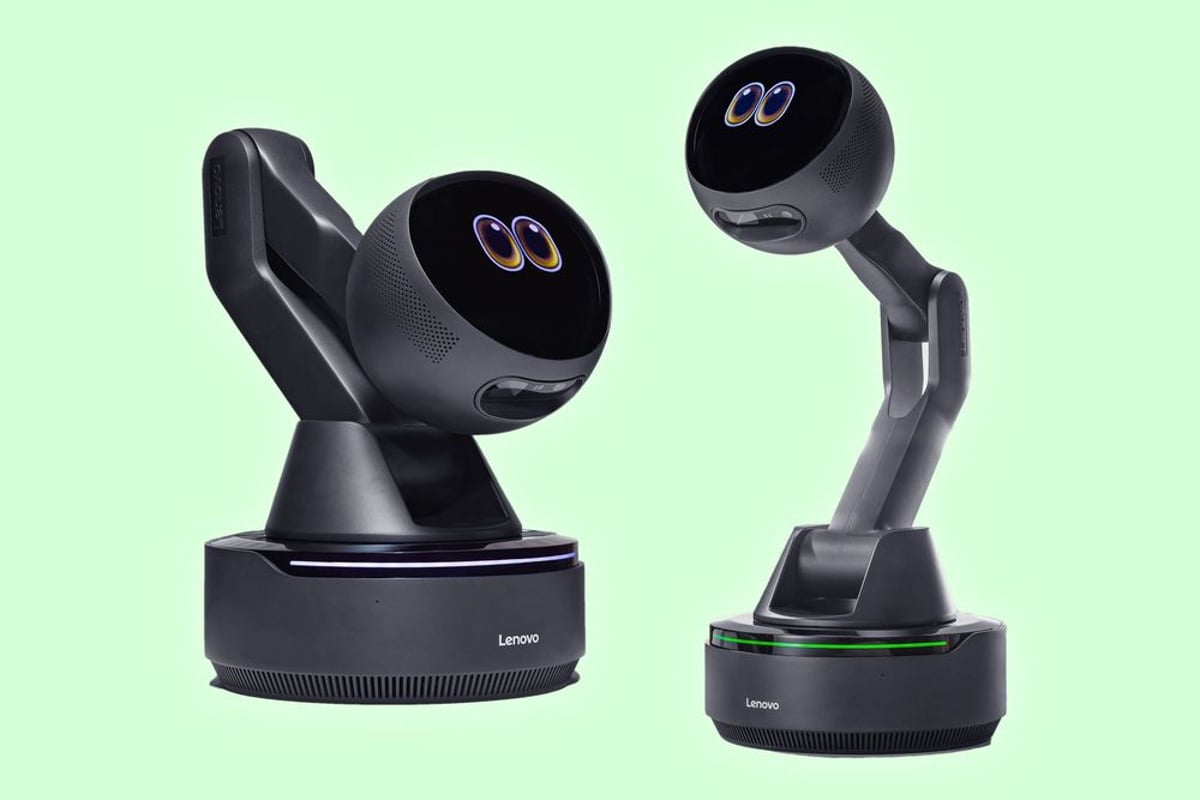
Lenovo just showed off something equal parts adorable and dystopian at Mobile World Congress. The company's AI Workmate Concept is a tiny robotic arm that sits on your desk, sports a bulbous screen displaying puppy dog eyes, and wants to be your new office companion. Alongside a second AI productivity device, Lenovo's betting that workers want more than just software assistants - they want physical desk buddies powered by local AI processing.
Lenovo is trying to answer a question nobody asked: what if your desk lamp had feelings? At Mobile World Congress in Barcelona, the company pulled back the curtain on its AI Workmate Concept, a desktop device that looks like someone crossed a Pixar character with a robotic arm and decided it belonged in your cubicle.
The AI Workmate Concept isn't subtle. It's got a swiveling base, an articulating arm, and a rounded screen perched on top that displays two expressive eyes. Think less industrial robot, more electronic pet that happens to be useful. Lenovo describes it as an "always-on desk companion," which sounds friendly until you remember it's watching you work all day.
But here's where it gets interesting - the device processes everything locally. Unlike cloud-dependent AI assistants that ping servers halfway around the world, the AI Workmate handles requests right there on your desk. You can talk to it like any smart assistant, and it responds with both voice and those expressive eyes that track your movements. The arm isn't just for show either. It can rotate and reposition itself to accomplish different tasks, though Lenovo hasn't detailed exactly what those tasks are yet.
The company announced this alongside a second AI productivity concept at MWC, though details on the companion device remain sparse. Both are part of Lenovo's broader push into what they're calling "AI-based productivity companions" - standalone hardware designed to boost office efficiency while adding a physical presence to your workspace.
This is still very much a concept, which means Lenovo is testing the waters before committing to production. But it signals where the company thinks AI hardware is headed - beyond laptops, beyond phones, into specialized devices that inhabit your physical space. The question is whether workers actually want that.
The timing makes sense. As AI capabilities get more sophisticated, tech companies are racing to figure out what AI hardware should actually look like. We've seen AI pins, AI glasses, and AI-powered everything else. Lenovo is betting that a friendly robot arm with personality might be the answer for desk workers.
There's something both charming and unsettling about the idea. On one hand, an assistant that can physically adjust itself, maintain eye contact, and provide companionship could make solo desk work less isolating. On the other, do we really want our productivity tools guilt-tripping us with sad puppy eyes when we ignore them?
The local processing is the real differentiator here. While competitors like Amazon's Alexa and Google's Assistant rely heavily on cloud connectivity, Lenovo is keeping the AI on-device. That means faster responses, better privacy, and functionality even when your internet drops. For enterprise customers worried about data security, that's a significant selling point.
Lenovo hasn't announced pricing, availability, or even confirmed these concepts will make it to production. The MWC showcase is partly about gauging interest and gathering feedback. But with AI hardware still finding its footing, experiments like this help the industry figure out what people actually want from intelligent devices.
What's clear is that Lenovo sees a market for AI companions that exist in physical space, not just as apps on your phone or voices from a speaker. Whether that market wants robot arms with feelings remains to be seen. But in a world where we're increasingly working alone, maybe a desk buddy with expressive eyes isn't such a weird idea after all.
Lenovo's AI Workmate Concept represents a fascinating gamble on the future of workplace AI. Instead of cramming more intelligence into existing devices, the company is creating entirely new categories of hardware designed to inhabit our physical spaces. Whether workers want robot arms with puppy dog eyes on their desks is still an open question, but the local AI processing and physical versatility show Lenovo is thinking beyond traditional form factors. As AI hardware continues to evolve, experiments like this help define what intelligent companions might actually look like - even if they're still figuring out whether anyone asked for them in the first place.