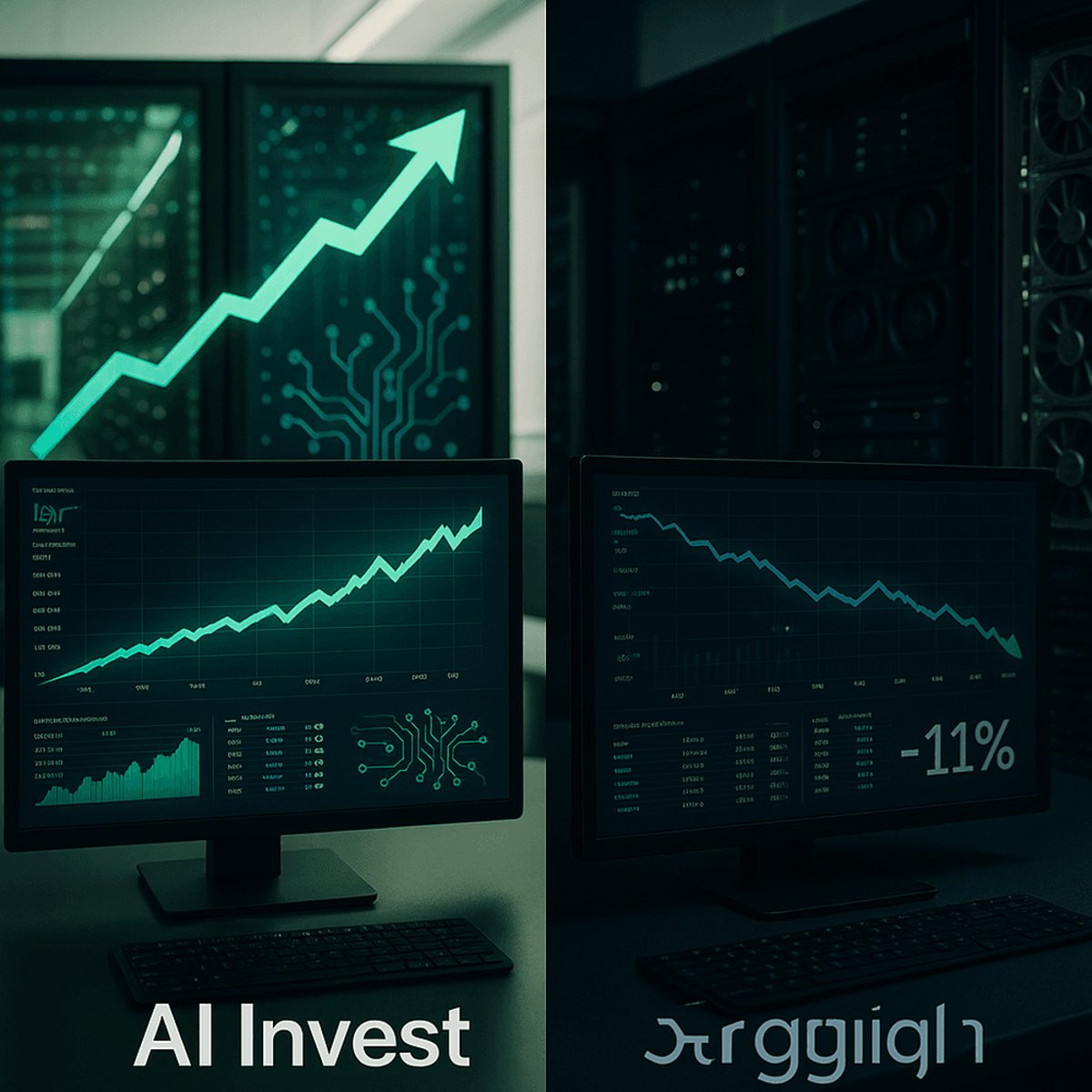
Meta and Microsoft just delivered a masterclass in how Wall Street judges AI investments - and the results couldn't be more different. Meta's stock jumped 8% after the company announced it'll nearly double AI spending to as much as $135 billion this year, while Microsoft plummeted 11% as Azure cloud growth decelerated and capacity constraints raised red flags. The divergence marks a critical moment in tech's AI gold rush, where investors are done accepting promises and now demand proof that massive capital outlays are actually paying off.
Wall Street just drew a line in the sand on AI spending - and it's all about returns. Meta got the green light to pour up to $135 billion into artificial intelligence this year, sending shares soaring 8% in a vote of confidence that would've been unthinkable just quarters ago. Meanwhile, Microsoft watched $140 billion in market value evaporate as investors punished the software giant's 11% stock plunge, spooked by slowing cloud growth and seemingly endless capacity constraints.
The contrast is stark. Meta's nearly doubling its AI budget from 2025 levels, yet investors are cheering because the company delivered 24% year-over-year revenue growth to back it up. The social media powerhouse proved AI isn't just a cost center - it's actively boosting the bottom line through smarter ad targeting and engagement algorithms. CEO Mark Zuckerberg told investors the spending spree will support his mission of "building personal super intelligence," signaling Meta's ambitions stretch far beyond better Instagram recommendations.
But Microsoft's stumble reveals the market's growing impatience with the "spend now, profit later" playbook. Azure cloud revenue growth decelerated to 39% from 40% in the previous quarter - a marginal slip that might've been overlooked in any other context. Not this time. With capital expenditures and finance leases rocketing 66% to $37.5 billion in the quarter (smashing the $34.31 billion analyst consensus from Visible Alpha), investors wanted to see acceleration, not deceleration.
The real problem? Microsoft can't deliver what customers are demanding. CFO Amy Hood admitted on the earnings call that Azure would've hit 40% growth if the company had channeled all its new GPU chips into the cloud business during Q1 and Q2. That's a stunning confession - Microsoft is supply-constrained at exactly the moment enterprise AI demand is exploding. Customers are ready to spend, but Microsoft can't provision the compute capacity fast enough.
This capacity crunch isn't just a Microsoft problem - it's an industry-wide bottleneck as cloud providers race to secure Nvidia GPUs and build out data center infrastructure. But when you're spending $37.5 billion in a single quarter and still can't meet demand, investors start questioning execution. The optics get worse when you're simultaneously showing slower growth than expected in the very segment that's supposed to justify all that spending.
Meta's success story offers a blueprint for what investors want to see. The company didn't just announce massive AI investments - it demonstrated concrete revenue impact from previous spending. Online advertising, Meta's cash cow, benefited directly from AI-powered recommendation systems and targeting improvements. That 24% revenue jump gave Zuckerberg the credibility to pitch even bigger bets, including new products the company plans to roll out throughout 2026.
The divergence also highlights different business model dynamics. Meta's AI investments directly enhance its existing advertising engine, creating a tight feedback loop between spending and revenue. Microsoft's Azure play is more complex - it requires building infrastructure, then monetizing it through enterprise contracts that take time to ramp. Both strategies can work, but investors clearly favor seeing immediate returns over future promises right now.
Meta's stock performance marks a significant reversal from previous quarters when Wall Street regularly hammered the company over metaverse spending and questioned Zuckerberg's capital allocation. Those concerns haven't disappeared entirely - the metaverse Reality Labs division continues burning cash - but AI's proven revenue contribution gives the CEO breathing room to pursue longer-term bets on personal super intelligence and next-generation products.
Microsoft faces harder questions. The 66% jump in capital spending suggests the company is desperately trying to solve its capacity problem, but GPU supply constraints and data center buildouts don't resolve overnight. If Azure growth continues decelerating while spending accelerates, the market could turn even more skeptical. Hood's comment about chip allocation reveals another challenge - Microsoft must balance Azure customer demand against its own AI product development, including Copilot integrations across Office and Windows.
The broader message from this earnings divergence is clear: the era of unconditional faith in AI spending is over. Investors want proof of concept, not science experiments. They'll fund massive AI buildouts if companies can demonstrate revenue traction, user engagement improvements, or margin expansion. But spending for spending's sake - or worse, spending while growth slows - won't cut it anymore. Meta passed that test this quarter. Microsoft didn't.
The Meta-Microsoft split verdict signals a new chapter in tech's AI arms race where talk is cheap and results are everything. Investors are done writing blank checks for ambitious AI roadmaps - they want to see revenue growth, margin expansion, or clear competitive advantages that justify the spending spree. Meta earned its leash by proving AI directly boosts its advertising business, buying Zuckerberg credibility to chase bigger bets. Microsoft's capacity struggles and Azure deceleration show that even the most established cloud players can't coast on potential anymore. As earnings season continues, expect this pattern to repeat: companies demonstrating AI ROI will get funded, while those showing cracks between spending and results will get hammered. The market just told us which side of that line matters.