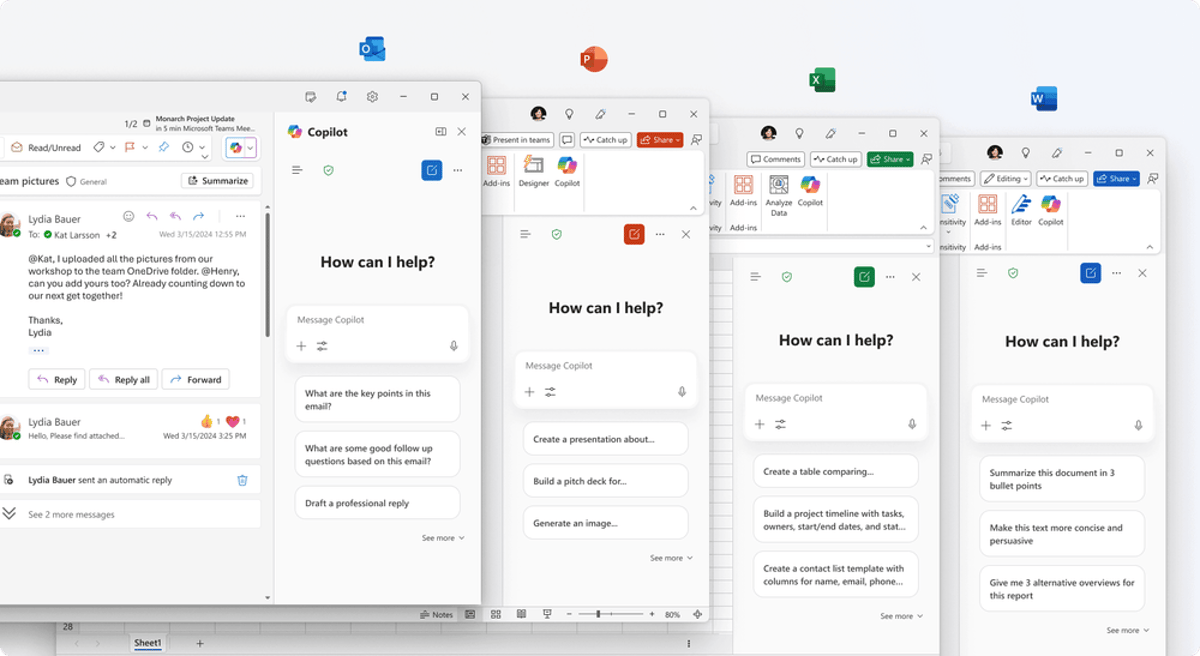
Microsoft just dropped a massive AI integration across its entire Office suite, rolling out free Copilot Chat features to Word, Excel, PowerPoint, Outlook, and OneNote for all business users. This marks Microsoft's boldest move yet to embed AI directly into workplace productivity tools, potentially disrupting standalone AI services and forcing competitors to accelerate their own integrations.
Microsoft just flipped the script on enterprise AI. The company's rolling out free Copilot Chat features across Word, Excel, PowerPoint, Outlook, and OneNote today, embedding AI assistance directly into the apps millions of workers use daily. The move represents Microsoft's most aggressive push yet to make AI ubiquitous in business workflows, potentially rendering standalone AI tools obsolete for many use cases.
"Copilot Chat is secure AI chat grounded in the web - and now, it's available in the Microsoft 365 apps," Seth Patton, general manager of Microsoft 365 Copilot product marketing, told The Verge. "It's content aware, meaning it quickly understands what you're working on, tailoring answers to the file you have open. And it's included at no additional cost for Microsoft 365 users."
The timing couldn't be more strategic. While competitors scramble to integrate AI into their productivity suites, Microsoft's leveraging its dominant position in enterprise software to make AI feel inevitable rather than optional. The free tier includes document rewriting, spreadsheet analysis, and PowerPoint slide creation - tasks that typically require switching between multiple AI services.
But Microsoft's playing a careful balancing act here. The $30 per month, per user premium Copilot license isn't going anywhere. Premium users retain exclusive access to GPT-5, file uploads, image generation, and the ability to reason across entire organizational data sets rather than single documents. "Users with a Microsoft 365 Copilot license get priority access to features like file upload and image generation, along with the latest technology like GPT-5, including faster response times and more consistent availability - even during peak usage periods," Patton explained.
This two-tier approach reflects lessons learned from Microsoft's consumer rollout earlier this year. When the company bundled Copilot features into personal Microsoft 365 plans, it simultaneously raised subscription prices, triggering user backlash. This time, Microsoft's keeping business pricing unchanged while the free features roll out.
The broader implications extend well beyond Microsoft's own ecosystem. Google Workspace users are already feeling pressure to match these capabilities, while smaller productivity startups face an existential question: how do you compete when AI becomes table stakes rather than a premium feature?
Microsoft's also preparing to bundle its sales, service, and finance Copilots into the main Microsoft 365 Copilot subscription this October, potentially reducing costs for businesses already invested in Microsoft's AI ecosystem. The message is clear - stick with Microsoft, and AI integration becomes seamless and cost-effective.
The rollout positions Microsoft to capture the massive wave of businesses still evaluating AI adoption. Rather than forcing organizations to choose between multiple AI vendors, Microsoft's making the choice simple: your existing productivity suite now includes AI by default. For IT departments managing vendor relationships and security compliance, this consolidation represents a compelling value proposition.
What's particularly clever about this approach is how it normalizes AI usage. Workers won't need to open separate AI tools or learn new interfaces - the assistance appears contextually within familiar applications. This reduces adoption friction that has historically slowed enterprise AI implementations.
Microsoft's free AI integration across Office apps represents more than a feature update - it's a strategic move to lock in the enterprise AI market before competitors can establish footholds. By making basic AI assistance free while maintaining premium tiers, Microsoft's creating a pathway for gradual AI adoption that keeps organizations within its ecosystem. The real test will be whether this approach accelerates enterprise AI adoption or simply shifts market share from standalone AI tools to Microsoft's integrated platform.