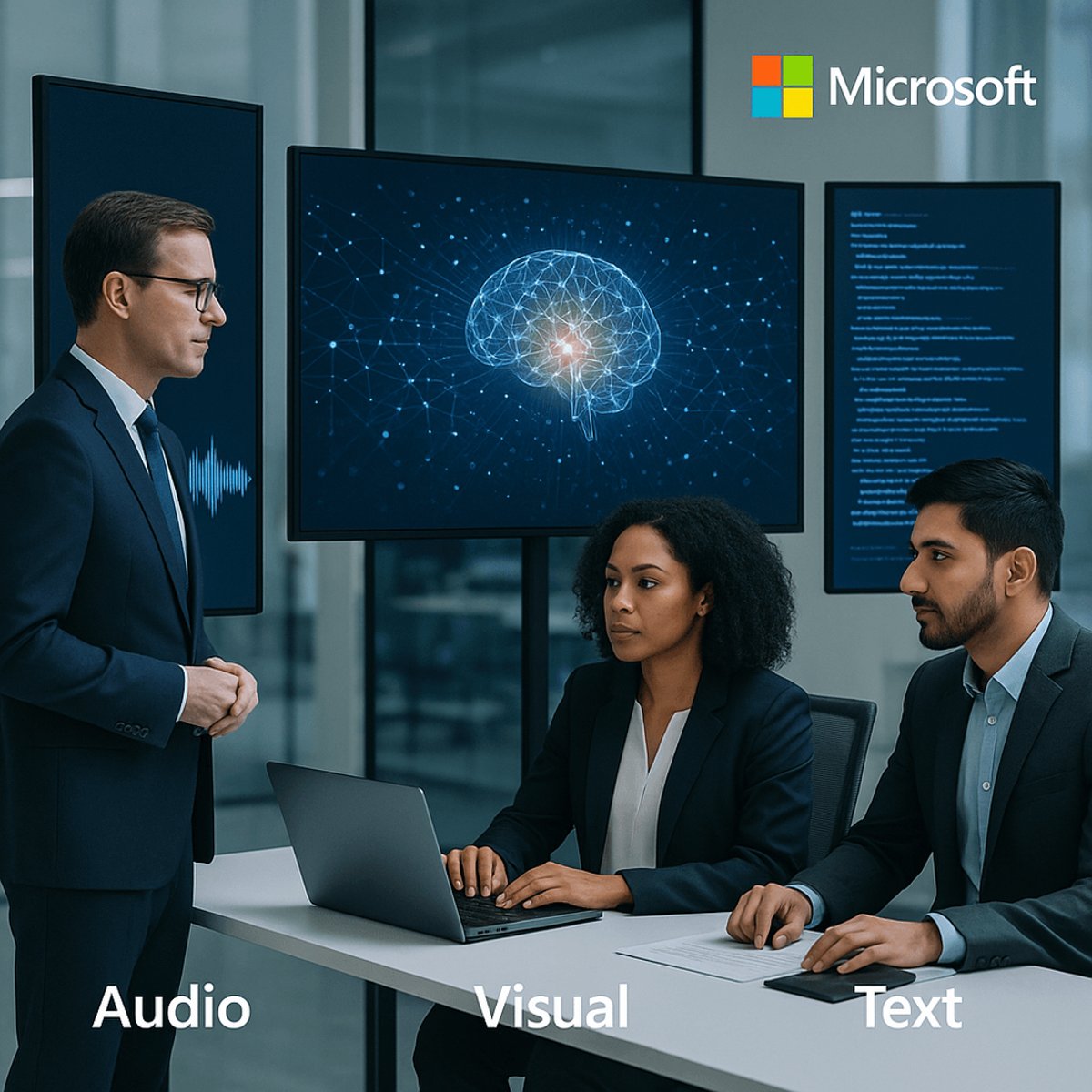
Microsoft's newly formed MAI division just dropped three foundational AI models - a direct challenge to OpenAI and Google in the multimodal race. The models handle voice transcription, audio generation, and image creation, marking the first concrete product launches since Mustafa Suleyman spun up the independent AI group six months ago. The move signals Microsoft's intent to own its AI stack rather than rely solely on OpenAI's technology.
Microsoft is making its boldest move yet to establish independence from its OpenAI partnership. The company's MAI division - the AI research group formed last October under former Google DeepMind co-founder Mustafa Suleyman - just released three foundational models that handle voice transcription, audio generation, and image creation.
The timing couldn't be more strategic. While Microsoft has poured billions into OpenAI and integrated GPT-4 across its product suite, the tech giant has quietly been building its own AI foundation. These models represent the first tangible output from that effort, giving enterprise customers Microsoft-native alternatives to third-party AI tools.
The voice transcription model takes aim at established players like OpenAI's Whisper and Google's Speech-to-Text services. It's designed to convert spoken language into written text with high accuracy, a critical capability for everything from meeting transcripts in Teams to accessibility features across Windows. The audio generation model flips that script, synthesizing realistic voice output - potentially powering everything from virtual assistants to audiobook narration.
But it's the image generation model that puts Microsoft in direct competition with OpenAI's DALL-E and Google's Imagen. Enterprise customers have been demanding more control over their AI image tools, especially around licensing, data privacy, and customization. A Microsoft-owned model gives corporate clients another option beyond external APIs.
Suleyman's MAI group has been operating somewhat under the radar since its formation six months ago. The division pulled together researchers from Microsoft's existing AI teams plus new talent poached from competitors. The goal was always to build Microsoft's own foundational models rather than just reselling OpenAI's technology with a blue wrapper.
This launch changes the dynamics of Microsoft's complicated OpenAI relationship. The companies remain close partners - Microsoft still holds a reported 49% stake in OpenAI and continues integrating GPT models across its products. But having in-house alternatives gives Microsoft leverage in negotiations and insurance if the partnership sours. It's the AI equivalent of Apple building its own chips to reduce Intel dependence.
The enterprise angle matters here. While consumer AI tools grab headlines, the real money is in corporate deployments where companies need guaranteed uptime, data residency, and custom fine-tuning. Microsoft's Azure cloud already hosts countless enterprise workloads. Adding native AI models that integrate seamlessly with existing Microsoft services creates a powerful moat.
Competitors aren't standing still. Google's Gemini models already handle text, images, audio, and video in a single unified architecture. Meta has been open-sourcing multimodal models like ImageBind. Amazon is pushing its own Titan models through AWS. The foundational model space is getting crowded, and differentiation is getting harder.
What's unclear is how these models stack up on benchmarks. Microsoft hasn't released detailed performance metrics or comparisons to competitors. Pricing, availability, and integration roadmaps also remain vague. Enterprise customers will want to see proof these models can match or beat alternatives before committing to migration projects.
The MAI launch also raises questions about Microsoft's AI strategy coherence. The company now offers OpenAI models through Azure OpenAI Service, its own MAI foundational models, and various other AI capabilities scattered across product lines. Developers and IT decision-makers will need clear guidance on which tools to use for which scenarios. Too much choice without clear differentiation creates confusion.
Still, shipping is what matters. MAI moved from formation to product launch in six months - fast for a foundational model effort. That suggests Microsoft is treating this as a priority initiative with top-level support and resources. Suleyman's track record at DeepMind and Inflection AI gives the effort credibility with researchers and enterprise buyers alike.
Microsoft's MAI models mark a strategic shift toward AI independence, but success depends on execution details we haven't seen yet. Enterprise customers now have more options, which is healthy for competition. But they'll need proof these models deliver real value over established alternatives. The bigger story is Microsoft hedging its OpenAI bet while keeping options open. In the high-stakes AI race, having your own foundational models isn't just smart - it's survival insurance. Watch for benchmark data, pricing announcements, and early customer deployments in the coming weeks. Those will tell us if MAI is a serious competitor or just an internal hedge that never gains traction outside Redmond.