TL;DR:
• NASA abandons building Mars relay systems, shifts to commercial connectivity services
• SpaceX, Blue Origin, and Rocket Lab unveil competing Mars communication architectures
• RFP deadline hits today for capability studies covering lunar and Mars data transmission
• Winner controls the critical infrastructure for future Mars human missions
NASA just flipped the script on deep space communications, triggering an all-out race among space industry titans to control the data pipeline to Mars. The agency's shift from building its own relay systems to buying connectivity as a service has SpaceX, Blue Origin, and Rocket Lab scrambling to pitch Mars communication solutions worth potentially billions in future contracts.
NASA's decades-old approach to Mars communications just got disrupted. The agency that once built every relay orbiter and spacecraft to ferry data back from the Red Planet is now shopping for connectivity like it's buying cloud services. The timing couldn't be more critical – with proposal deadlines hitting today for what could become the most lucrative space infrastructure contract of the decade.
The immediate catalyst came from NASA's Space Communications and Navigation program, which released an RFP in July seeking commercial solutions to replace its aging Deep Space Network infrastructure. Current Mars communications rely on orbiters like Mars Reconnaissance Orbiter and MAVEN to relay data from surface missions back to Earth's giant antennas. But according to NASA's latest senior review, this hardware was never meant to be permanent backbone infrastructure.
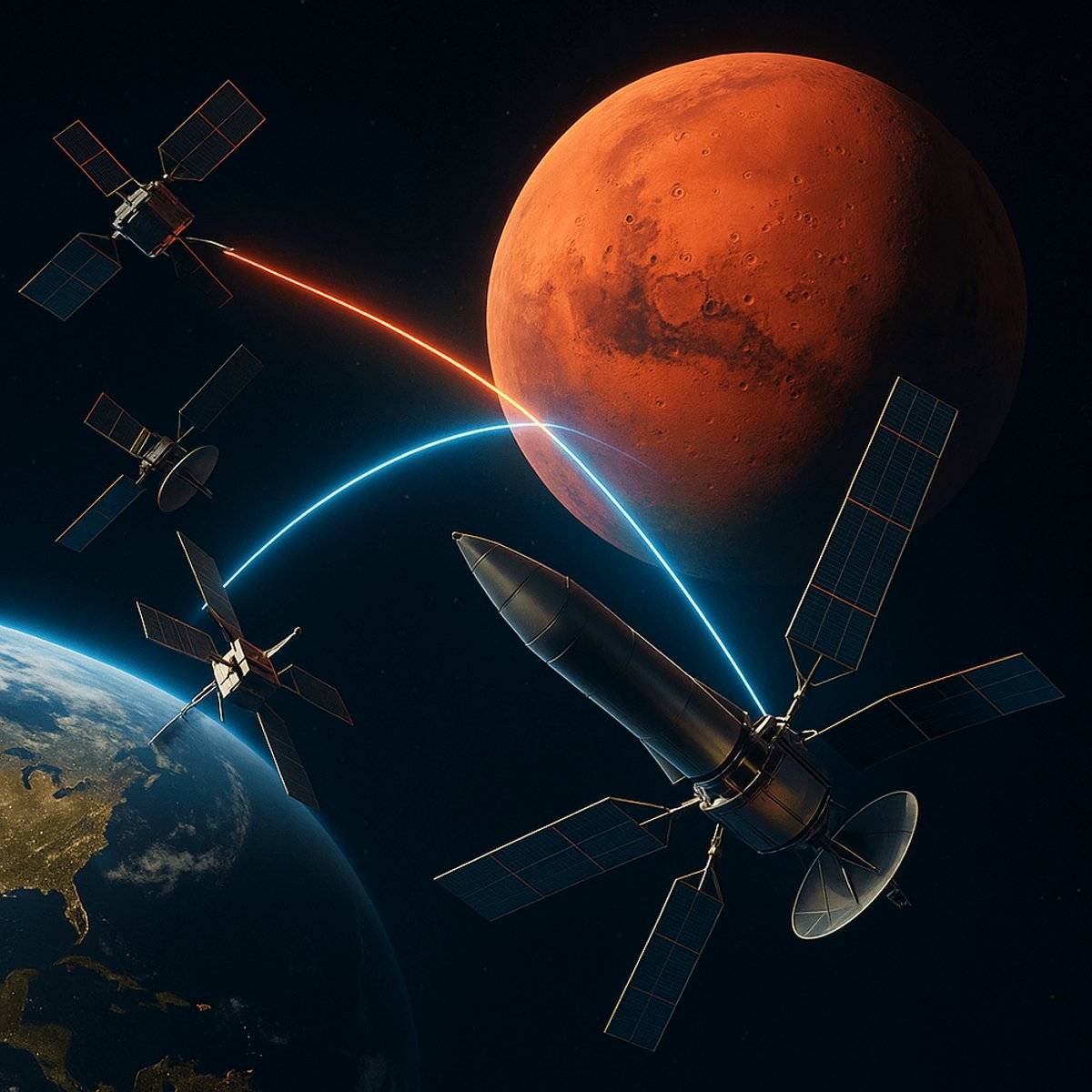
Blue Origin fired the first major salvo yesterday, unveiling its Mars Telecommunications Orbiter built on the company's Blue Ring platform. The announcement pitched maneuverable, high-performance spacecraft ready to support NASA missions as early as 2028. "We're not just talking about relay satellites," the company's pitch suggests – they're positioning for the entire Mars communication ecosystem.
Rocket Lab quickly countered with its own Mars telecom orbiter concept, which the company describes as core to its proposed Mars Sample Return architecture. The New Zealand-based launcher has been quietly building its deep space credentials, and this Mars communication play represents its boldest expansion yet beyond Earth orbit services.
But SpaceX might hold the trump card. The company received one of three NASA-funded commercial services studies in 2024 specifically for next-generation relay services, alongside Lockheed Martin and Blue Origin. SpaceX's proposal to "adapt Earth-orbit communication satellites for Mars" almost certainly leverages its Starlink constellation expertise – imagine a Starlink network for Mars, with the same rapid deployment and mesh networking capabilities that revolutionized terrestrial internet.
The technical challenges are staggering. Any Mars communication architecture must handle vast distances, extreme latency, periodic solar interference, and Earth visibility windows that can black out communications for weeks. NASA isn't asking for immediate hardware procurement – they want capability studies first, recognizing that solving these puzzles requires fundamental innovation in space-based networking.
What makes this race particularly intense is the scope of NASA's vision. The current RFP covers both a "lunar trunkline" between Earth and Moon, plus end-to-end Mars communications moving data from surface assets through Mars orbit to Earth operations centers. The agency wants to create an "interoperable marketplace" where NASA becomes just one customer rather than the owner-operator of deep space infrastructure.
This represents NASA's broader transformation from pure science missions toward permanent human presence on Mars. The same commercial services model that revolutionized launch markets through SpaceX's Falcon 9 and astronaut transport via Crew Dragon is now extending to deep space communications. The winner doesn't just get a contract – they get to define how humanity stays connected across the solar system.
Market implications extend far beyond NASA. Commercial Mars missions, space tourism to Mars, and eventual Mars colonization will all depend on this infrastructure. Lockheed Martin, with its decades of Mars mission experience, brings traditional aerospace credibility. But the nimble approaches from SpaceX and the ambitious platforms from Blue Origin and Rocket Lab suggest this won't be a legacy contractor's game.
The proposal deadline hitting today marks just the beginning. NASA will evaluate capability studies before moving to actual procurement, but early positioning matters enormously in space infrastructure contracts. Whichever company can demonstrate the most credible path to reliable, cost-effective Mars communications will likely lock in advantages for the next generation of Red Planet exploration.
This isn't just about replacing aging satellites – it's about who controls the digital highway to Mars. As NASA transforms from hardware owner to service buyer, the winning architecture will shape everything from scientific discovery to eventual human settlement. With SpaceX's Starlink expertise, Blue Origin's ambitious platforms, and Rocket Lab's scrappy innovation all in play, the race to become Mars' internet provider has officially begun.