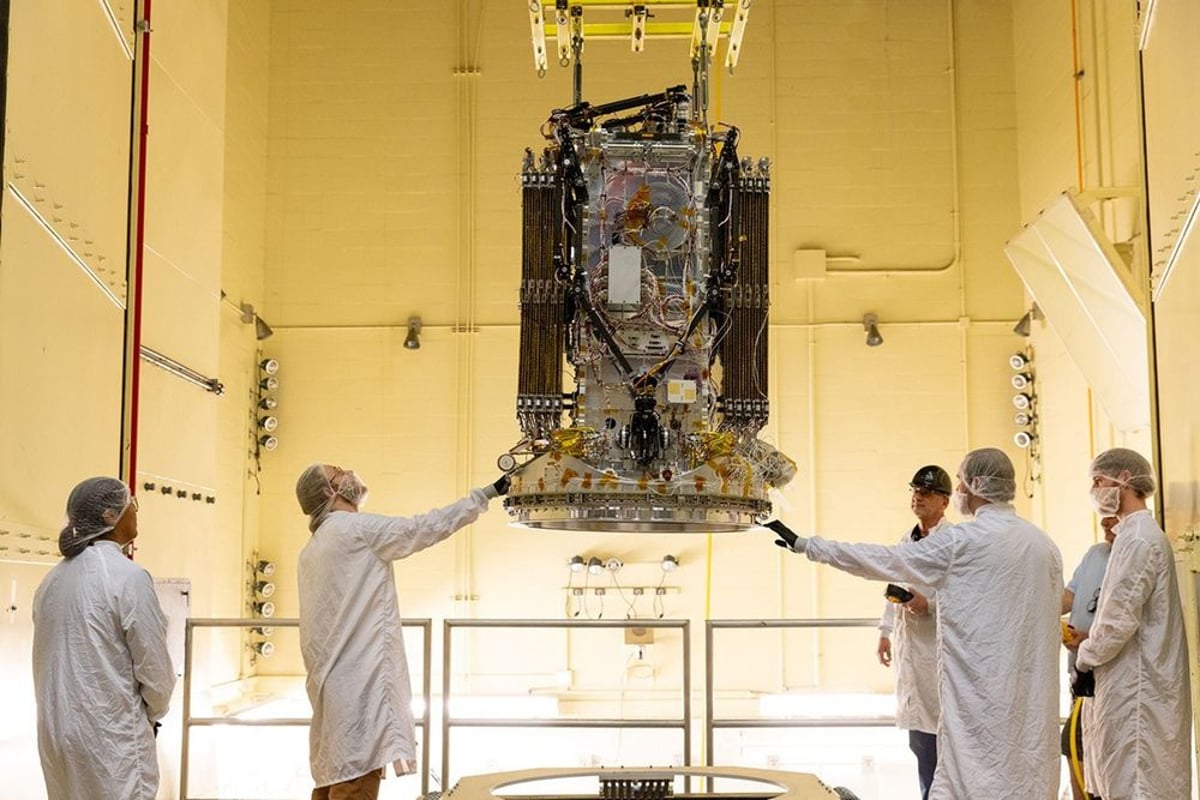
NASA's Swift Observatory is in a race against time. The 20-year-old satellite, pushed toward Earth by recent solar storms, could burn up in the atmosphere within months. That's why NASA enlisted Katalyst Space Technologies, a space startup that launched its Link spacecraft Friday on an unprecedented orbital rescue mission. The three-armed robotic craft aims to intercept Swift at 224 miles altitude and boost it 150 miles higher, buying the aging observatory years of additional science operations.
NASA just pulled the trigger on what might be the most dramatic satellite rescue attempt in space history. The agency's Swift Observatory, launched back in 2004 to hunt gamma-ray bursts across the cosmos, is now the one in danger of going up in flames.
Recent solar storms battered Swift's orbit, dragging the telescope lower and lower. Without any propulsion system of its own, the satellite has been helplessly circling at just 224 miles above Earth, well below its intended altitude. According to NASA mission documents, Swift could re-enter the atmosphere and burn up as soon as late 2026 if nothing changes.
Enter Katalyst Space Technologies, a space startup that's betting its future on orbital servicing. The company's Link spacecraft lifted off Friday on what Reuters described as an "orbital rescue mission" - and that's not hyperbole. Link needs to rendezvous with Swift, latch onto the tumbling observatory with its three robotic arms, and fire its thrusters to push the satellite 150 miles higher.
The technical challenge is staggering. Swift wasn't designed to be serviced. It has no docking ports, no grapple fixtures, nothing that makes it easy for another spacecraft to grab hold. Katalyst engineers spent months at NASA's Goddard Space Flight Center in Maryland testing Link inside vibration chambers, simulating the intense shaking the craft would experience during launch. The April testing regime, documented in NASA imagery, showed engineers stabilizing the robotic servicing vehicle as it prepared for its high-stakes mission.
But the stakes go beyond just saving one telescope. Swift has been a workhorse for NASA's astrophysics program, detecting and studying gamma-ray bursts from colliding neutron stars and black holes. The observatory's 20-year track record makes it invaluable for understanding some of the most violent events in the universe. Losing it would leave a gap in NASA's observational capabilities.
The mission also represents a watershed moment for commercial space services. NASA has increasingly turned to private companies for capabilities it once handled entirely in-house. SpaceX flies astronauts. Commercial firms build lunar landers. And now startups like Katalyst are being trusted to rescue multimillion-dollar scientific instruments.
According to AP News coverage, NASA enlisted Katalyst specifically because traditional options were too slow or too expensive. Building a new gamma-ray observatory would take years and hundreds of millions of dollars. Link's rescue mission, by contrast, offers a faster and cheaper path to keeping Swift operational.
The orbital mechanics alone make this mission fascinating. Link has to match Swift's velocity perfectly, approach without causing a collision, and then execute a delicate capture maneuver. Once attached, Link's thrusters will fire in carefully calculated bursts to raise Swift's orbit without spinning it out of control or damaging its sensitive instruments.
If Katalyst pulls this off, it won't just save Swift - it'll validate an entire industry. Dozens of satellites worth billions of dollars are orbiting Earth right now with no way to refuel, repair, or relocate themselves. Companies that can provide those services stand to unlock a massive market. Northrop Grumman has already tested satellite servicing with its Mission Extension Vehicle spacecraft. But Katalyst's approach with Link represents a new generation of more agile, purpose-built orbital mechanics.
The solar storms that doomed Swift's orbit also highlight a growing concern. We're entering a period of increased solar activity, and that means more satellites could face similar orbital decay issues. The sun's radiation heats Earth's upper atmosphere, causing it to expand and create more drag on low-orbit spacecraft. Swift just happened to be vulnerable at the wrong time.
NASA hasn't disclosed the full contract value for Katalyst's rescue mission, but industry observers estimate orbital servicing missions typically run in the tens of millions of dollars - still a fraction of what a replacement observatory would cost. For a startup like Katalyst, success here could mean future contracts not just from NASA but from commercial satellite operators and international space agencies.
The next few weeks will be critical. Link needs to complete its orbital maneuvers, locate Swift, and execute the capture. If everything goes according to plan, Swift could be back at a safe altitude by late summer, ready to resume its hunt for cosmic explosions. If something goes wrong, both spacecraft could be lost, and Swift's two-decade mission could end in a fiery re-entry.
This mission is more than just a rescue - it's a proof of concept for the future of space operations. If Katalyst succeeds in saving Swift, it'll demonstrate that commercial players can handle complex orbital servicing tasks that were once the exclusive domain of government agencies. And with more satellites facing similar threats from solar activity and orbital decay, the company that cracks this problem first stands to dominate an industry that barely existed five years ago. For now, all eyes are on Link as it chases down a telescope that's been falling toward Earth for months.