Nuclear startup X-energy just closed a massive $700 million Series D round, capitalizing on surging demand from tech giants scrambling for clean power to fuel their data centers. The funding comes less than a year after the company expanded its Series C to $700 million, bringing total recent fundraising to $1.4 billion as the nuclear renaissance accelerates.
The nuclear power industry just got another massive vote of confidence. X-energy closed a $700 million Series D round led by Jane Street, the company told TechCrunch, marking one of the largest funding rounds in the resurging nuclear sector. The timing couldn't be better—tech companies are desperately hunting for clean power sources to feed their energy-hungry AI data centers.
This latest infusion comes less than a year after X-energy expanded its Series C from $500 million to $700 million, bringing the startup's total fundraising over the past year to a staggering $1.4 billion. That's serious money, even in today's overheated nuclear startup landscape. The company has now raised $1.8 billion total since its founding.
Amazon is driving much of this momentum. The tech giant's Climate Pledge Fund led X-energy's Series C last year and committed to purchasing more than 600 megawatts of nuclear capacity across the Pacific Northwest and Virginia. Those reactors are expected to come online in the early 2030s, with the full Amazon partnership potentially deploying 5 gigawatts by 2039.
The market validation is clear in X-energy's order book. The startup says it has secured orders for 144 small modular reactors (SMRs) capable of generating 11 gigawatts of electricity. Beyond Amazon, customers include chemical giant Dow and British energy company Centrica—a diverse mix that shows nuclear's appeal extends well beyond hyperscale data centers.
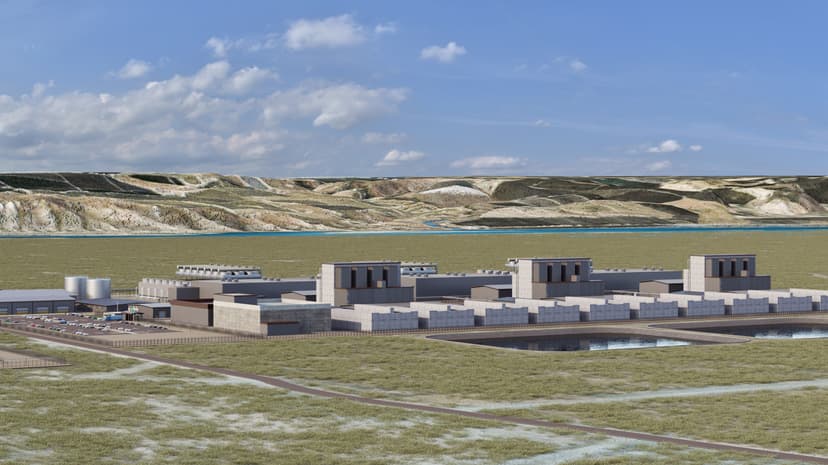
X-energy's technology centers on high-temperature, gas-cooled reactors, a design more commonly deployed in Japan and China than the US. Each Xe-100 reactor generates 80 megawatts of electricity using a distinctive fuel system: billiard ball-sized, carbon-coated pebbles containing uranium particles. Helium gas flows over these pebbles, collecting heat that gets transferred to steam turbines for electricity generation.
The Series D investor lineup reads like a who's who of institutional capital. Jane Street, which first invested during X-energy's expanded Series C, led the round. Joining them are Ares Management funds, ARK Invest, Corner Capital, Emerson Collective, Galvanize, Hood River Capital Management, NGP, Point72, Reaves Asset Management, Segra Capital Management, and XTX Ventures.
This funding will specifically target supply chain development—a critical bottleneck as nuclear startups race to commercialize their designs. X-energy faces stiff competition from several other SMR developers all promising to revitalize America's nuclear industry. The challenge is execution: while many designs look promising on paper, only a handful of SMR power plants have been built globally, and none operate in the United States.
The nuclear renaissance reflects a broader shift in how tech companies approach energy infrastructure. As AI workloads explode and data center power demands soar, companies like Amazon, Microsoft, and Google are making unprecedented commitments to clean baseload power. Nuclear offers something solar and wind can't: 24/7 generation without weather dependence.
But turning these ambitious plans into operating reactors remains the industry's biggest test. Regulatory approval, construction timelines, and supply chain scaling all present significant hurdles. X-energy's massive funding round provides the capital to tackle these challenges, but the real proof will come when the first Xe-100 reactors actually start generating power.
X-energy's $700 million Series D represents more than just another big funding round—it signals institutional confidence that small modular reactors can deliver on their promise to provide clean, reliable baseload power. With major customers like Amazon already committed and a robust supply chain development plan, X-energy appears well-positioned in the nuclear startup race. The real question isn't whether there's market demand, but whether any of these SMR companies can navigate the complex path from prototype to commercial operation. Success here could reshape both the nuclear industry and how tech giants power their AI ambitions.