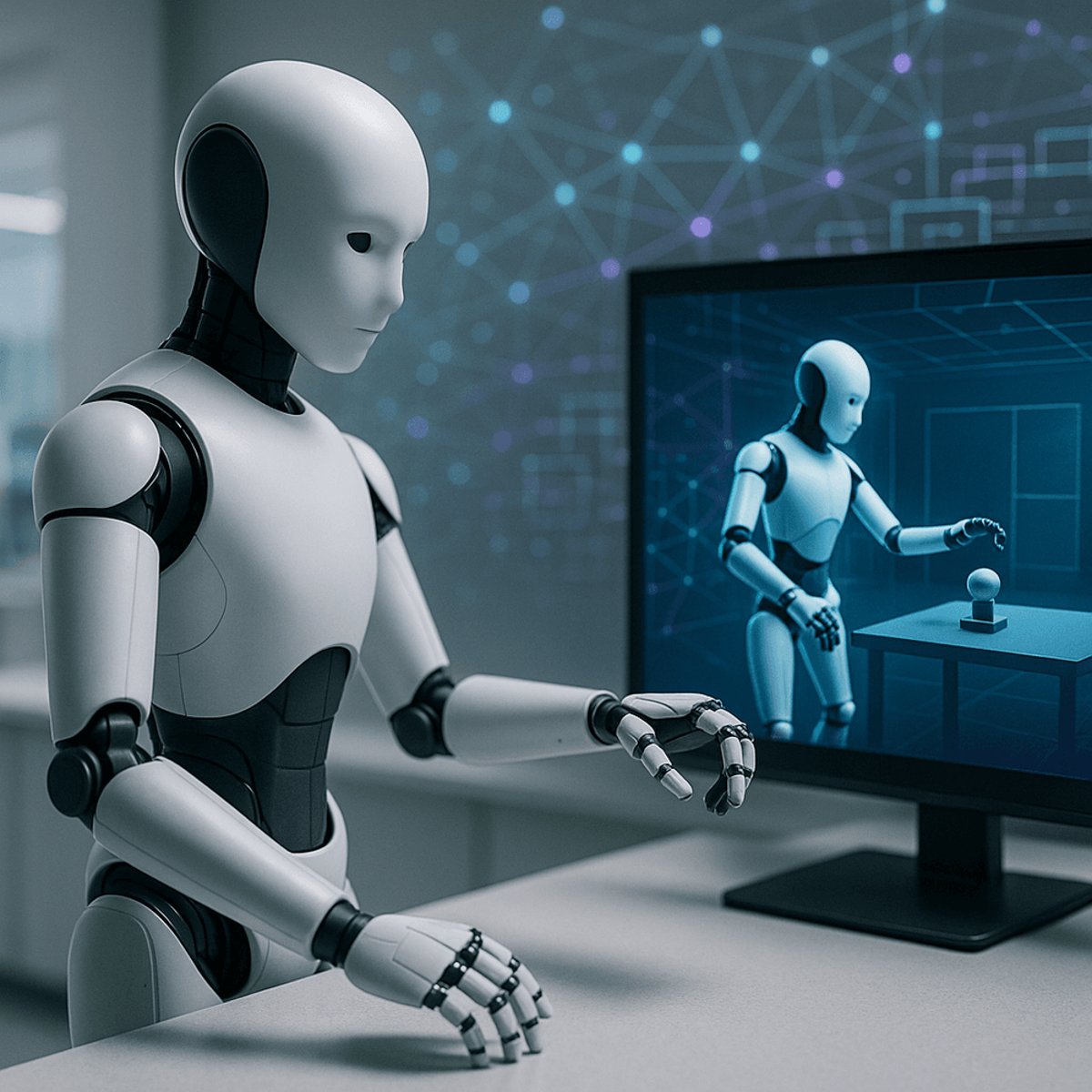
Nvidia just opened the gates to its entire physical AI infrastructure. The chipmaker unveiled a comprehensive suite of open-source models and frameworks at CES 2026 that spans the complete robotics development lifecycle - from high-fidelity simulation to edge deployment. The move gives developers direct access to the same tools powering everything from Caterpillar's voice-controlled heavy equipment to FDA-cleared surgical robots, potentially accelerating the path from lab prototypes to real-world autonomous systems.
Nvidia is betting that open-source infrastructure will define the next era of robotics development. The company's latest physical AI release represents a fundamental shift - instead of keeping its simulation and training tools behind closed doors, Nvidia is handing developers the complete toolkit it uses internally to build autonomous systems.
The timing matters. At CES 2026, the show floor became a proving ground for these tools, with companies demonstrating machines that moved beyond demos into actual deployment. Caterpillar brought its Cat AI Assistant directly into equipment cabs, letting operators adjust safety parameters by voice using Nvidia Nemotron models running on Jetson Thor edge modules. Behind those voice commands sits Omniverse-generated digital twins of entire job sites, where the company simulates traffic patterns and multi-machine workflows before deploying changes to real construction zones.
The medical robotics space is seeing similar transformation. LEM Surgical showcased its Dynamis Robotic Surgical System, which is already FDA-cleared and performing spinal procedures in clinical settings. The dual-arm humanoid surgical robot runs on Jetson AGX Thor for compute, uses Holoscan for real-time sensor processing, and trains its autonomous movements through Isaac Sim digital twin simulation. What makes this notable isn't just the hardware - it's that LEM Surgical generates its training data using Nvidia Cosmos Transfer, the open world model that creates physically accurate synthetic datasets without requiring thousands of hours of real surgical footage.
The physical AI stack Nvidia opened up connects several previously separate pieces. Cosmos world models provide the foundation for understanding how objects move and interact. The new Isaac Lab-Arena framework lets developers evaluate trained policies in standardized scenarios before touching hardware. Alpamayo brings together AI models and datasets specifically for autonomous vehicles. And OSMO orchestrates training across different compute environments, from cloud clusters to edge devices.
OpenUSD serves as the connective tissue. The 3D framework standardizes how simulation data flows between tools, letting developers build a digital twin once and reuse it across training, testing, and deployment phases. It's the reason NEURA Robotics can train its 4NE1 humanoid and MiPA service robots in Isaac Sim, then deploy those same behaviors to physical hardware without rebuilding everything from scratch.
NEURA Robotics is pushing that interoperability further through a collaboration with SAP and Nvidia. The company is integrating SAP's Joule agents with its robots using the Mega Omniverse Blueprint to simulate complex operational scenarios. Those simulated behaviors then deploy into NEURA's Neuraverse ecosystem and real-world robot fleets, creating a feedback loop between virtual testing and physical performance.
Chinese robotics company AgiBot demonstrates how these tools stack together. The company uses Nvidia Cosmos Predict 2 as the world-modeling backbone for its Genie Envisioner platform, which generates action-conditioned videos that show robots how tasks should unfold. Combining that synthetic data with Isaac Sim and Isaac Lab training, then post-training on AgiBot's own datasets, results in policies that transfer more reliably to its Genie2 humanoids and compact tabletop robots powered by Jetson Thor.
The developer ecosystem is already building on top. Intbot is using Cosmos Reason 2 to give its social robots contextual awareness - the model's reasoning capabilities let robots identify social cues and safety context that go beyond simple programmed responses. The company published a Cosmos Cookbook recipe showing how vision language models help robots decide when to speak and how to interact more naturally with humans.
Nvidia recently introduced Agile, an Isaac Lab-based engine that packages a complete sim-to-real workflow for humanoid locomotion and manipulation. The framework includes task configurations, Markov Decision Process models for decision-making, and deterministic evaluation tools. Developers can stress-test policies in Isaac Lab before transferring whole-body behaviors to platforms like the Unitree G1 and LimX Dynamics TRON.
Hugging Face is bringing its robotics community into the Nvidia ecosystem through direct integration. The AI company embedded Isaac GR00T N models and Isaac Lab-Arena into its LeRobot platform, streamlining policy training and evaluation for its developer base. Hugging Face's open-source Reachy 2 humanoid is now fully compatible with Jetson Thor, enabling direct deployment of vision language action models.
ROBOTIS, known for its smart servos and open-source humanoid platforms, built a complete sim-to-real pipeline using Isaac technologies. The workflow starts with high-fidelity data generation in Isaac Sim, scales up training sets using GR00T-Mimic for augmentation, then fine-tunes vision language action-based Isaac GR00T N models that deploy straight to hardware. The company documented the process showing how policies trained entirely in simulation transfer to physical manipulators performing real-world tasks.
The shift to open infrastructure changes the economics of robotics development. Startups no longer need to build simulation environments from scratch or train world models on massive compute clusters. They can start with Nvidia's pre-trained foundations, customize them with domain-specific data, and deploy to standardized hardware. That compression of the development cycle is already visible in the variety of applications showing up at CES - from industrial equipment to surgical systems to social robots.
Nvidia's decision to open its physical AI infrastructure signals a strategic bet that collaborative development will accelerate robotics adoption faster than proprietary approaches. By giving developers access to the same simulation, training, and deployment tools used by companies shipping FDA-cleared surgical robots and industrial equipment, Nvidia is compressing the timeline from prototype to production. The early implementations at CES 2026 suggest the strategy is working - these aren't concept demos but deployed systems using the newly opened stack. Watch how quickly startups without massive research budgets start shipping autonomous systems using these foundations.