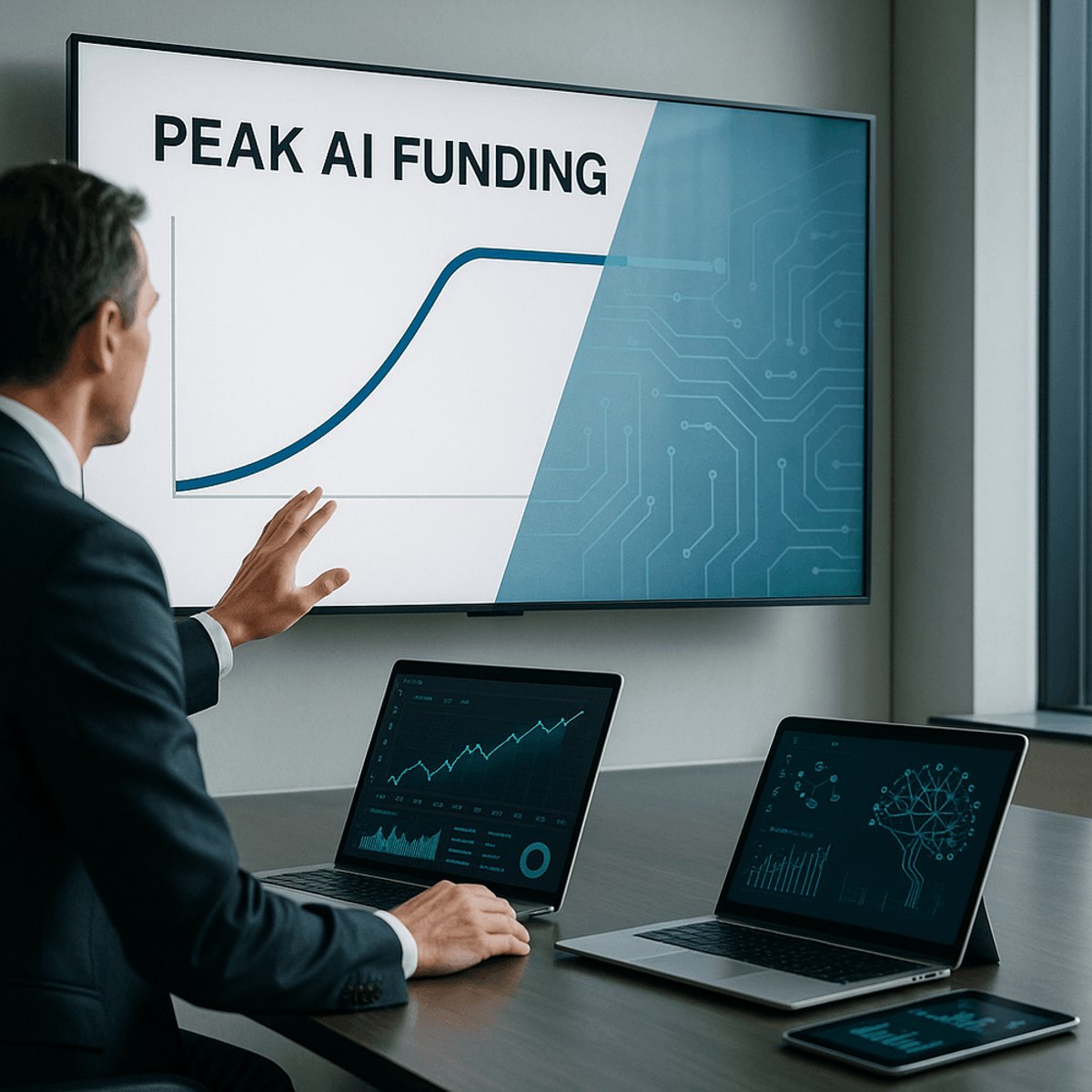
Nvidia CEO Jensen Huang just dropped a bombshell that has venture capitalists and AI founders rethinking the next 18 months. Speaking about OpenAI's massive $30 billion funding round, Huang suggested it "might be the last" investment of this scale in the AI sector—a striking statement from the executive whose chips power nearly every major AI model. The comment signals a potential inflection point in an industry that's absorbed over $50 billion in venture capital over the past two years, raising urgent questions about whether we've hit peak AI funding.
Nvidia CEO Jensen Huang isn't known for dampening enthusiasm around artificial intelligence—his company's $2 trillion valuation rides on AI's continued expansion. So when he suggests that OpenAI's staggering $30 billion funding round could represent the ceiling for AI investments, the market pays attention.
The timing of Huang's comment is particularly striking. OpenAI reportedly closed its latest round at a $157 billion valuation, making it one of the most valuable private companies on the planet. That capital influx was meant to fund massive compute infrastructure—largely built on Nvidia's H100 and upcoming B200 chips—and extend its runway in the race to artificial general intelligence. But Huang's assessment suggests even this war chest might represent an end rather than a beginning.
"We might be seeing a natural maturation of the investment cycle," notes a prominent venture capital partner who requested anonymity to speak candidly about portfolio companies. "When Jensen says something like this, he's looking at order books, capacity planning, and capital deployment across every major AI lab. He sees demand signals six to nine months before the rest of us."
The implications ripple across the startup ecosystem. AI companies raised more than $50 billion in 2025 alone, with mega-rounds becoming almost routine. Anthropic pulled in $7 billion, Cohere raised $500 million, and dozens of application-layer startups secured nine-figure Series B rounds on the promise of foundation model integration. Huang's comment suggests that party might be ending.
What's driving this potential peak? The answer lies in the economics of frontier AI development. Training runs for cutting-edge models now cost hundreds of millions of dollars, requiring massive upfront capital. But the revenue models remain uncertain. OpenAI reportedly generated $3.4 billion in revenue in 2024—impressive growth, but still a fraction of the capital it's consumed. Investors are starting to demand clearer paths to profitability.
Nvidia's unique vantage point makes Huang's assessment particularly credible. The company supplies the vast majority of GPUs used for AI training and inference, giving it real-time visibility into where capital is flowing and how it's being deployed. When compute purchases slow or shift from training to inference, Nvidia sees it first. Huang's comment may reflect what he's observing in current order patterns.
The shift also reflects changing investor sentiment. Early AI investments bet on platform dominance—whoever builds the best foundation model wins the market. But as models commoditize and performance differences narrow, attention turns to sustainable business models. Application-layer companies with clear revenue and manageable compute costs suddenly look more attractive than frontier labs burning through billions quarterly.
There's also a technical argument for why mega-rounds might diminish. Some researchers believe we're approaching diminishing returns on pure scale. If intelligence doesn't scale linearly with compute beyond a certain threshold, the rationale for $30 billion war chests weakens considerably. Huang himself has spoken about efficiency gains and architectural innovations that could reduce capital requirements for competitive AI systems.
For founders currently fundraising, Huang's comment lands like a warning shot. The message: secure your runway now, because the mega-round environment that made $100 million Series Bs commonplace may not persist. Several late-stage AI startups have reportedly already begun cutting burn rates and extending timelines to profitability in anticipation of tighter capital markets.
The potential funding peak doesn't mean AI innovation slows—it means the innovation becomes more capital-efficient. Smaller, focused models trained on specific domains may offer better unit economics than monolithic foundation models. Open-source alternatives reduce dependency on proprietary APIs. Inference optimization stretches compute budgets further. The technology continues advancing, but the business models evolve.
What remains unclear is whether Huang's assessment proves prescient or premature. AI's trajectory has consistently defied skeptics, and another breakthrough could easily reignite funding frenzy. But coming from the executive whose company profits most directly from AI's capital intensity, the caution carries unusual weight.
Huang's statement marks a potential turning point in AI's investment narrative. Whether it proves prescient or premature, the comment from tech's most AI-exposed CEO signals a market reassessment underway. Founders should prepare for a funding environment that rewards capital efficiency over growth-at-all-costs, while investors recalibrate expectations around timeline to returns. The AI revolution continues, but the financial dynamics supporting it may be fundamentally shifting. What comes next will test whether the technology can deliver on the massive expectations its funding boom created.