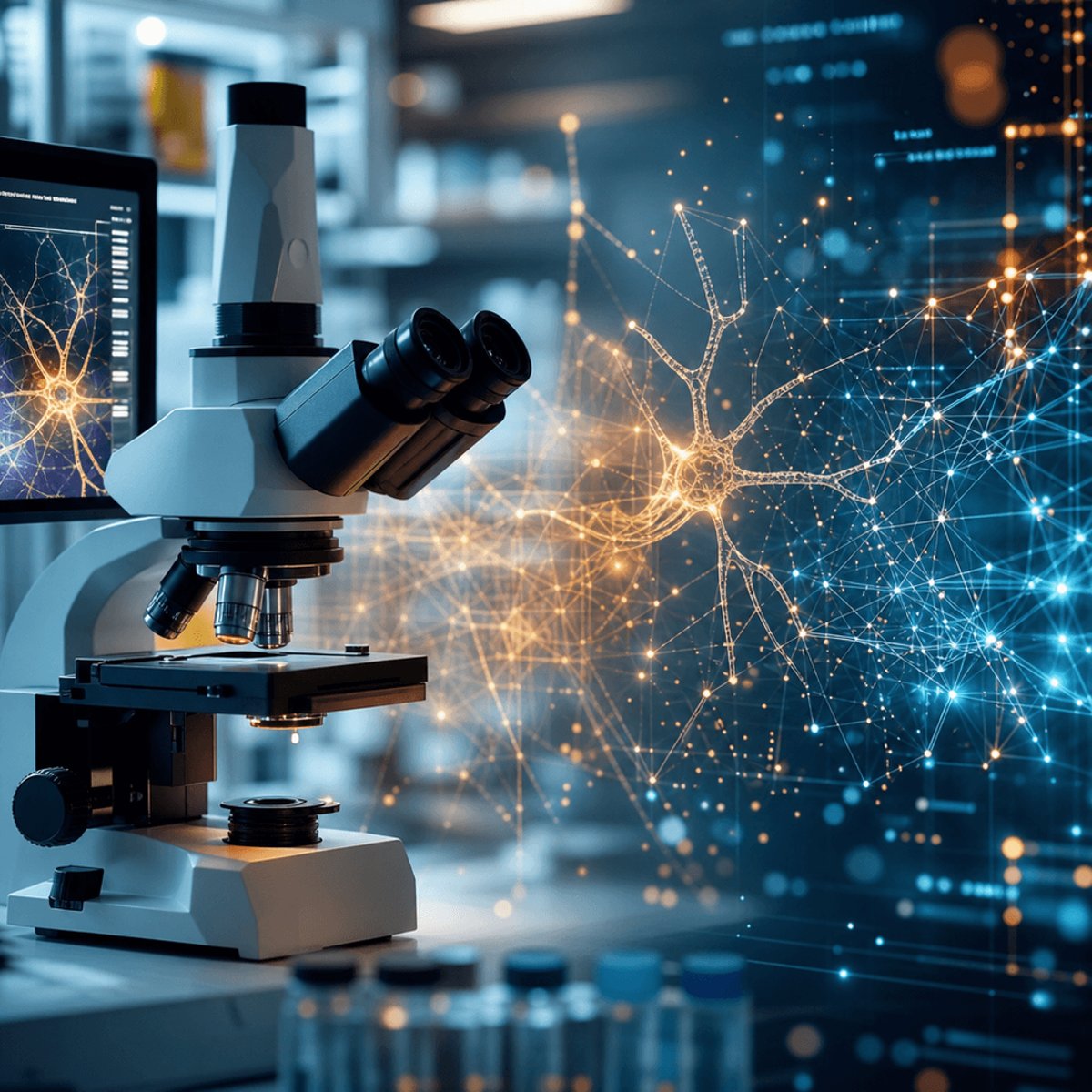
Jeff Bezos is making a audacious bet that the future of artificial intelligence lies not in bigger models, but in actual brain tissue. The Amazon founder is backing Flourish, a neuroscience-focused AI startup that just landed $500 million in funding at a $2.5 billion valuation. Instead of following the industry's brute-force approach to AI, Flourish is taking a radically different path - putting real neurons under the microscope to hunt for what they're calling the brain's "core algorithm."
Jeff Bezos just made his boldest AI investment yet, and it couldn't be more different from what OpenAI, Google, and Anthropic are doing. While the rest of Silicon Valley races to build ever-larger language models, the Amazon founder is betting half a billion dollars on a startup that thinks the answer lies in biological neurons, not digital ones.
Flourish, a neuroscience-based AI company that's been operating mostly under the radar, just closed a massive $500 million funding round that values the company at $2.5 billion, according to Wired. Bezos is leading the charge alongside other high-profile investors who are willing to gamble that studying actual brain tissue might unlock AI capabilities that silicon alone can't achieve.
The pitch sounds almost like science fiction. Instead of training neural networks on massive datasets using thousands of GPUs, Flourish wants to literally put neurons under microscopes and figure out the fundamental computational principles that make biological intelligence work. They're calling it the search for the brain's "core algorithm" - the underlying logic that allows three pounds of grey matter to outperform supercomputers at tasks like reasoning, learning from limited examples, and understanding context.
It's a dramatic departure from the current AI paradigm. Companies like OpenAI have proven that throwing more compute power and training data at transformer models produces increasingly capable systems. GPT-4 works because it was trained on essentially the entire internet. But that approach hits diminishing returns and requires exponentially more resources for incremental gains. Flourish is betting there's a smarter way.
The timing of this funding round is significant. Just as concerns mount about the sustainability of scaling laws in AI - both financially and environmentally - alternative approaches are attracting serious capital. While Nvidia continues printing money selling GPUs for traditional AI training, investors like Bezos are hedging their bets on fundamentally different architectures.
What makes Flourish particularly intriguing is the pedigree reportedly behind it. While the company has kept details close to the vest, neuroscience-inspired AI isn't entirely new territory. Companies like DeepMind (now part of Google) have long drawn inspiration from cognitive science. But Flourish appears to be taking a more direct biological approach, actually studying living neural systems rather than just mimicking their high-level architecture.
The $2.5 billion valuation puts Flourish in rarefied company before it's even launched a product. For comparison, that's approaching the early valuations of companies like Anthropic, which raised hundreds of millions based on the track record of its ex-OpenAI founders. Flourish is commanding similar numbers based purely on the promise of a radically different approach to intelligence.
Bezos has been methodically building his AI portfolio since stepping back from Amazon's day-to-day operations. He's previously invested in multiple AI startups and clearly sees artificial intelligence as the next transformational technology wave. But this investment in bio-inspired AI suggests he's not convinced the current transformer-based approach represents the final word in machine intelligence.
The market reaction to bio-hybrid and neuromorphic computing approaches has been mixed. While the theoretical potential is enormous - biological brains are vastly more energy-efficient than digital computers - translating neuroscience insights into practical AI systems has proven extraordinarily difficult. Critics argue we don't understand the brain well enough to reverse-engineer its algorithms. Believers counter that we don't need to understand everything, just the core principles.
What's clear is that Flourish now has the runway to find out. Half a billion dollars buys a lot of microscope time and a lot of top-tier neuroscience talent. If they can even partially decode how biological neural networks achieve general intelligence with such efficiency, the implications would reshape the entire AI industry.
The funding also highlights the growing diversification of AI investment strategies. While most venture capital still flows toward companies building on top of existing large language models, deep-pocketed investors like Bezos are spreading bets across multiple AI paradigms. It's a recognition that we're still in the early innings of understanding what artificial intelligence can become.
Bezos's massive bet on Flourish represents more than just another AI investment - it's a signal that even the industry's biggest players aren't convinced the current path to artificial general intelligence is the only one worth pursuing. Whether studying actual neurons will unlock the secrets to more efficient, capable AI systems remains to be seen. But with $500 million in the bank and a $2.5 billion valuation, Flourish now has the resources to find out if biology holds answers that pure computer science has missed. If they're right, it could reshape how we think about building intelligent machines. If they're wrong, it'll be one of the most expensive neuroscience experiments ever conducted.