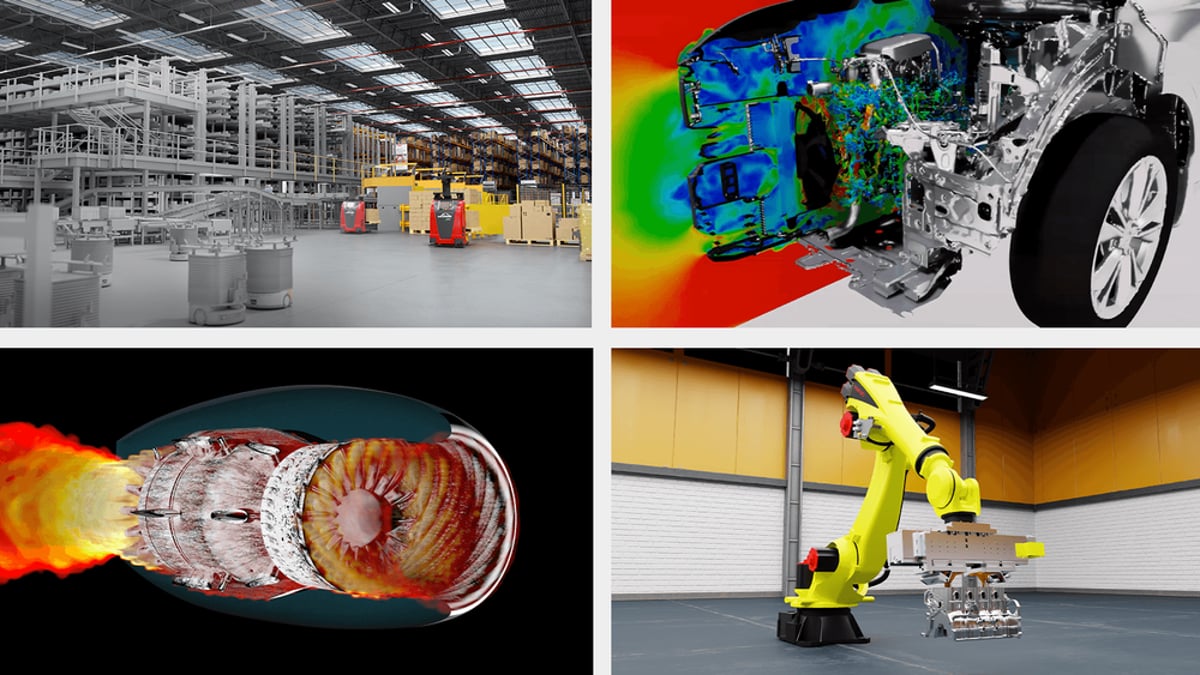
Nvidia just handed the robotics and autonomous vehicle industries a major infrastructure upgrade. The chip giant unveiled its Physical AI Data Factory Blueprint, an open reference architecture designed to automate the messy, expensive process of generating training data for robots, vision systems, and self-driving cars. According to Nvidia's announcement, the blueprint slashes the costs, time, and complexity of training physical AI at scale - addressing what's become the industry's most stubborn bottleneck.
Nvidia is making a calculated play for the physical AI infrastructure layer, and the timing couldn't be sharper. The company's newly announced Physical AI Data Factory Blueprint tackles what engineers in robotics and autonomous vehicle labs have been griping about for years - the astronomical cost and time sink of generating quality training data for systems that need to navigate the real world.
The blueprint arrives as an open reference architecture, meaning companies can adopt and customize it without vendor lock-in. But make no mistake, this is Nvidia building the rails for an industry expected to explode. According to Nvidia's press release, the system unifies and automates three critical stages - data generation, augmentation, and evaluation - that currently eat up months of engineering time and millions in compute costs.
Here's why that matters. Unlike language models that can feast on text scraped from the internet, physical AI systems need massive amounts of labeled sensor data showing how robots should grip objects, how autonomous vehicles should react to pedestrians, and how warehouse bots should navigate cluttered spaces. Collecting and labeling that data in the real world is prohibitively expensive. Simulating it has been fragmented across dozens of incompatible tools.
Nvidia's betting that a standardized, automated pipeline will do for physical AI what cloud platforms did for web apps - turn infrastructure from a competitive disadvantage into a commodity. The blueprint integrates with Nvidia's existing Omniverse simulation platform and Isaac robotics tools, creating a closed loop where synthetic data gets generated, tested against real-world performance, and iteratively improved without human intervention.
The announcement lands during Nvidia's GTC conference, where the company has been systematically expanding beyond its GPU cash cow into full-stack AI infrastructure. While competitors like Amazon Web Services and Google Cloud scramble to build their own robotics platforms, Nvidia's approaching it differently - give away the architecture, sell the chips and software to run it.
Industry watchers see this as Nvidia hedging against a future where GPU margins compress. Physical AI represents one of the few growth markets where training workloads will expand rather than plateau. Autonomous vehicles alone are projected to generate exabytes of training data annually by 2028, according to various industry forecasts. Robotics companies building humanoid workers and warehouse automation systems face similar data appetites.
The "open" positioning is strategic too. By releasing the blueprint as a reference architecture rather than a proprietary platform, Nvidia invites ecosystem development while maintaining control over the underlying compute layer. It's the classic platform play - be generous with the map, but own the roads.
What makes the Data Factory particularly clever is how it addresses the quality problem, not just the quantity challenge. The blueprint includes automated evaluation loops that compare synthetic training results against real-world performance metrics, flagging edge cases where simulation diverges from reality. That feedback mechanism has been the missing piece keeping many robotics projects stuck in development hell.
Early adoption signals will be worth watching. If major AV players like Tesla or robotics startups building on Nvidia hardware quickly integrate the blueprint, it could establish a de facto standard before competitors respond. That would give Nvidia enormous influence over how the next generation of physical AI gets built.
The move also puts pressure on startups that have raised millions to solve pieces of this puzzle - synthetic data generation companies, labeling platforms, and simulation tool makers. If Nvidia's integrated blueprint delivers on its promise, niche point solutions lose their value proposition. Consolidation in the physical AI tooling space seems inevitable.
For enterprises evaluating robotics or AV investments, the blueprint offers a compelling argument to standardize on Nvidia infrastructure early. The promise of reduced training costs and faster iteration cycles addresses two of the biggest objections CFOs raise when evaluating physical AI projects. If Nvidia can demonstrate meaningful cost reductions in early case studies, adoption could accelerate quickly.
Nvidia's Physical AI Data Factory Blueprint represents more than a developer tool launch - it's an infrastructure land grab targeting the next wave of AI compute spending. By open-sourcing the architecture while controlling the underlying hardware and software stack, Nvidia positions itself as the inevitable platform for robotics, vision AI, and autonomous vehicles. The real test comes in the next six months, as enterprises and startups decide whether to standardize on Nvidia's vision or risk fragmenting an already complex tooling landscape. For an industry desperate to escape training data bottlenecks, that's not really a choice at all.