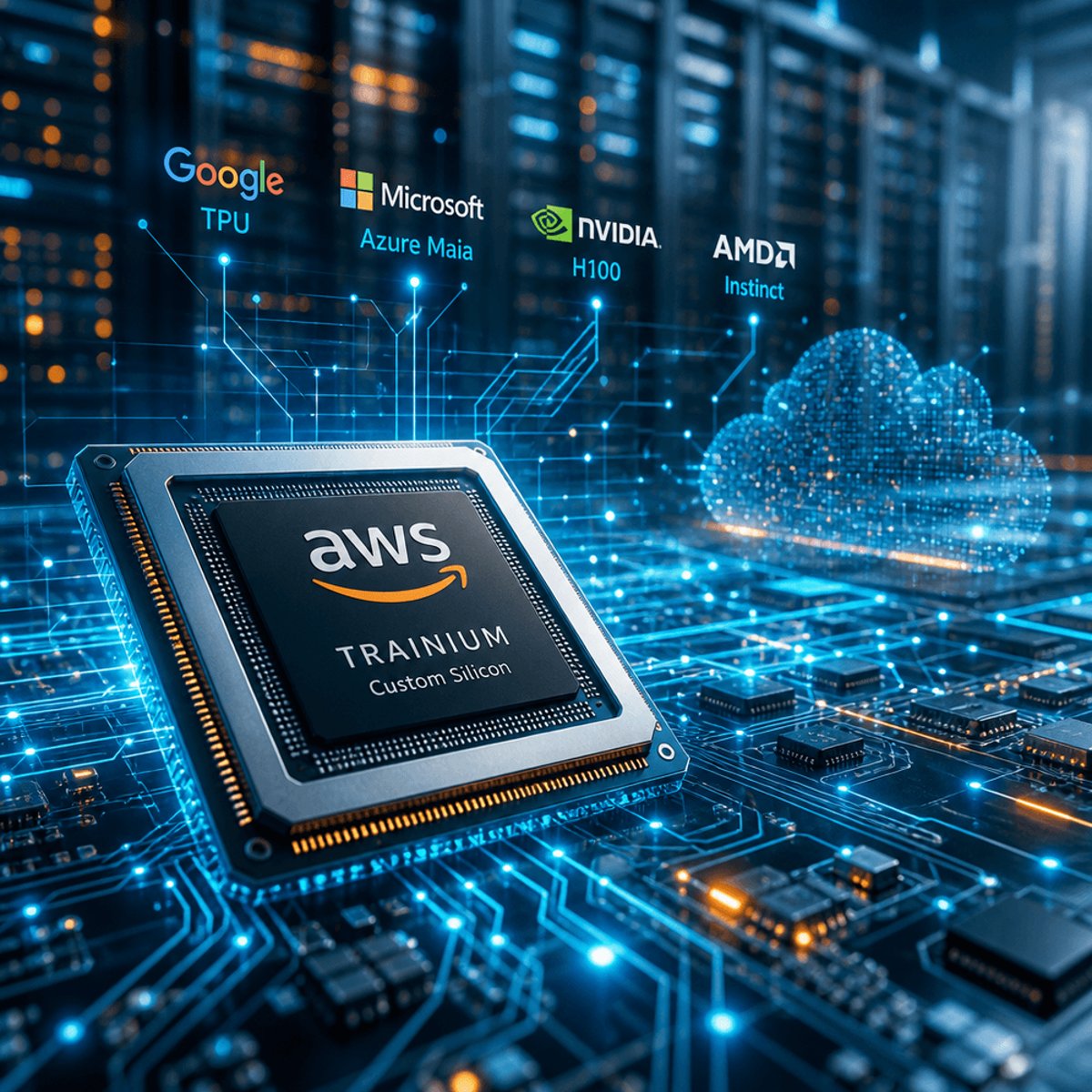
Amazon just crossed a milestone that cements its position as one of the world's top chip companies. The e-commerce giant's custom silicon business through AWS has hit a $25 billion annual revenue run rate, according to company disclosures. That puts Amazon in direct competition with Nvidia for enterprise AI infrastructure spending, reshuffling a market that was worth $527 billion globally in 2025. The shift happened quietly over a decade, but the implications for cloud pricing and AI deployment costs are just starting to land.
Amazon didn't set out to become a chip company. But a decade of relentless focus on reducing costs for AWS customers has turned its custom silicon division into a business bigger than most semiconductor companies' entire operations. The $25 billion annual revenue run rate disclosed by Amazon puts it in rarefied air, competing with established players who've spent decades in the chip game.
The numbers tell a remarkable transformation story. When Amazon acquired Annapurna Labs in 2015 for roughly $350 million, industry analysts questioned why a retail company needed a chip design team. Fast forward to 2026, and that acquisition has generated a 70x return in annual revenue terms alone. The Graviton processors that emerged from that deal now power everything from Netflix's streaming infrastructure to Meta's AI training workloads.
What makes this particularly disruptive is the cost advantage Amazon's offering enterprise customers. According to AWS's own performance benchmarks, workloads running on Graviton4 processors deliver up to 40% better price-performance compared to x86-based instances. For AI training specifically, the Trainium2 chips Amazon started shipping in early 2026 cut costs by roughly 35% versus comparable Nvidia H100 configurations. Those aren't marginal improvements - they're the kind of numbers that make CFOs rethink their entire cloud strategy.
Nvidia isn't sitting still, but Amazon's vertical integration creates structural advantages that are hard to match. Where Nvidia sells chips that cloud providers mark up, AWS uses its silicon to offer better economics while maintaining healthy margins. The company's also designing chips specifically for the workloads its customers actually run, rather than general-purpose GPUs that work for everything but aren't optimized for anything specific.
The competitive ripple effects are already visible. Microsoft accelerated development of its Maia and Cobalt custom chips after seeing AWS's success with Graviton. Google has been designing TPUs for years but recently expanded their availability to cloud customers beyond internal workloads. The hyperscalers are all moving in the same direction - toward custom silicon that gives them pricing power and performance advantages.
For enterprise customers, this chip war translates into real savings. A typical Fortune 500 company running 10,000 instances on AWS could save $8-12 million annually by migrating from Intel-based instances to Graviton3, according to cost optimization analyses from cloud management platforms. Multiply that across thousands of enterprises, and you start to understand why Amazon's betting so heavily on silicon.
But the $25 billion milestone also raises questions about Amazon's relationship with traditional chip suppliers. Intel and AMD still provide processors for many AWS instance types, but their share of new deployments has been declining steadily. Industry sources suggest Graviton-based instances now account for roughly 60% of new compute capacity AWS adds each quarter, up from essentially zero in 2019.
The AI boom that started with ChatGPT's launch has supercharged demand for custom training chips. Amazon's Trainium line specifically targets the massive compute requirements of large language models, offering an alternative to Nvidia's dominance in that space. Early OpenAI competitors and enterprise AI teams have started testing Trainium2 clusters, attracted by the 40% cost reduction and AWS's promise of better availability than Nvidia's perpetually supply-constrained H100s.
What's less visible but equally important is the inference side of the equation. Amazon's Inferentia chips handle the serving of AI models after they're trained, where cost per query matters more than raw training speed. With billions of AI inference requests happening daily across AWS, even small efficiency gains compound into massive cost advantages. The company's claiming Inferentia2 delivers up to 50% lower cost per inference compared to GPU-based alternatives.
The strategic implications extend beyond just hardware margins. By controlling the silicon layer, Amazon can optimize the entire stack from chips through networking to software frameworks. That vertical integration lets AWS offer capabilities competitors can't easily replicate, from custom machine learning accelerators to networking performance that assumes specific chip architectures.
Industry analysts are already revising their semiconductor market forecasts to account for hyperscaler custom silicon. What looked like a temporary experiment five years ago now appears to be a permanent restructuring of how cloud infrastructure gets built. The question isn't whether Microsoft and Google will follow Amazon's path - they already are. It's whether traditional chip companies can adapt fast enough to remain relevant in a market where their biggest customers are becoming competitors.
Amazon's $25 billion chip business isn't just a milestone - it's a signal that the cloud wars have fundamentally shifted. The companies that control AI infrastructure won't just be reselling someone else's silicon anymore. They'll design it, optimize it, and use it as a competitive weapon to lock in customers and compress costs. For enterprises betting big on AI deployments, that means more choices and better pricing. For traditional chipmakers, it means their biggest customers just became their fiercest competitors. The next phase of this battle will determine whether custom silicon remains a hyperscaler advantage or becomes table stakes across the industry.