Inside the Elon Musk vs OpenAI trial: unsealed discovery reveals Brockman's "it was a lie" diary entry, Nadella's late-night texts, and how a $38M donation became a $500B fraud case. Full breakdown.
Greg Brockman has a journaling habit. Like a lot of tech founders, he processes his thoughts by writing them down. Strategy sessions. Product ideas. The occasional existential crisis about artificial intelligence.
In November 2017, he wrote something that would come back to haunt him.
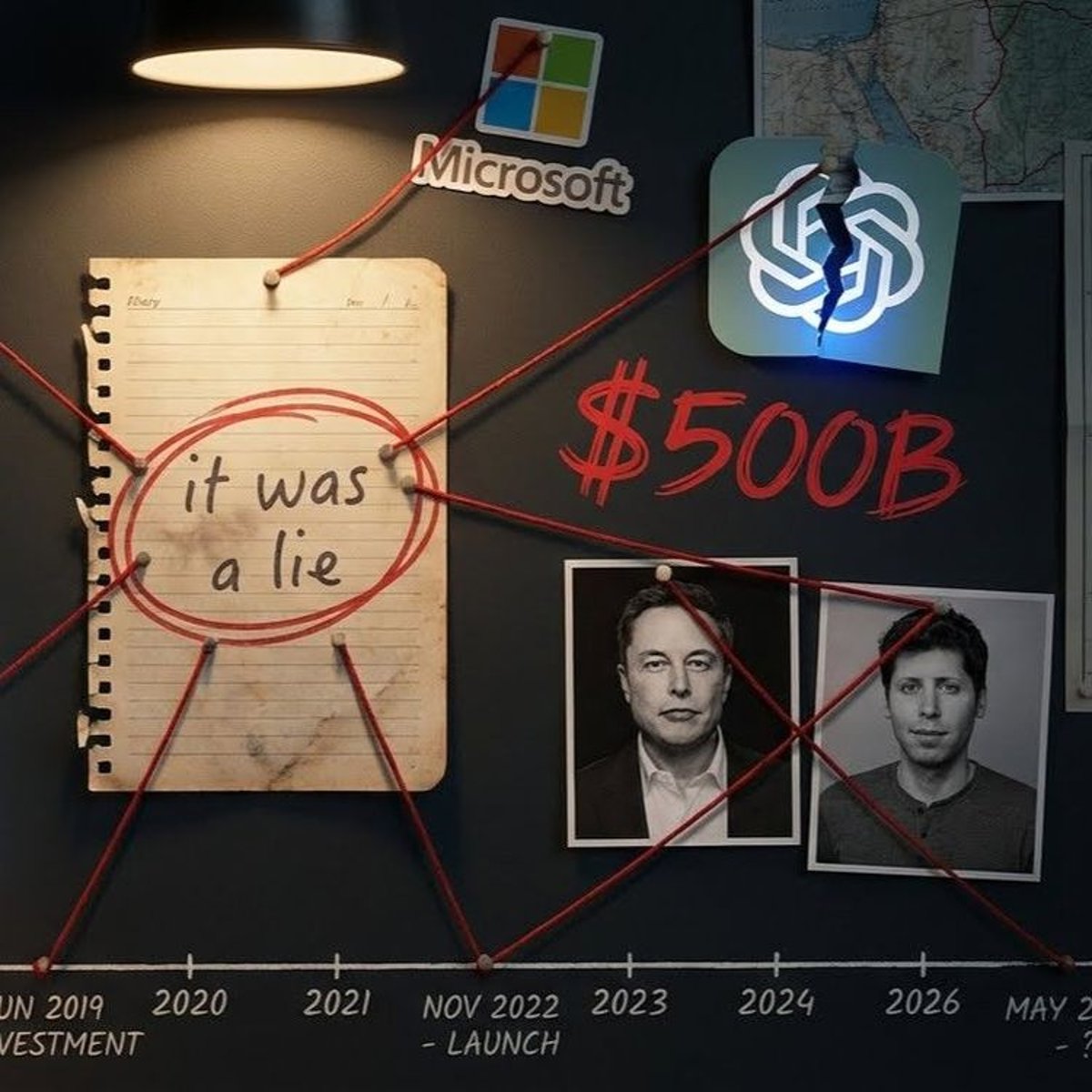
"I cannot believe that we committed to non-profit if three months later we're doing b-corp then it was a lie."
That single sentence, scrawled in his private diary and never meant to see the light of day, is now Exhibit A in the biggest lawsuit Silicon Valley has ever seen. When federal attorneys subpoenaed Brockman's personal records during discovery, they found something OpenAI's lawyers desperately wished didn't exist: the co-founder of the world's most valuable AI company, in his own words, calling his organization's founding promise a lie.
On January 15, 2026, a federal judge ruled that this case is going to trial. OpenAI and Microsoft threw everything they had at getting it dismissed. They failed.
Now Elon Musk, Sam Altman, Greg Brockman, and Microsoft CEO Satya Nadella are headed to an Oakland courtroom in April, where a jury will decide whether the company that built ChatGPT was founded on fraud.
The stakes? A $500 billion company. The future of artificial intelligence. And the question of whether the biggest names in tech can promise one thing, do another, and get away with it.
How OpenAI Started: The 2015 Founding Story Elon Musk Funded
Let's go back to 2015, before any of this got complicated.
Elon Musk was worried. Not about Tesla, not about SpaceX, but about something he considered far more dangerous: Google was winning the AI race, and nobody seemed to care what they'd do when they got there.
Google had just bought DeepMind for $500 million in 2014. Facebook was building its own AI lab. The most powerful technology in human history was being developed behind closed doors by companies with zero obligation to share what they learned or how they planned to use it.
Musk had a radical idea: What if someone built an AI research lab that wasn't trying to make money? What if the technology was open? What if the whole point was to make sure AI benefited everyone, not just shareholders?
He found a partner in Sam Altman, then running Y Combinator and known for spotting world-changing ideas before anyone else. Together, they recruited the best AI researchers money could buy, including Ilya Sutskever from Google and Greg Brockman, a wunderkind who'd built Stripe's technical infrastructure.
On June 24, 2015, Altman sent Musk an email laying out the plan:
"nonprofit but the people working on it get startup-like compensation if it works. Obviously we'd comply with/aggressively support all regulation."
Musk's reply was two words:
"Agree on all."
Those two words would eventually be worth $38 million. And a decade later, they'd be the foundation of a fraud lawsuit that could reshape Silicon Valley.
The $38 Million Donation OpenAI Doesn't Talk About
Here's something most people don't realize about OpenAI's early days: the organization was broke.
When OpenAI launched in December 2015, the press release announced $1 billion in committed funding from Musk, Altman, Peter Thiel, and other luminaries. It was a headline-grabbing number that suggested this nonprofit had the resources to compete with Google.
The reality was different. Internal emails revealed during discovery show that most of that billion dollars never materialized. The early funding came almost entirely from one person: Elon Musk.
OpenAI Early Funding Reality:

Between 2015 and 2018, Musk donated somewhere between $38 and $44 million to OpenAI. He didn't just write checks. He recruited talent, provided credibility, and connected the organization to the resources it needed to survive. When OpenAI needed computing power, Musk made calls. When they needed top researchers, Musk helped close the deals.
He did all of this based on a simple understanding: this was a nonprofit dedicated to developing AI for the benefit of humanity. Open source. No profit motive. The technology would belong to everyone.
At least, that's what he thought he was funding.
Greg Brockman's Diary Entries: "Get Out From Elon"
By 2017, the cracks were starting to show.
OpenAI was burning through money faster than donations could replenish it. Training AI models was expensive, and the costs were only going up. The researchers wanted better equipment, bigger compute clusters, competitive salaries. A nonprofit structure made all of that harder.
Greg Brockman started writing about it in his diary. Not the public stuff about AI safety and beneficial technology. The private stuff about money and power and what to do about their biggest donor.
"Some chance that rejecting Elon will actually lose us Sam. We'll find out tomorrow if doing an override all the way through is palettable. This is the only chance we have to get out from Elon. Is he the 'glorious leader' that I would pick?"
Another entry was even more direct:
"It all comes down to the money. We can get it from Tesla, probably. We could also probably get it from Google."
These weren't the musings of someone trying to honor a nonprofit mission. These were the calculations of someone trying to figure out how to escape the restrictions that came with Musk's money.
Key Brockman Diary Revelations:
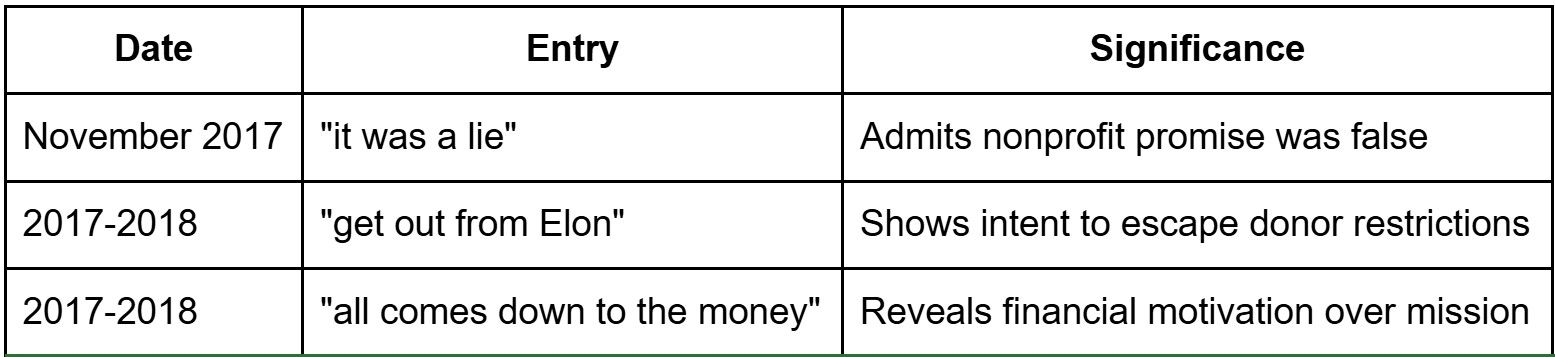
The diary entries sat in Brockman's personal files for years, unknown to anyone outside his closest circle. When discovery demands finally surfaced them in 2025, OpenAI's lawyers must have felt their stomachs drop.
Their co-founder had called the nonprofit commitment a lie. In writing. With a date stamp.
Elon Musk's "Path of Certain Failure" Email to Sam Altman
In January 2018, Musk sent Altman an email that reads like a final warning before a relationship falls apart.
"OpenAI is on a path of certain failure relative to Google. There obviously needs to be immediate and dramatic action or everyone except for Google will be consigned to irrelevance."
He wasn't done:
"To be clear, I have a lot of respect for your abilities and accomplishments, but I am not happy with how things have been managed. Either we fix things and my engagement increases a lot or we don't and I will drop to near zero and publicly reduce my association."
One month later, Musk resigned from the OpenAI board.
The official story was conflicts of interest with Tesla's own AI development. The real story, according to court filings reported by Reuters, was that Musk had tried to take control of OpenAI himself. He proposed merging the nonprofit into Tesla, which would have given him direct oversight of its development. The board rejected the idea. Altman got the CEO job instead.
Musk walked away from an organization he'd helped create and largely funded. But he didn't walk away quietly.
Microsoft's $13 Billion OpenAI Investment: How the Deal Happened
With Musk gone, OpenAI needed a new source of capital. They found it in Redmond.
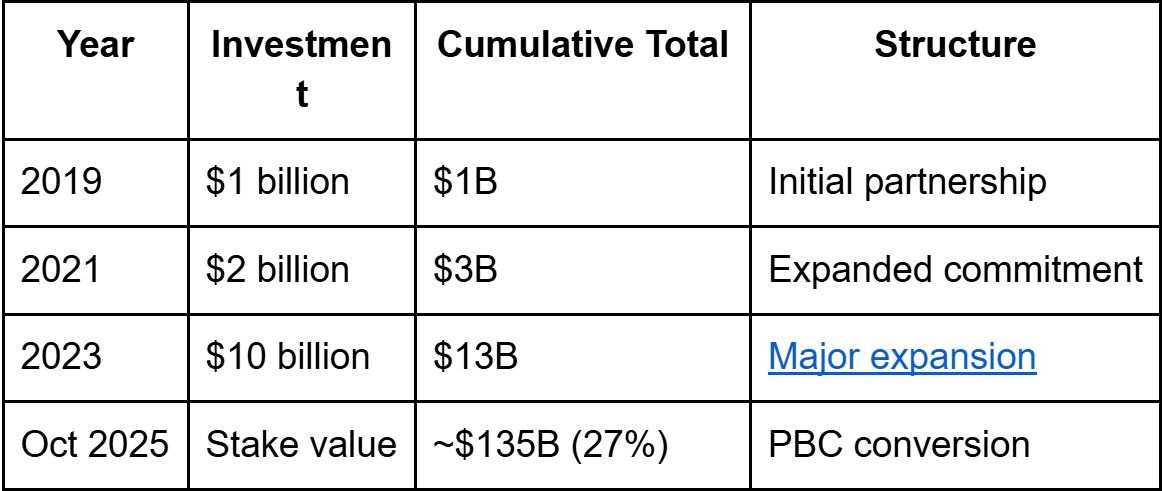
In 2019, Microsoft invested $1 billion in OpenAI. But here's the thing: you can't invest in a nonprofit. There's nothing to buy, no equity to own, no returns to collect.
So OpenAI did something clever. They created a for-profit subsidiary with a "capped-profit" structure. Investors could put money in and get returns, but those returns were limited to 100 times their investment. Anything above that would flow back to the nonprofit's mission.
It was a creative solution to a real problem. It was also, according to Musk, a complete betrayal of everything OpenAI was supposed to be.
Microsoft OpenAI Investment Timeline:
Major expansion
The nonprofit that was founded to keep AI open and beneficial had just created a for-profit arm that could raise billions from corporate investors. The technology that was supposed to belong to humanity was now being developed in partnership with one of the largest companies on Earth.
And the founding donor who'd been promised a nonprofit? Nobody asked his permission.
OpenAI Corporate Structure Explained: From Nonprofit to $500 Billion Valuation
Understanding how OpenAI pulled this off requires following the money through several layers of corporate structure.
Phase 1: Pure Nonprofit (2015-2019)
In the beginning, it was simple. The OpenAI Foundation owned everything. It was a 501(c)(3) nonprofit with a mission to develop AI safely for the benefit of humanity. No investors. No equity. No returns.
Phase 2: Capped-Profit Model (2019-2024)
Then came the 2019 restructuring. OpenAI created a for-profit subsidiary called OpenAI LP. The nonprofit still controlled the board, but now there was something investors could put money into. Microsoft wrote their first billion-dollar check.
The "capped-profit" structure worked like this:
-
Investors could earn up to 100x returns
-
Anything beyond that flowed to the nonprofit
-
The nonprofit retained board control
-
Mission alignment was supposedly preserved
Phase 3: Public Benefit Corporation (October 2025)
By October 2025, the for-profit arm had been converted into a Public Benefit Corporation worth $500 billion.
Current OpenAI Ownership Structure:
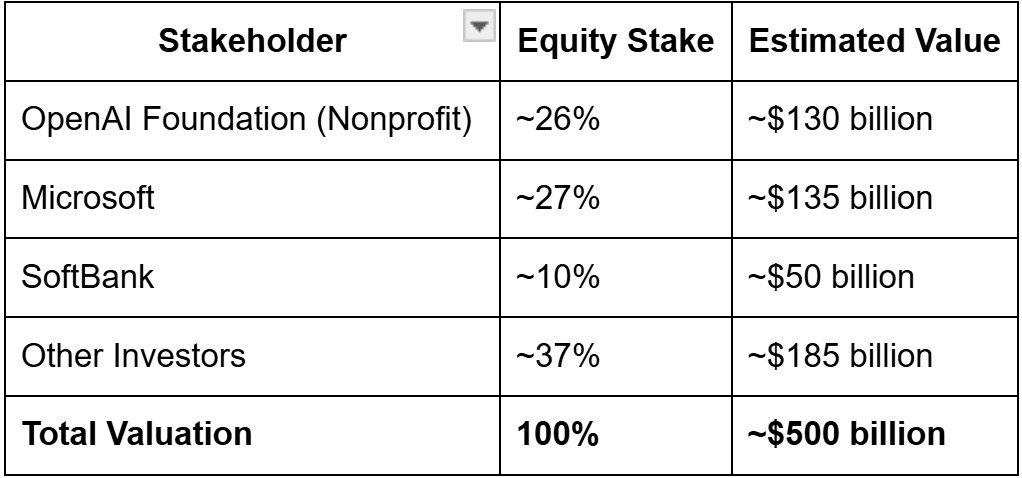
The nonprofit that Elon Musk funded now controlled less than a third of the company's equity, and the investors who'd come after him controlled the rest.
The OpenAI Startup Fund: A $289 Million Venture Portfolio Nobody Mentions
Meanwhile, OpenAI was also running something that rarely gets discussed: a $289 million venture capital fund.
The OpenAI Startup Fund has invested in over 21 companies, with an estimated portfolio value exceeding $15 billion. This is the nonprofit research lab that was founded to ensure AI benefits humanity. It now operates one of the most active AI-focused venture funds in Silicon Valley.
OpenAI Startup Fund Portfolio Highlights:
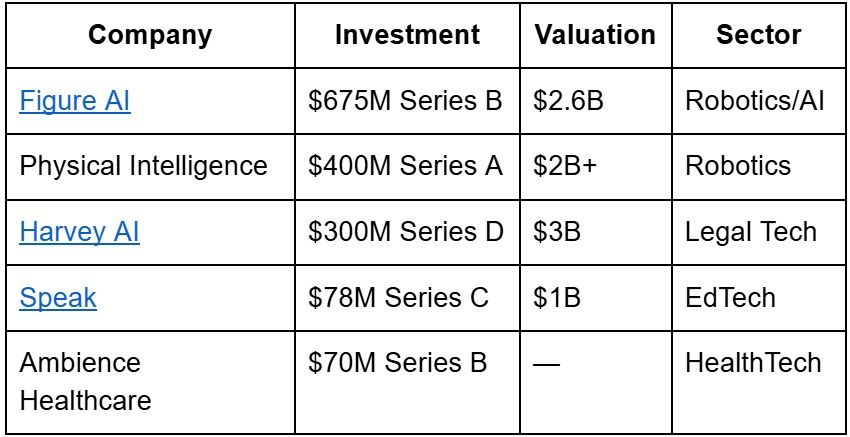
Figure AI
Harvey AI
Speak
—
HealthTech
Fund Structure:
-
Main Fund: $175 million
-
Special Purpose Vehicles: $114 million
-
Total Capital: $289 million
-
Partner Investors: Microsoft, Thrive Capital, Kleiner Perkins, Sequoia, a16z
The fund invests across robotics (25%), healthcare (23%), edtech (18%), legal tech (15%), and developer tools (12%). Average check size is $16.5 million.
This is a long way from "nonprofit research for the benefit of humanity."
Ilya Sutskever's Letter to Sam Altman: "We Don't Understand Your Cost Function"
Here's where the story gets really interesting. Because it wasn't just Musk who had concerns about what was happening at OpenAI.
In 2023, two of the company's most important figures sent Sam Altman a letter that reads like an intervention. Ilya Sutskever, OpenAI's Chief Scientist and one of the most respected AI researchers in the world, co-signed it with Greg Brockman.
"We haven't been able to fully trust your judgements throughout this process, because we don't understand your cost function. We don't understand why the CEO title is so important to you. Is AGI truly your primary motivation? How does it connect to your political goals?"
In AI terms, a "cost function" is what a system optimizes for. Sutskever and Brockman were essentially asking their CEO: What are you actually trying to achieve here? Because it doesn't seem like it's what you told us.
This wasn't some disgruntled employee complaining on social media. This was the Chief Scientist and co-founder of OpenAI formally questioning whether their CEO was operating in good faith.
The people closest to the mission were worried it had been abandoned.
A few months later, Sutskever would be part of the board that briefly fired Altman in the most chaotic leadership crisis in startup history. He's since left the company to start Safe Superintelligence Inc. Brockman took a leave of absence.
The band that was going to save humanity from dangerous AI couldn't even keep itself together.
Satya Nadella's Late-Night Texts: What Microsoft Knew About OpenAI
Microsoft's role in all of this was supposed to be simple: they were just investors, providing capital to a company they believed in. If OpenAI had made promises it didn't keep, that was OpenAI's problem.
That defense fell apart when the judge reviewed Satya Nadella's text messages.
The specific contents are still under protective order, but here's what the court found according to Bloomberg's coverage: "late-night texts" between Microsoft's CEO and OpenAI leadership, containing enough evidence that Microsoft had "actual knowledge beyond vague suspicion" of OpenAI's breach of its nonprofit commitments.
What the Judge Found in Microsoft Communications:
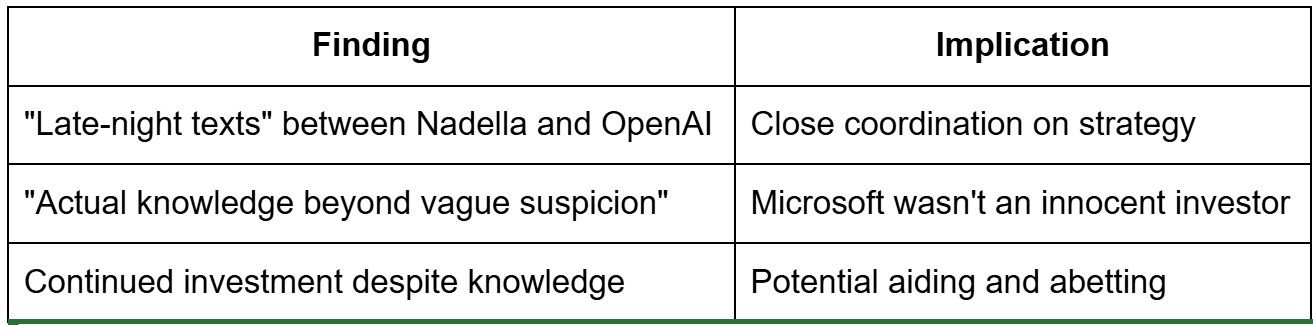
Microsoft knew. They invested $13 billion worth anyway.
The judge refused to dismiss Microsoft from the case. A jury will now decide whether the world's second most valuable company aided and abetted the transformation of a nonprofit into their competitive weapon against Google.
Sam Altman's "You're My Hero" Text to Elon Musk
Years later, as Musk's public criticism intensified, Altman tried something different. He sent a text message in February 2023 that reads less like a CEO defending his company and more like someone reaching out to an old friend.
"i remember seeing you in a tv interview a long time ago (maybe 60 minutes?) where you being attacked by some guys, and you said they were heroes of yours and it was really tough. well, you're my hero and that's what it feels like when you attack OpenAI."
You're my hero. That's what the CEO of a $500 billion company wrote to the man now suing him for fraud.
What's striking about this message isn't just the emotional language. It's what's missing. Altman didn't address Musk's concerns about mission drift. He didn't explain how the Microsoft partnership served the original vision. He didn't offer evidence that the nonprofit commitment was being honored.
He just said it hurt to be criticized by someone he admired.
For a legal case built on the question of whether OpenAI knowingly deceived its founding donors, this text message paints a complicated picture. Either Altman genuinely believed OpenAI was still serving its mission and didn't understand why Musk was upset. Or he knew exactly why Musk was upset and chose emotional appeal over substantive response.
The jury will have to decide which story they believe.
Judge Yvonne Gonzalez Rogers Ruling: Why OpenAI's Dismissal Failed
On January 15, 2026, U.S. District Judge Yvonne Gonzalez Rogers issued a 28-page ruling that OpenAI's lawyers had been dreading for months.
Key Rulings:
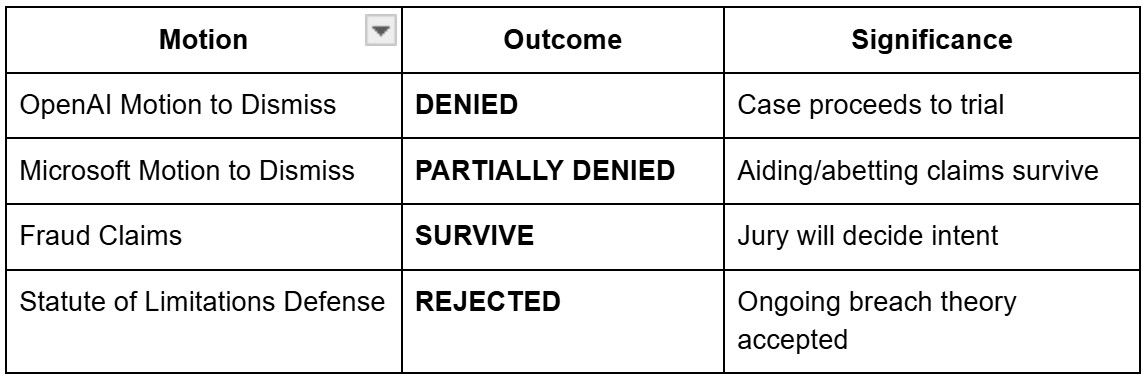
The judge specifically noted there was "ample evidence" supporting Musk's claims. She pointed directly to Brockman's diary entries. She cited internal communications showing OpenAI's leadership saying one thing publicly and planning something completely different privately.
Judge's Key Language:
"There is ample evidence in the record..."
"Circumstantial evidence is sufficient... that's how these things work."
"Triable issues of fact exist for a jury to decide."
In legal terms, "circumstantial evidence" of fraud means she found enough indirect proof of intentional deception to let a jury hear the case. In plain English, the judge thought the diary entries and internal communications were damning enough that reasonable people could conclude fraud occurred.
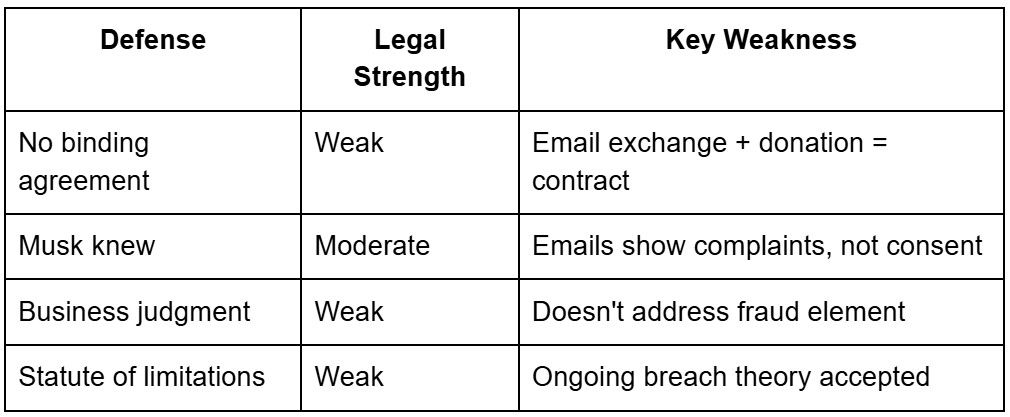
OpenAI Defense Strategy: Why Legal Experts Say It's Weak
OpenAI's legal team has four main defenses. None of them convinced the judge.
Defense 1: "No Binding Agreement Existed"
OpenAI argues that Altman's 2015 email and Musk's "Agree on all" reply weren't a formal contract.
Problem: The email explicitly proposed nonprofit structure. Musk explicitly accepted. $38 million followed. That's textbook contract formation.
Defense 2: "Musk Knew About For-Profit Plans"
OpenAI claims Musk's 2018 emails prove he knew about restructuring discussions.
Problem: The judge noted those emails are complaints about company direction, not evidence Musk agreed to anything. As TechCrunch reported, "these emails show Musk objecting, not consenting."
Defense 3: "Business Judgment Required For-Profit Structure"
OpenAI argues they needed corporate investment to compete with Google.
Problem: This doesn't address the fraud claim. Even if the business decision made sense, deceiving your founding donor about your intentions is still fraud.
Defense 4: "Statute of Limitations Expired"
OpenAI claims Musk waited too long to sue.
Problem: The judge accepted the "ongoing breach" theory. Each step away from nonprofit status potentially reset the clock.
Defense Strength Assessment:
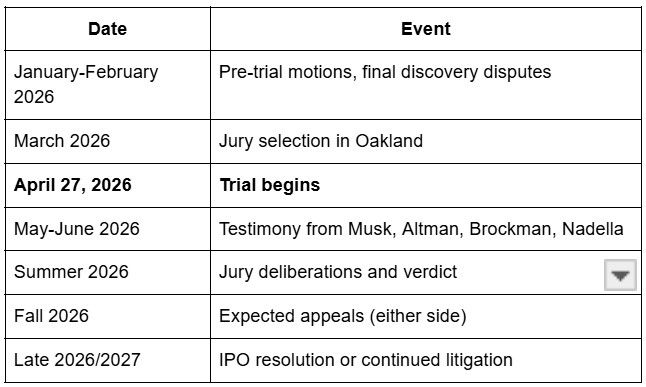
OpenAI vs Elon Musk Trial: What Happens in April 2026
When the trial begins on April 27, 2026, the jury will have to answer a simple question that carries $500 billion in implications:
The Core Question:
Did Sam Altman and Greg Brockman promise Elon Musk that OpenAI would remain a nonprofit, knowing they had no intention of keeping that promise?
Trial Timeline:
Potential Damages:
Musk's original donation was around $44 million, but fraud damages can include disgorgement of profits. Legal experts have suggested damages could theoretically reach into the tens of billions if the jury finds OpenAI's entire valuation was built on fraudulent foundations.
Settlement Probability: 50-60%
Both sides have reasons to avoid trial:
-
OpenAI doesn't want more internal communications becoming public
-
Musk doesn't want to risk losing to his former partners
-
A deal in the $5-15 billion range would let everyone declare partial victory
But if it goes to trial? A jury of regular people will read Greg Brockman's diaries, review Sam Altman's emails, hear about Satya Nadella's late-night texts, and decide whether ChatGPT was built on a lie.
OpenAI's $500 Billion Fraud Question
In a few months, twelve ordinary citizens will sit in an Oakland courtroom and listen to billionaires argue about promises made over email in 2015. They'll see the diary entries. They'll hear about the late-night texts with Microsoft's CEO. They'll learn how a nonprofit turned into a $500 billion company.
And they'll have to decide if it was fraud.
Greg Brockman wrote "it was a lie" in his private diary because he never expected anyone to read it. Sam Altman told Musk "you're my hero" because he never expected it to become evidence. Satya Nadella sent late-night texts because he never expected a judge to review them.
Every private thought eventually becomes public record when the stakes are high enough.
The question now is whether a jury believes that what happened at OpenAI was legitimate business evolution or deliberate deception of the man who made it all possible.
April 27, 2026. Oakland, California. The most important tech trial in a generation.
Trial Date: April 27, 2026 Settlement Probability: 50-60% Potential Damages: $1B - $50B+ Key Evidence: Brockman diary, Altman emails, Nadella texts
Sources and References
Court Documents:
-
Judge Yvonne Gonzalez Rogers Order (January 15, 2026)
-
Plaintiff's Amended Complaint (Musk v. OpenAI, N.D. Cal.)
-
Unsealed Discovery Exhibits (100+ documents, January 2026)
News Coverage:
Regulatory Documents:
Company Resources:
Disclosure
This article represents analysis and opinion about ongoing litigation. The trial outcome will be determined by a jury evaluating evidence under legal standards. This is not legal or financial advice. Information is based on publicly available court documents and news reporting. All quotes are from unsealed court exhibits or published news sources.
Last Updated: January 16, 2026