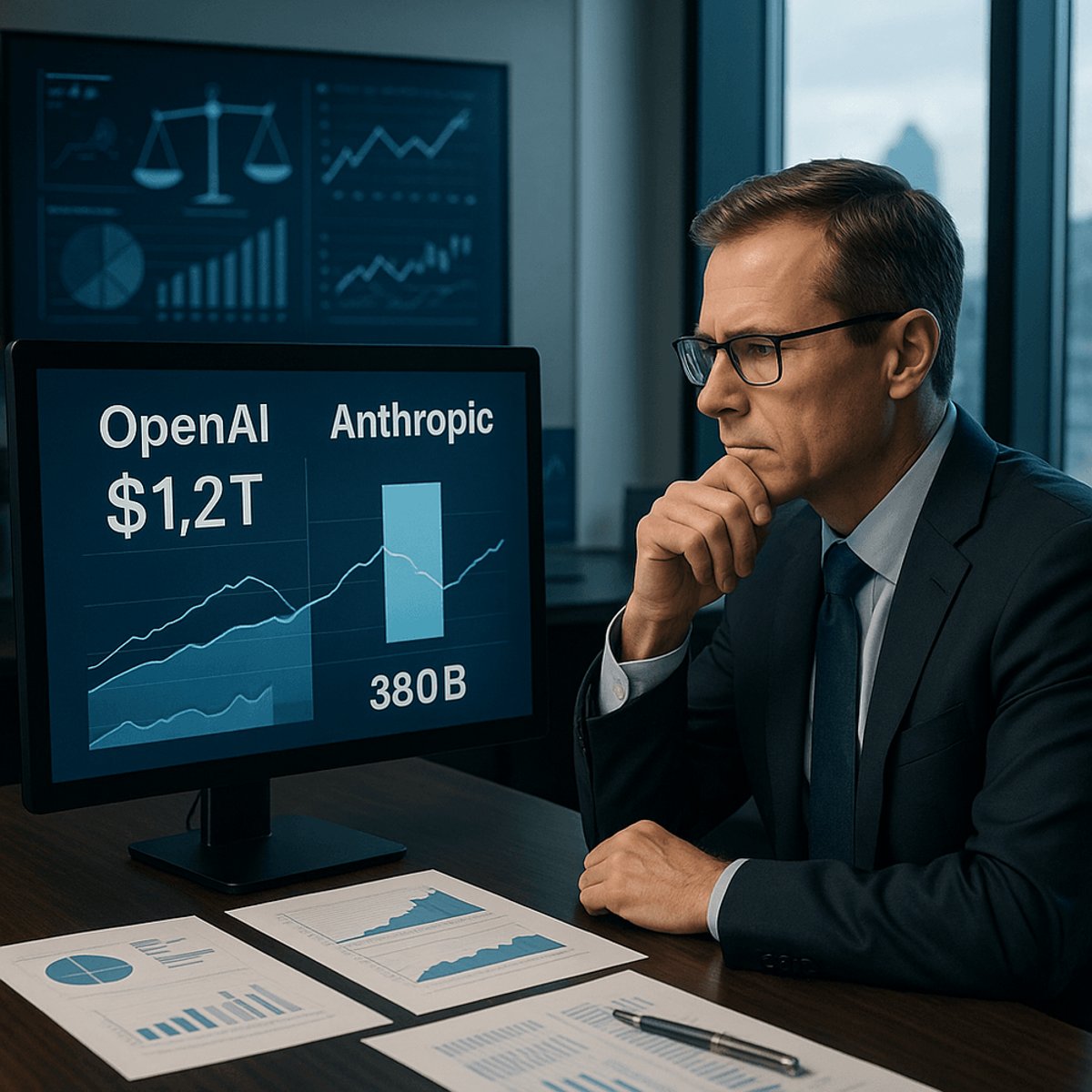
The AI investment landscape is experiencing a surprising shift. Investors who backed both OpenAI and Anthropic are now questioning whether they bet on the wrong horse, according to fresh reporting from the Financial Times. At the heart of this soul-searching: OpenAI's recent funding round only makes sense if the company hits a staggering $1.2 trillion IPO valuation, while Anthropic's current $380 billion price tag suddenly looks like a steal. It's a remarkable reversal for an industry that, until recently, treated OpenAI as the untouchable frontrunner in the race to build artificial general intelligence.
The whispers started quietly in boardrooms and investor calls, but they're getting louder. Some of the same venture capitalists and institutional investors who poured money into OpenAI are now privately admitting they might have been better off concentrating their bets on Anthropic.
The math is sobering. According to sources speaking to the Financial Times, justifying OpenAI's most recent funding round requires believing the company will go public at a $1.2 trillion valuation or higher. That's not just optimistic—it's a bet that OpenAI will achieve a market cap larger than most of the world's biggest tech companies on day one of trading. For context, that would put it ahead of Amazon and within striking distance of Apple.
Meanwhile, Anthropic's current $380 billion valuation is starting to look downright reasonable by comparison. The company, founded by former OpenAI researchers including siblings Dario and Daniela Amodei, has been methodically building its Claude AI assistant while maintaining a lower profile than its flashier competitor. But quiet doesn't mean unsuccessful.
The sentiment shift reflects more than just spreadsheet calculations. Investors are watching how both companies navigate the treacherous path from research lab to sustainable business. OpenAI has faced mounting questions about its complex corporate structure, the costs of training increasingly large models, and whether its partnership with Microsoft offers enough room for the kind of explosive growth needed to justify a trillion-dollar-plus valuation.
Anthropic, by contrast, has been methodically securing enterprise customers and building partnerships with companies like Google, which invested heavily in the startup. The company's focus on AI safety and constitutional AI—building guardrails directly into model training—has resonated with enterprise customers worried about regulatory risk and reputational damage from AI mishaps.
One investor who backed both startups told the FT that the valuation disparity became impossible to ignore during recent portfolio reviews. The implication is clear: even if both companies succeed wildly, Anthropic investors might see better returns simply because they paid a lower entry price for comparable technology and market position.
The timing of this investor reassessment is particularly striking. OpenAI has dominated headlines for years, from the viral launch of ChatGPT to the dramatic boardroom coup that briefly ousted CEO Sam Altman before his swift reinstatement. That constant spotlight translated into investor FOMO—fear of missing out—that likely inflated valuations beyond what the fundamentals alone would support.
Anthropic took a different path. While OpenAI was grabbing consumer attention, Anthropic was quietly winning over developers and enterprises with Claude's performance on reasoning tasks and its reputation for more reliable safety features. The company's latest models have benchmarked competitively with GPT-4 and other frontier systems, undermining the narrative that OpenAI maintains an insurmountable technical lead.
The valuation concerns also intersect with broader questions about AI economics. Training costs for cutting-edge models continue to soar, with some estimates putting the price tag for the next generation of systems at billions of dollars per training run. Revenue growth has been impressive across the sector, but it's not clear either company has found a path to profitability that justifies valuations in the hundreds of billions—let alone over a trillion.
Investors are also weighing competitive dynamics. The AI landscape has gotten significantly more crowded since OpenAI and Anthropic first raised their mega-rounds. Google's Gemini models, Meta's open-source Llama family, and well-funded startups like Mistral and Cohere are all vying for market share. In that environment, paying a premium valuation for what might become a commoditized technology looks riskier.
The shift in investor sentiment doesn't mean OpenAI is in trouble. The company still commands enormous mindshare, maintains a partnership with one of the world's most valuable companies in Microsoft, and has a consumer product in ChatGPT that has become synonymous with AI for millions of users. But it does suggest that the unquestioning belief in OpenAI's inevitable dominance is starting to crack.
For Anthropic, the investor reassessment represents validation of its slower-burn approach. The company has avoided some of the drama and controversy that has swirled around OpenAI, and that relative stability now appears to be paying dividends in how investors perceive risk and reward.
The real test will come when both companies need their next capital injections. Investors vote with their checkbooks, and if the sentiment shift described in the FT report is widespread, it could show up in the terms and valuations of future funding rounds. A down round or flat valuation for OpenAI would be a stunning reversal for a company that has spent years as the industry's hottest ticket.
The investor reassessment brewing around OpenAI and Anthropic reveals something fundamental about the AI boom: hype and headlines don't always translate to the best returns. While OpenAI built a consumer phenomenon with ChatGPT, Anthropic quietly built a business that might offer better risk-adjusted returns at current valuations. The question isn't whether either company will succeed—both are likely to remain major players in AI's future. Instead, investors are grappling with whether they paid too much for the privilege of backing the name everyone knows versus the competitor that might deliver similar results at a fraction of the entry price. As AI moves from science project to industrial infrastructure, that kind of cold-eyed calculation could reshape which companies dominate the next decade of artificial intelligence.