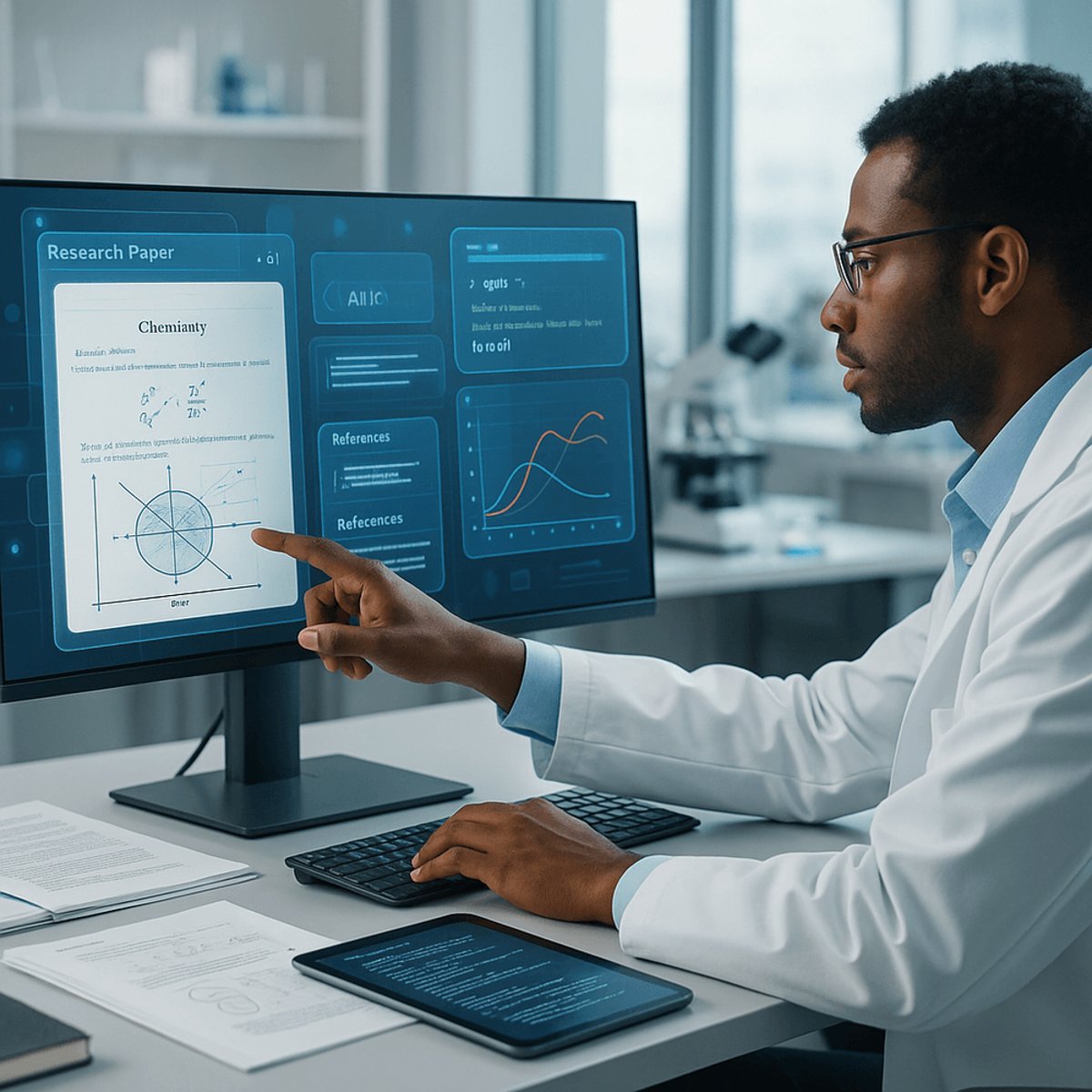
OpenAI just dropped Prism, a free AI-powered workspace that could reshape how scientists write research papers. The tool integrates GPT-5.2 directly into the scientific writing workflow, combining intelligent research assistance with LaTeX formatting and visual diagram creation. Available now to anyone with a ChatGPT account, Prism represents OpenAI's latest push into specialized professional tools, following the AI coding boom that dominated 2025.
OpenAI is betting that scientific research is about to have its ChatGPT moment. The company launched Prism on Tuesday, a free web-based workspace that weaves GPT-5.2 directly into the scientific paper writing process. Anyone with a ChatGPT account can access it starting now.
The timing isn't random. OpenAI says ChatGPT is already fielding 8.4 million messages per week on advanced hard science topics, though the company can't say how many come from actual professional researchers versus curious students. Either way, the demand is clearly there.
"I think 2026 will be for AI and science what 2025 was for AI and software engineering," Kevin Weill, VP of OpenAI for Science, told reporters during a press call announcing the tool. That's a bold claim considering how tools like Cursor and Windsurf transformed coding workflows last year.
Prism positions itself as the research equivalent of those coding assistants. It's not trying to replace human scientists or autonomously conduct experiments. Instead, it handles the grunt work - formatting citations, searching prior literature, revising awkward prose, and assessing whether claims align with existing research. The tool integrates with LaTeX, the open-source typesetting system that's been the academic standard for decades but remains notoriously clunky to work with.
What makes Prism different from just copying text into ChatGPT? Context management. When researchers open the AI assistant within Prism, GPT-5.2 can access the full scope of their project - all the notes, drafts, and references they've accumulated. That means more intelligent, relevant responses instead of generic suggestions.
The visual capabilities stand out too. Prism leverages GPT-5.2's image understanding to convert whiteboard sketches and rough drawings into polished diagrams ready for publication. Anyone who's wrestled with LaTeX figure formatting knows that's a genuine pain point.
OpenAI is arriving at a moment when AI-assisted research is gaining real traction. In mathematics, AI models have cracked several long-standing Erdos problems through literature review combined with creative applications of existing techniques. The significance of these proofs is still debated, but they represent early wins for the AI research camp.
Even more striking, a statistics paper published in December used GPT-5.2 Pro to establish new proofs for a central axiom of statistical theory. Human researchers only provided prompts and verification. OpenAI celebrated this in a blog post, positioning it as the template for future human-AI collaboration.
"In domains with axiomatic theoretical foundations," the post explains, "frontier models can help explore proofs, test hypotheses, and identify connections that might otherwise take substantial human effort to uncover."
That's the use case Prism is chasing - not replacing scientific thinking, but accelerating the mechanical parts of research that slow down breakthroughs. Much of what Prism does would technically be possible for a power user manually feeding context into GPT-5.2. But OpenAI is betting that a polished, purpose-built interface will attract scientists faster than makeshift workarounds.
"Software engineering accelerated in part because of amazing models," Weill said, "and in part because of deep workflow integration." That combination - powerful AI plus seamless integration into existing tools - proved transformative for developers in 2025. If Weill's prediction holds, researchers might see similar productivity gains in 2026.
The fact that Prism is free removes a major adoption barrier. OpenAI doesn't need to convince university departments to allocate budget or navigate procurement processes. Any researcher can start using it immediately, which could drive rapid uptake if the tool delivers on its promises.
But questions remain. How will academic publishers and peer reviewers view AI-assisted research? Will there be new disclosure requirements for papers written with Prism's help? And what happens when AI tools become so integrated into the research process that distinguishing human insight from machine assistance becomes nearly impossible?
For now, OpenAI is focused on getting Prism into researchers' hands and proving it can meaningfully accelerate their work. The company clearly sees scientific research as the next major professional domain ripe for AI transformation, following the coding revolution that defined 2025. Whether scientists embrace it as enthusiastically as developers embraced AI coding assistants remains to be seen.
OpenAI's Prism arrives at a pivotal moment when AI is proving it can contribute to actual scientific breakthroughs, not just summarize existing knowledge. By making the tool free and deeply integrated with researchers' existing workflows, OpenAI is removing friction that might slow adoption. If Prism delivers on its promise to accelerate the mechanical parts of research without replacing human insight, 2026 could indeed become the year AI transforms scientific discovery the way it transformed software development in 2025. The real test won't be whether researchers try Prism - it'll be whether they keep using it six months from now when the novelty wears off.